
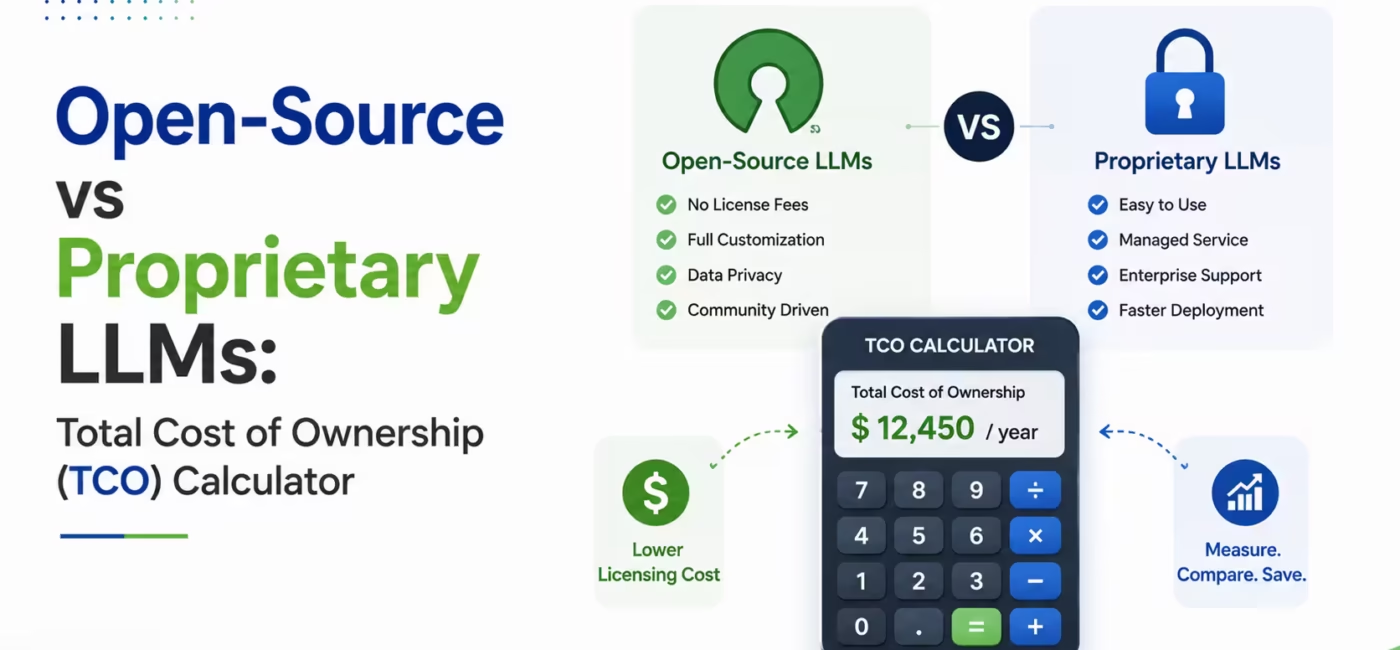
Choosing between open-source models (like Llama 3.3 70B or DeepSeek-V3) and proprietary APIs (like OpenAI GPT-5.5 or Claude 4.8 Opus) shifts your financial model. Proprietary APIs run on variable Operational Expenditure (OpEx). Self-hosting combines fixed infrastructure fees with dedicated MLOps labor.
Proprietary API models cost less for workloads under 20M tokens per day because they require zero hardware setup and zero engineering maintenance. Self-hosting open-source models costs less at scale (>50M tokens per day), assuming your team keeps GPU utilization above 60%.
Interactive TCO Calculator: Open-Source vs Proprietary LLMs
Estimate your monthly Total Cost of Ownership by adjusting your monthly token volume, hardware choices, and engineering overhead.
Interactive LLM TCO Calculator
Estimate and compare monthly expenses for Proprietary APIs vs. Self-Hosted Open-Source LLMs.
Proprietary API
Self-Hosted Open Source
Core Components of the TCO Equation
Calculating LLM economics using only token pricing creates inaccurate budgets. A standard framework evaluates four specific categories:
Total Cost of Ownership = Infrastructure + Software & Licensing + MLOps Operations + Risk & Downtime
1. Infrastructure Expenses
Proprietary models carry $0 infrastructure setup. You pay for consumed tokens while the provider manages GPU procurement, networking, cooling, and server deprecation.
Open-source models require fixed hardware allocation. Running a 70B parameter model (like Llama 3.3 70B in FP8 precision) requires at least 2x NVIDIA A100 (80GB) or 1x NVIDIA H100 GPU for low latency. Cloud GPU rates run between $1.50 and $3.50 per hour per GPU. You pay for reserved server time continuously, even during zero-traffic periods.
2. Software & Licensing Fees
Proprietary vendors include software fees in the token cost.
Open-source model weights use licenses like Apache 2.0, MIT, or custom terms like Meta’s Llama license. Base usage costs $0, though high-volume commercial scale (>700M monthly active users under Meta’s terms) requires custom commercial licensing.
3. MLOps & Engineering Labor
Self-hosted deployments require continuous operational work:
- Inference Engines: Configuring tools like vLLM or TensorRT-LLM to maintain high token throughput and low Time-To-First-Token (TTFT).
- Quantization: Converting models from FP16 to FP8 or INT4 to fit within GPU VRAM constraints.
- Autoscaling: Setting up orchestration tools like Ray Serve or KServe to scale nodes during traffic spikes and downscale off-peak.
| Financial Category | Proprietary LLM API | Self-Hosted Open-Source LLM |
| Cost Structure | Pay-per-token OpEx | Fixed server OpEx + engineering time |
| Initial Setup Cost | Low ($0 – $500 engineering setup) | High ($5,000 – $25,000 setup & pipeline build) |
| Scaling Behavior | Linear with query volume | Step-function (adding GPU nodes at capacity limits) |
| Idle Infrastructure Cost | $0 | High (24/7 server reservation charges) |
| Engineering Time Required | 2-5 hours / month | 20-60 hours / month |
| Data Privacy | Subject to vendor terms | Data stays within your cloud network |
Do you know: How to Evaluate AI Tool Security: SOC 2, HIPAA & Data Privacy Audit?
Cost Comparison Walkthrough
A SaaS product processes 100,000 daily user requests, averaging 800 input tokens and 300 output tokens per request.
- Monthly Input Tokens: 100,000 requests x 800 tokens x 30 days = 2.4 Billion Tokens
- Monthly Output Tokens: 100,000 requests x 300 tokens x 30 days = 900 Million Tokens
Option A: Proprietary Flagship API ($2.50 / 1M Input, $10.00 / 1M Output)
- Input Token Spend: 2,400 x $2.50 = $6,000
- Output Token Spend: 900 x $10.00 = $9,000
- Total Monthly Spend: $15,000
Option B: Self-Hosted Llama 3.3 70B on Cloud GPUs
To maintain low latency at this volume, the team provisions 4x NVIDIA H100 GPUs running vLLM.
- GPU Compute: 4 GPUs x $2.50/hr x 720 hours = $7,200
- Bandwidth & Storage: $500
- Allocated MLOps Labor: $3,000
- Total Monthly Spend: $10,700
At 100,000 daily requests, self-hosting saves $4,300 per month. If daily traffic drops to 20,000 requests, the API spend decreases to $3,000 per month, while the open-source infrastructure spend remains fixed at $10,700.
Selection Criteria
Use Proprietary APIs When:
- Traffic volume fluctuates: You avoid paying for idle GPU capacity during off-peak hours.
- Engineering bandwidth is limited: You skip managing CUDA drivers, GPU memory leaks, and node orchestration.
- Workloads require advanced reasoning: Complex multi-step reasoning tasks perform better on frontier commercial models.
Use Self-Hosted Open Source When:
- Data privacy mandates apply: Healthcare (HIPAA), Finance (SOC2/PCI-DSS), or legal applications require processing data entirely inside your cloud boundary.
- Traffic volume is high and steady: Hardware stays utilized above 50% capacity, lowering the cost per token.
- Task-specific fine-tuning is required: Fine-tuning an open-source 8B or 14B model on private domain data often matches broad commercial performance at lower inference costs.
What Formula Should You Use?
Keep it simple enough to explain to finance. If the math needs a whiteboard and an apology, it’s too complicated.
A practical framing looks like this:
Then compare the two annually, not just monthly. Open-source often looks bad in month one and much better in month twelve. Proprietary often looks easy in month one and surprisingly expensive once usage compounds.
Conclusion
The honest answer is that neither side wins by default. Proprietary models buy speed and simplicity. Open-source models buy control and potentially lower unit economics at scale. The only sensible way to choose is to calculate full annual TCO with workload, engineering, compliance and risk included from the start.
Check about our recent articles:
Claude Opus 4.8 vs GPT-5.5 vs Gemini 3.5 Flash: Developer’s Guide
Top 7 Enterprise AI Code Assistants Compared (2026 Benchmarks)
Google’s Agentic Defense Strategy: Can It Stop AI-Powered Cyberattacks?
Disclaimer:
This article is based on publicly available cost analyses and deployment guidance from Latitude, PatSnap, AceCloud, Hugging Face and related sources as of July 2026. Pricing, workload efficiency and hosting economics vary by model, region and provider. Validate current rates and internal staffing assumptions before making procurement decisions.
