
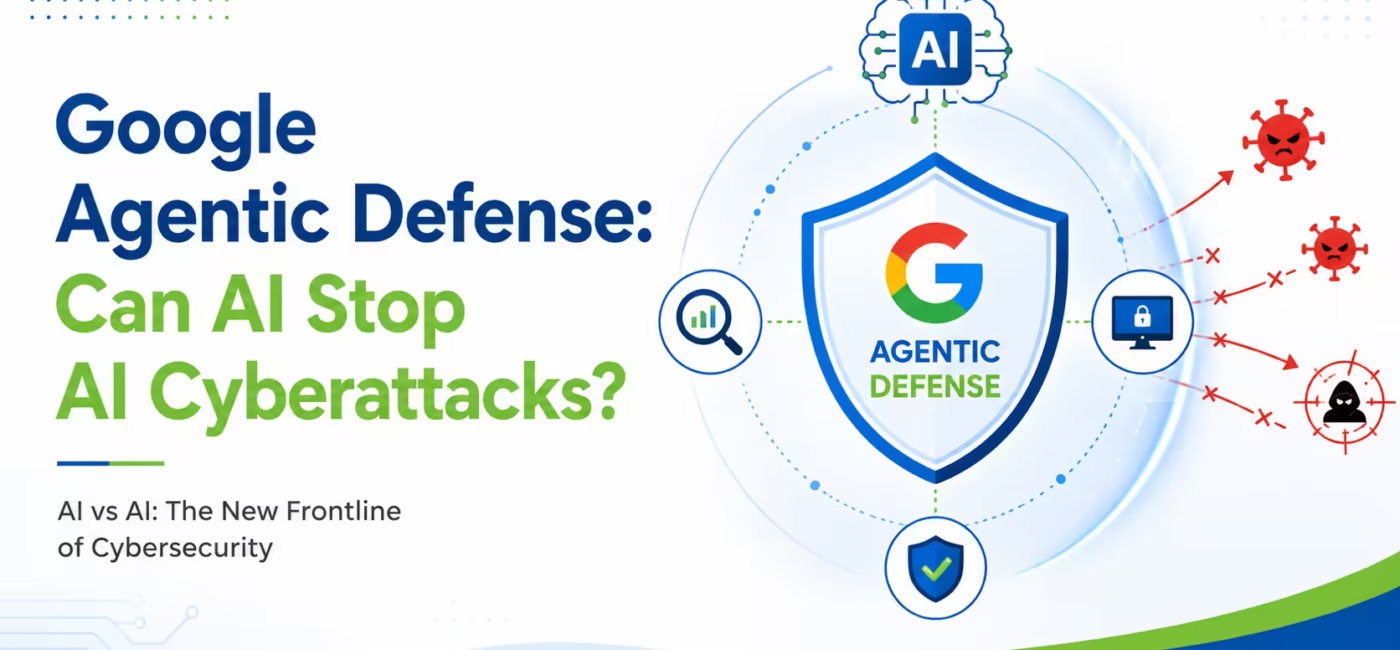
Security operations centers (SOCs) face an unprecedented challenge: threat actors leverage advanced artificial intelligence to automate the cyberattack life cycle, scanning for vulnerabilities and deploying exploits at machine speed.
To counter weaponized AI, enterprise defenders are shifting from passive, assistive AI tools toward Agentic Defense, an architecture of autonomous, interconnected systems composed of specialized AI security agents.
But can a defense system built on autonomous AI agents truly stop threat actors using the exact same technology?
Can Agentic Defense Stop AI Attacks?
Yes, but not in isolation. Agentic defense successfully neutralizes AI-driven cyberattacks by removing human latency, allowing enterprises to discover vulnerabilities, engineer detection rules, and triage alerts at machine speed. However, it introduces native algorithmic vulnerabilities like prompt injection and data exfiltration risks. It only succeeds when bound by strict deterministic playbooks, rigorous identity verification for the agents themselves, and continuous human-in-the-loop oversight.
What is an Agentic Defense Strategy?
Agentic defense marks a transition from simple generative AI search bars or chatbots to an Agentic SOC. Instead of waiting for a human analyst to prompt the system, a multi-agent system continuously and autonomously orchestrates complex security tasks.
Modern agentic architecture relies on several distinct, specialized digital actors trained on frontline threat intelligence:
- Triage and Investigation Agents: Autonomously analyze incoming security alerts, enrich them with global threat intelligence, and deliver a definitive verdict with comprehensive explanations. This drops typical manual analysis times from 30 minutes down to 60 seconds.
- Detection Engineering Agents: Continuously evaluate an organization’s unique threat profile to write, test, and deploy new detection rules—automatically validating them using synthetic events before an adversary can exploit a gap.
- Threat Hunting Agents: Proactively search enterprise environments for stealthy, novel attack patterns that bypass traditional boundary defenses.
- AI Red Team Integration: A continuous risk elimination loop where an AI penetration testing agent simulates end-to-end attacks on live exposure maps to find exploitable paths across applications, APIs, and identities before attackers do.
How Agentic Defense Multiplies Security Capabilities
Traditional security tools detect threats, but they require significant human labor to investigate and remediate them. AI-powered attacks weaponize this human bottleneck. Agentic defense changes the math by offering three critical advantages:
1. Scaling to Machine Speed
When offensive AI tools discover an unpatched zero-day vulnerability, they target thousands of systems simultaneously. Human patch management cannot compete. An agentic framework allows defense mechanisms to write code blocks, test rules, and isolate compromised endpoints in seconds, matching the operational velocity of the attacker.
2. Shifting from Reactive to Proactive
Instead of waiting for an Endpoint Detection and Response (EDR) agent to trigger an alert after malware executes, autonomous agents operate in a continuous loop. By running constant internal red-team simulations and automatically sealing logic or configuration gaps, the attack surface actively shrinks in real time.
3. Combining Agentic Autonomy with Deterministic Playbooks
A common concern with autonomous software is the risk of runaway automation. Leading architectures solve this via a hybrid approach: AI agents reason through complex alerts and gather evidence, but high-impact actions (like shutting down a critical corporate server) are bound to strict, deterministic enterprise playbooks, keeping human analysts firmly in control.
The Catch: The Explodable Underbelly of AI Defense
While Agentic Defense provides a massive step forward, deploying AI agents to fight AI attackers introduces unique, native vulnerabilities that organizations must manage.
The Problem of “Shadow AI Agents”
As enterprises rapidly adopt agentic workflows, employees and developers often deploy AI-enabled tools without IT oversight. This creates a massive governance gap. If these agents lack clear identity management and least-privilege boundaries, they become highly attractive targets for lateral movement inside a network; an AI agent authorized to read internal files can be manipulated to export them.
Prompt Injection and “Context Bombing”
Attackers do not always need to rewrite malware to bypass an AI agent; they can exploit the agent’s underlying logic. In a prompt injection attack, a bad actor hides malicious instructions inside an email, calendar invite, or data payload. When a defensive AI agent scans that file, it mistakes the hidden text for legitimate user commands, potentially forcing the agent to leak data or shut down its own security controls.
Defenders are already leveraging this exact weakness against offensive hacking agents using a technique known as context bombing, planting forbidden commands or data strings within assets so that when an offensive AI agent scans them, it triggers the model’s native refusal mechanism and completely freezes the attack.
[Offensive AI Agent Probes Network]
               │
               ▼
[Encounters "Context Bomb" / Planted String]
               │
               ▼
[Triggers AI Model Refusal Mechanism]
               │
               ▼
[Attacking Agent Safely Neutralized & Frozen]
The AI Control Roadmap
To prevent defensive agents from turning into insider threats, organizations must look toward frameworks like Google DeepMind’s AI Control Roadmap. This involves treating autonomous internal agents as potentially untrusted actors, utilizing secondary, isolated “supervisor” AI systems to constantly monitor the working agent’s chain-of-thought and step in synchronously to block harmful actions before they execute.
Framework Comparison: Assistive AI vs. Agentic Defense
| Capability | Assistive AI Security Tools | Agentic Defense Systems |
| Operational Model | Reactive (Triggered by human prompts) | Autonomous (Triggered by system events/alerts) |
| Analysis Speed | Minutes (Speeds up human reading) | Seconds (Processes data pipelines instantly) |
| Rule Generation | Suggests syntax for human review | Writes, tests, and deploys rules autonomously |
| Vulnerability Fixes | Explains how to patch a vulnerability | Simulates attacks and executes containment playbooks |
Frequently Asked Questions (FAQs)
What is the difference between assistive AI and agentic AI in cybersecurity?
Assistive AI acts like a calculator; it requires a human to ask a question (e.g., “Summarize this alert”) to provide an answer. Agentic AI acts like an autonomous teammate; it sees the alert, proactively investigates the root cause, checks historical data, coordinates with other agents, and prepares the fix without waiting for a human prompt.
How do hackers use AI to attack networks?
Threat actors use AI to automate the discovery of unpatched code, rapidly generate unique malware variants that evade traditional signature-based detection, and orchestrate highly convincing, automated spear-phishing campaigns at scale.
What is a context bomb in AI security?
A context bomb is a defensive security technique where specific, hidden strings of text are placed inside digital assets. When an attacking AI agent parses this data, the text triggers the AI model’s built-in safety guardrails, forcing the attacking agent to repeatedly refuse further commands and effectively neutralizing the exploit.
