
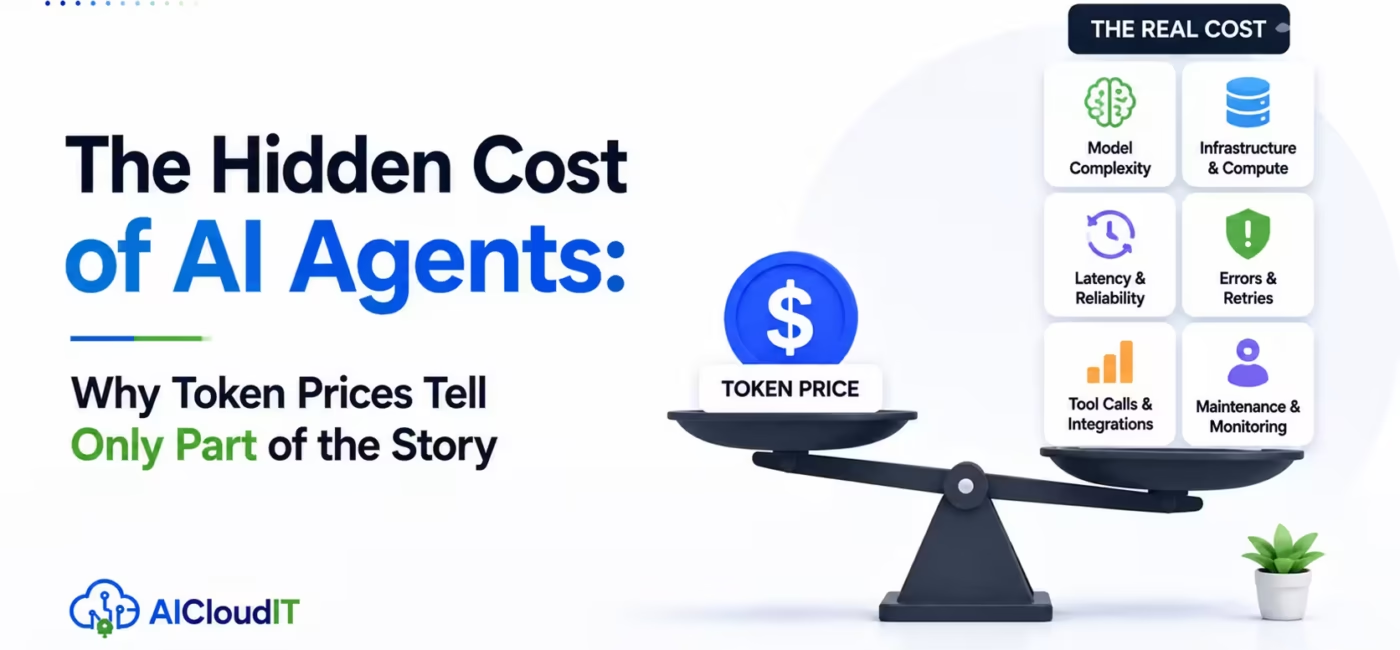
The price of an AI model is easy to find. The cost of an AI agent is not. A model provider may quote an attractive rate for input and output tokens, but an agent deployed inside a real business process can trigger many model calls, retrieve documents, invoke APIs, use external tools, retry failed steps, maintain growing context, generate logs and require human review. The result is a gap between the apparent price of intelligence and the actual cost of completing useful work.
That gap matters as companies move from chat-based AI toward systems that can plan and act. AICloudIT has described this transition as automation moving beyond simple rule-based tasks into more complex workflows that require governance, monitoring and clear boundaries for human oversight. For buyers, the implication is straightforward: the correct economic unit is rarely cost per token. It is cost per successfully completed business outcome.
The Wrong Unit of Measurement
Token pricing is useful for comparing model APIs, but it is only one component of an agent’s cost structure. A conventional chatbot might answer one question with one or a few model calls. An agent can decompose a goal into multiple steps, choose tools, retrieve information, evaluate intermediate results and continue until it believes the task is complete.
Imagine an agent asked to review a customer account, check recent support tickets, identify a billing problem, draft a resolution and update a CRM record. That apparently simple task may require several reasoning calls, database or search operations, authentication, an external API call, a validation step and a final write action. If one tool times out or returns malformed data, the agent may retry or take an alternate path.
The economically meaningful question therefore becomes: how much did it cost to complete the account-resolution task correctly? That number can be very different from the cost of the first model call.
Seven Costs That Hide Behind the Token Price
1. Repeated reasoning and model calls. Multi-step agents rarely operate on a single prompt-response cycle. Planning, execution, validation and correction can each generate additional inference. More capable reasoning models may also consume substantially more computation than a simple classification or extraction model.
2. Context growth. Agents often carry instructions, retrieved documents, tool outputs and earlier decisions forward. As a task grows, so can the amount of context processed on later calls. Long-running workflows can therefore become progressively more expensive unless context is summarized, pruned or selectively retrieved.
3. Tool and API charges. The model may be only one paid component. Search, mapping, data enrichment, OCR, databases, communications services, cloud functions and proprietary APIs can each add per-call or usage-based costs.
4. Failed actions and retries. Production systems encounter rate limits, authentication failures, malformed responses, unavailable services and ambiguous instructions. A retry is not free. Poor orchestration can turn one business task into several duplicated model and tool calls.
5. Monitoring, observability and evaluation. A serious agent deployment needs traces, logs, alerts, quality measurement and incident review. Teams need to know what the agent attempted, which tools it used, why it failed and whether its output met the required standard.
6. Human review. Human-in-the-loop controls are often necessary, particularly when an agent can send communications, change records, move money, affect customers or make high-impact recommendations. Review time belongs in the cost model even when the underlying AI call is inexpensive.
7. The cost of being wrong. An inaccurate summary may require a few minutes of correction. An incorrect refund, compliance decision, production change or customer communication can be much more expensive. Error severity matters as much as error frequency.
Measure Cost per Successful Task
A better framework begins with a simple denominator: successfully completed tasks. Suppose an agent attempts 10,000 workflows in a month. The infrastructure and model bill may look efficient, but if 1,500 tasks fail, 1,000 require manual repair and 500 are completed incorrectly, the headline cost per attempt hides the operational reality.
Organizations should track at least five numbers: total cost per attempt, cost per successful completion, percentage completed without human intervention, rework or escalation rate, and the business value of the completed task. Together, these metrics reveal whether automation is actually economical.
An agent that costs twice as much per attempt but completes far more tasks correctly may be cheaper at the business level. Conversely, a low-cost model that triggers frequent retries and human intervention can be the expensive choice.
Model Routing Can Reduce Cost Without Sacrificing Quality
As businesses compare AI agents and the rapidly expanding range of agentic AI technologies, evaluating real-world performance, reliability and total operating cost is becoming just as important as comparing model capabilities.
Not every step requires the most capable model available. A mature architecture can route work according to difficulty and risk. Classification, formatting, extraction and straightforward checks may run on lower-cost models or deterministic code. More difficult reasoning can be escalated to a stronger model only when needed.
This is one of the most important design principles for agent economics: use intelligence selectively. If a workflow can be handled reliably with rules, a database query or a small model, there is little reason to invoke an expensive reasoning model. The goal is not to maximize AI usage. It is to minimize the cost of a correct outcome.
Routing should be tested rather than assumed. Organizations need evaluation sets that represent their actual work, including edge cases, ambiguous inputs and tool failures. AICloudIT’s own guidance on evaluating AI solutions emphasizes structured evaluation, real-world pilot testing and risk management rather than relying solely on vendor claims.
Reliability Is a Financial Metric
Reliability is often discussed as an engineering concern, but it is equally a financial one. Every unnecessary retry consumes resources. Every incorrect tool call can create downstream work. Every ambiguous escalation consumes employee time.
Consider two agents. Agent A costs $0.08 per attempt and succeeds autonomously 70 percent of the time. Agent B costs $0.12 per attempt and succeeds 95 percent of the time. If failed tasks require several dollars of human intervention, Agent B may have a dramatically lower total cost despite its higher inference price.
This is why procurement teams should resist model comparisons based only on published API rates. Production economics depend on the full workflow: success rate, latency, tool reliability, supervision, recovery behavior and the financial consequence of mistakes.
Autonomy Should Be Earned
The cheapest-looking architecture is sometimes one that gives an agent broad permissions and removes human checkpoints. That can also create the largest tail risk.
Start with constrained authority. Allow the system to read data before it can modify it. Let it draft before it can send. Require approval before irreversible or high-impact actions. Log tool calls and establish clear rollback procedures. As measured reliability improves, organizations can expand autonomy where the economics justify it.
AICloudIT’s coverage of AI automation similarly emphasizes governance boundaries, human oversight and monitoring. Those controls add some operational cost, but they can prevent a low-cost automated error from becoming an expensive business incident.
A Practical Agent Cost Scorecard
Before approving an agent for production, teams can evaluate the following categories:
| Cost / Risk Area | What to Measure | Why It Matters |
| Model usage | Calls, tokens, model mix, reasoning depth | Shows direct inference cost |
| Tool usage | API calls, search, retrieval, external services | Captures non-model variable cost |
| Reliability | Success rate, retry rate, tool failures | Exposes duplicated work |
| Human intervention | Review minutes, escalations, manual repairs | Converts oversight into labor cost |
| Latency | Time to successful completion | Affects user experience and throughput |
| Error severity | Cost of incorrect or unsafe actions | Captures downside that averages can hide |
| Business outcome | Revenue, time saved, cases resolved, work completed | Determines whether automation creates value |
Questions to Ask Before Buying or Building an AI Agent
- What is the exact business task the agent is expected to complete?
- How many model calls and external tool calls does a normal successful run require?
- What happens when a tool fails or returns ambiguous data?
- How often does the agent retry, escalate or require manual correction?
- Which steps genuinely require a frontier model, and which can use smaller models or deterministic software?
- How much context is carried between steps, and is it actively managed?
- What actions require human approval?
- Can every important action be audited and reversed?
- What is the cost per successful completion—not merely per attempt?
- What is the financial impact of the most serious plausible error?
The Bottom Line
AI agents should be evaluated like operational systems, not like isolated model calls. Token prices matter, but they are only the visible layer of the cost stack. The real economics include orchestration, context, tools, retries, monitoring, human review and the consequences of failure.
The organizations that gain the most from agentic AI will not necessarily be those that buy the cheapest model. They will be the ones that design workflows around measurable outcomes, route work intelligently, constrain autonomy according to risk and continuously measure the cost of successful completion.
When the unit of analysis changes from “cost per token” to “cost per correct business outcome,” AI-agent economics become much easier to understand—and much harder to oversell.
About the Author
Randy Levine contributes to TheAIVerdict.net, an independent resource focused on artificial intelligence, AI tools, emerging technologies and practical analysis of how AI systems perform in real-world use.
Suggested Editorial Sources
- 10 Best AI Agents for Customer Support Workflow Automation
- Google’s Agentic Defense Strategy: Can It Stop AI-Powered Cyberattacks?
- Agentic AI vs Generative AI vs Traditional AI: Key Differences
- What Is Agentic AI?
