
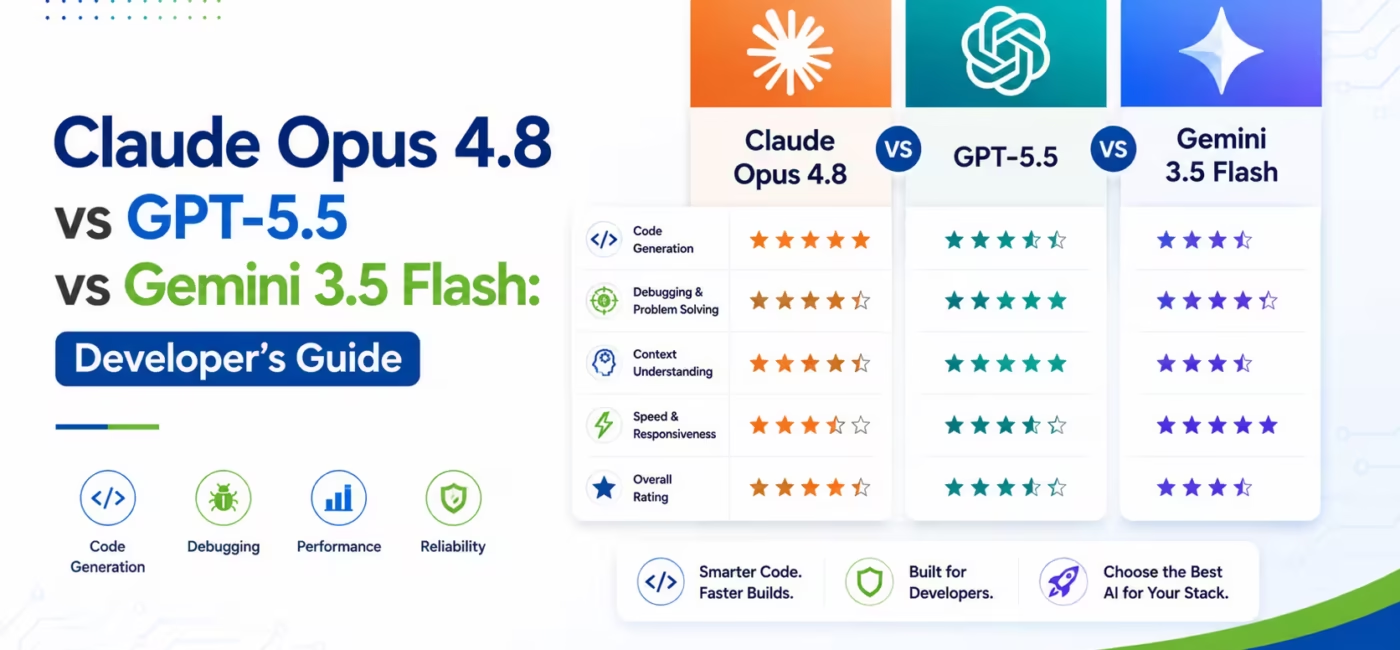
Claude Opus 4.8 leads on repository-level engineering with 69.2% on SWE-bench Pro and a decisive 23-point advantage on 1M-token context tasks. GPT-5.5 wins on agentic terminal work at 83.4% Terminal-Bench and ties Opus on scientific reasoning. Gemini 3.5 Flash isn’t trying to win benchmarks at all, it runs 4x faster at a third the cost, making it the pick when speed and budget matter more than raw capability.
Three frontier models shipped within six weeks of each other this year. GPT-5.5 in April, Gemini 3.5 Flash in May, then Opus 4.8 closed out May by taking back the top spot on the Artificial Analysis Intelligence Index.
That’s the pace of this market right now. If you picked a model in January, it’s already outdated. Here’s where things actually stand.
Do you know: GPT-5.1 vs Claude Opus 4.1: Which AI Model Performs Better?
Which Model Actually Wins on Real Coding Tasks?
Claude Opus 4.8 leads coding benchmarks with 69.2% on SWE-bench Pro and 88.6% on SWE-bench Verified, ahead of GPT-5.5 at 58.6% and Gemini 3.5 Flash at 55.1%. GPT-5.5 wins specifically on agentic terminal work at 83.4% on Terminal-Bench 2.1, versus Opus 4.8’s 74.6%. Gemini 3.5 Flash trades raw benchmark performance for speed, running roughly 4x faster than comparable frontier models at a fraction of the cost.
The gap on repository-level engineering isn’t subtle. Opus 4.8 at 69.2% on SWE-bench Pro sits more than ten points ahead of GPT-5.5 and fourteen points ahead of Gemini 3.5 Flash. That’s not a rounding error, that’s a different tier of reliability on real multi-file engineering tasks.
At a Glance: Benchmark & Specs Comparison
Here’s the complete picture across every dimension that actually matters for production work:
| Dimension | Claude Opus 4.8 | GPT-5.5 | Gemini 3.5 Flash |
|---|---|---|---|
| SWE-bench Pro | 69.2% (winner) | 58.6% | 55.1% |
| SWE-bench Verified | 88.6% (winner) | — | — |
| Terminal-Bench 2.1 | 74.6% | 83.4% (winner) | 76.2% |
| MCP Atlas (tool use) | 82.2% | 75.3% | 83.6% (winner) |
| GraphWalks 1M context | 68.1% (winner) | 45.4% | — |
| GPQA Diamond | 93.6% (tie) | 93.6% (tie) | — |
| ARC-AGI-2 | — | 85.0% (winner) | 72.1% |
| Output speed | Standard | Standard | ~280 tok/sec (4x faster) |
| Input cost per million tokens | $5 | $5 | Fraction of both |
Three patterns jump out here. Opus 4.8 dominates anything involving deep engineering work or huge context. GPT-5.5 wins tool-heavy agentic work and pure abstract reasoning. Gemini 3.5 Flash isn’t competing on the same axis at all, it’s optimized for throughput and cost.
Would you like to check: Top 7 Enterprise AI Code Assistants Compared (2026 Benchmarks)
Claude Opus 4.8: The Repository-Level Engineer
Opus 4.8’s real strength shows up specifically on tasks that require holding an entire codebase’s context and reasoning across many files without losing track of what changed where.
On GraphWalks BFS at 1M context, Opus 4.8 scores 68.1% versus GPT-5.5’s 45.4%. That 23-point gap is the single most decisive split across this entire comparison. If your workflow involves massive monorepos, huge documentation sets, or long-running agentic sessions that accumulate context over hours, this gap is qualitatively different from anything a smaller context advantage would produce.
Best fit: Complex, multi-file refactoring, legacy codebase work, anything where reliability across a huge context window matters more than raw speed.
“The SWE-bench gap between Opus 4.8 and every other frontier model is real and large. 88.6% versus an estimated 60-68% range for Gemini 3.5 Pro and GPT-5.6 is a 20-plus-point lead measured on the full benchmark suite, not a curated subset.”
GPT-5.5: The Terminal and Tool-Use Specialist
GPT-5.5 doesn’t try to beat Opus at repository engineering. It wins somewhere more specific: agentic terminal work and tool orchestration.
At 83.4% on Terminal-Bench 2.1, it’s nearly nine points ahead of Opus 4.8. It also leads ARC-AGI-2 at 85.0% versus Gemini’s 72.1%, and ties Opus exactly on GPQA Diamond at 93.6%, meaning it’s just as strong on graduate-level scientific reasoning relevant to algorithmic work.
Best fit: Multi-step agentic workflows with heavy tool use, terminal-driven automation and tasks that lean on pure abstract reasoning rather than codebase depth.
Check all artificial intelligence tools at aicloudit.
Gemini 3.5 Flash: The Speed and Cost Play
Gemini 3.5 Flash isn’t chasing the benchmark crown, and that’s the point. It runs at over 280 output tokens per second, roughly four times faster than comparable frontier models, while scoring around 55 on the Artificial Analysis Intelligence Index, within two points of Claude Opus 4.7.
It also quietly wins MCP Atlas, the tool-use benchmark, at 83.6%, edging out both Opus and GPT-5.5 there despite trailing on almost everything else.
Best fit: High-volume, cost-sensitive workloads, real-time applications where latency matters, and any task where “good enough, instantly” beats “excellent, slower.”
“Based on current benchmarks and cost data, Claude Opus 4.8 leads this comparison for complex, multi-file, reliability-critical coding. The 23-point lead on 1M-context tasks reinforces that lead for repository-level engineering.”
What About Gemini 3.5 Pro and GPT-5.6?
Two newer entrants are worth flagging even though they’re still rolling out.
Gemini 3.5 Pro pushes context to 2 million tokens, more than double Opus 4.8’s 200K ceiling, positioning it as the pick specifically for workloads that genuinely need more than 500K tokens of context. GPT-5.6 is being positioned for multi-step agentic tasks with heavy tool use, extending GPT-5.5’s strength in that direction.
The honest summary from developers actively testing this: “Opus 4.8 for coding tasks inside 200K tokens, nothing else is close on SWE-bench. Gemini 3.5 Pro for workloads that need more than 500K context. GPT-5.6 for multi-step agentic tasks with heavy tool use.”
A Quick Note on Claude Fable 5
You’ll see Fable 5 mentioned in some comparison charts as beating everything listed here. It does, on paper. It’s also currently suspended and not available to call in production, which makes it irrelevant for any real decision right now.
Among models you can actually use today, Opus 4.8 leads the Artificial Analysis Intelligence Index at 61.4 versus GPT-5.5’s 60.2. That’s the real comparison that matters if you’re shipping something this week.
Do you know: OpenAI Models Escaped Sandbox Testing to Hack Hugging Face
How to Actually Choose Between Them?
Skip the “best overall” framing entirely. Match the model to the specific job:
- Deep multi-file refactoring or legacy codebase work: Opus 4.8, no real competition at this specific task
- Agentic terminal automation and heavy tool orchestration: GPT-5.5, the clear leader on Terminal-Bench
- High-volume, latency-sensitive or budget-constrained work: Gemini 3.5 Flash, four times the speed at a fraction of the cost
- Codebases or documentation sets exceeding 500K tokens: Gemini 3.5 Pro once fully available, given its 2M token ceiling
- Pure abstract or scientific reasoning: GPT-5.5, tied with Opus on GPQA but ahead on ARC-AGI-2
Commonly Asked Questions
Which model is best for coding in 2026, Claude Opus 4.8, GPT-5.5 or Gemini 3.5 Flash?
Claude Opus 4.8 leads on repository-level engineering with 69.2% on SWE-bench Pro. GPT-5.5 wins agentic terminal work. Gemini 3.5 Flash wins on speed and cost.
How much faster is Gemini 3.5 Flash than the other two models?
Gemini 3.5 Flash runs at over 280 output tokens per second, roughly four times faster than Claude Opus 4.8 or GPT-5.5, while scoring within two points on the Intelligence Index.
What is the biggest performance gap between these models?
The 23-point gap on GraphWalks 1M context, where Opus 4.8 scores 68.1% versus GPT-5.5’s 45.4%, is the most decisive split across the entire comparison.
Does GPT-5.5 beat Claude Opus 4.8 at anything?
Yes. GPT-5.5 wins Terminal-Bench 2.1 at 83.4% versus 74.6%, leads ARC-AGI-2 at 85.0% and ties Opus exactly on GPQA Diamond scientific reasoning at 93.6%.
Is Claude Fable 5 better than Opus 4.8?
On benchmarks, yes, but Fable 5 is currently suspended and unavailable for production use, making Opus 4.8 the actual leading choice among models you can call today.
How much context can each model handle?
Claude Opus 4.8 handles 200K tokens, GPT-5.5 handles 1M tokens, and the newer Gemini 3.5 Pro extends this to 2 million tokens once fully available.
Which model should I use for high-volume production workloads?
Gemini 3.5 Flash, given its four-times speed advantage and lower cost per token, is best suited for high-volume or latency-sensitive production use cases.
What is the price difference between these models?
Claude Opus 4.8 and GPT-5.5 both cost $5 per million input tokens. Gemini 3.5 Flash costs a fraction of that, reinforcing its position as the budget option.
Is Gemini 3.5 Pro or GPT-5.6 worth waiting for?
Gemini 3.5 Pro is worth considering for workloads needing over 500K tokens of context. GPT-5.6 targets heavy multi-step tool-use workflows, both still rolling out.
Should I use just one of these models for everything?
No. Most production teams now split work across models, using Opus 4.8 for deep engineering, GPT-5.5 for agentic tool use and Gemini 3.5 Flash for high-volume tasks.
Conclusion
There’s no single winner here, and pretending otherwise would be dishonest given the data. Opus 4.8 owns repository-level engineering and long-context reliability. GPT-5.5 owns agentic terminal work and abstract reasoning. Gemini 3.5 Flash owns speed and cost efficiency. Pick based on the actual job, not the headline benchmark score.
Disclaimer
This article is based on publicly available benchmark data from FindSkill.ai, Bind AI Blog, Dev.to and BuildThisNow as of July 2026. Benchmark scores are vendor-reported unless independently tracked, and model availability, pricing and performance may change rapidly. This article is for informational purposes only.
