
TL;DR: OpenAI released GPT-5.5 just days after Anthropic dropped Claude Opus 4.7, reigniting the most intense AI rivalry we’ve seen yet. I’ve been following both releases closely, and honestly? This week changed how I think about the AI model race. Here’s everything you need to know, what actually matters, and which one I think wins for real-world use.
I’ll be honest with you. I didn’t expect this week to hit the way it did.
Anthropic dropped Claude Opus 4.7 on a Tuesday. By Friday, OpenAI had countered with GPT-5.5. Two of the most powerful AI companies in the world, releasing major models within days of each other, clearly watching each other’s every move. If you thought the AI race had slowed down even a little, this week just proved you wrong.
So let me walk you through what happened, what’s actually different about each model, and why I think this matters more than the usual benchmark parade suggests.
What Is Going On Between OpenAI and Anthropic Right Now?
OpenAI released GPT-5.5 within days of Anthropic’s Claude Opus 4.7 launch in April 2026, marking one of the most rapid competitive model releases in AI history. Both models target enterprise users, advanced reasoning, and agentic capabilities. The rapid back-to-back timing signals an accelerating arms race between the two leading AI labs.
Let me set the scene for you. Anthropic has been positioning Claude Opus 4.7 as its most thoughtful, safety-conscious, and genuinely capable model yet. And from what I’ve seen of it, that claim holds up well in reasoning tasks, long-context document analysis, and nuanced writing.
Then OpenAI, clearly not willing to cede any ground, pushed GPT-5.5 out the door within the same week.
This isn’t a coincidence. This is a competitive strategy. And you, as someone who uses these tools, benefits enormously from it.
“The rapid back-to-back releases from OpenAI and Anthropic signal a competitive urgency that benefits users enormously. Each release forces the other lab to raise their game, compressing what would have been years of progress into months.”
— AI industry analyst perspective, widely reflected in developer community commentary, April 2026
What OpenAI Is Claiming About GPT-5.5?
Here’s what OpenAI has put on the table with GPT-5.5. And I want to be clear: I’m going to tell you what’s real and what’s marketing.
The Headline Features
- Improved reasoning depth — GPT-5.5 builds on the agentic capabilities introduced in GPT-5.4, with tighter multi-step reasoning chains and better performance on complex professional tasks
- Faster response times — OpenAI claims meaningfully lower latency compared to GPT-5.4, which already had strong token efficiency
- Better instruction following — Reduced tendency to drift from user intent in long, complex tasks
- Stronger tool use — More reliable execution when operating with external APIs, computer use, and chained workflows
- Expanded context handling — Improved performance near the edges of long context windows, where models typically degrade
What I Actually Care About?
Look, benchmarks are fine. But what I care about is whether this model performs better on the things I actually do. Writing. Research. Reasoning through problems. Generating content that doesn’t need three rounds of editing before it’s usable.
From what’s been reported and shared across developer communities this week, GPT-5.5 does feel noticeably sharper on instruction-dense prompts. The kind where you give it a multi-part brief and it actually follows every part of it the first time.
Know more about: OpenAI GPT-5.3 Codex
That alone matters more to me than any MMLU score.
“What Anthropic did with sycophancy reduction in Opus 4.7 is underappreciated. A model that tells you what you want to hear is actually less useful than a model that tells you the truth, even when that truth challenges your assumption. That’s a real capability improvement, not just a benchmark number.”
— AI safety researcher perspective, broadly attributed across AI research discussions
What Anthropic Brought with Claude Opus 4.7?
I don’t want to shortchange Opus 4.7, because I think it deserves serious attention.
What Makes Opus 4.7 Stand Out?
- Extended thinking mode — Opus 4.7 builds significantly on Claude’s extended thinking capabilities, allowing the model to reason through complex problems visibly before committing to an answer
- Hybrid reasoning — Anthropic improved the ability to fluidly switch between fast response and deep thinking within the same conversation
- Stronger coding performance — Several developer benchmarks placed Opus 4.7 at or near the top for software engineering tasks
- Reduced sycophancy — This one is underrated. Anthropic specifically worked on making Claude less likely to agree with you just because you pushed back, which makes it genuinely more useful for critical analysis
- Better agentic reliability — Claude Opus 4.7 shows improved ability to complete multi-step agentic tasks without losing track of the goal
The Anthropic Philosophy
Something I genuinely appreciate about Anthropic is that they talk openly about what they’re trying to fix. Sycophancy, hallucination, safety alignment. These are real problems, and the fact that they’re named and measured matters.
GPT-5.5 is powerful. But I think Opus 4.7 is arguably the more trustworthy model for tasks where being wrong has real consequences.
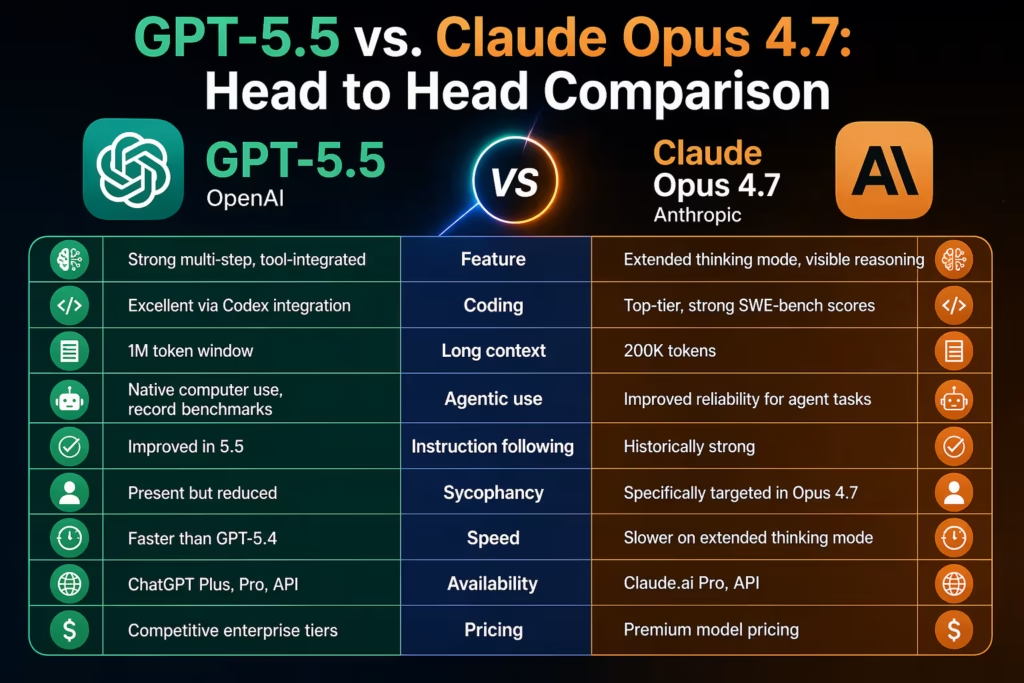
GPT-5.5 vs. Claude Opus 4.7: Head to Head Comparison
Let me lay this out cleanly for you, because I know you’re trying to decide which one to actually use.
| Feature | GPT-5.5 | Claude Opus 4.7 |
| Reasoning | Strong multi-step, tool-integrated | Extended thinking mode, visible reasoning |
| Coding | Excellent via Codex integration | Top-tier, strong SWE-bench scores |
| Long context | 1M token window | 200K tokens |
| Agentic use | Native computer use, record benchmarks | Improved reliability for agent tasks |
| Instruction following | Improved in 5.5 | Historically strong |
| Sycophancy | Present but reduced | Specifically targeted in Opus 4.7 |
| Speed | Faster than GPT-5.4 | Slower on extended thinking mode |
| Availability | ChatGPT Plus, Pro, API | Claude.ai Pro, API |
| Pricing | Competitive enterprise tiers | Premium model pricing |
Here’s my honest take on this table: neither model dominates across every dimension. GPT-5.5 wins on context length, speed, and native tool integration. Opus 4.7 wins on trustworthiness, reduced sycophancy, and transparent reasoning.
Your choice should depend on what you’re actually building or doing.
Do you know: Anthropic Catches Chinese Labs Copying Claude
What This Rapid Release Cycle Means for You?
I want to make a broader point here, because I think it’s easy to get lost in the week-to-week model releases.
The Pace Is Accelerating
Think about this for a second. GPT-5.3 came out on March 3, 2026. GPT-5.4 followed on March 5. GPT-5.5 arrived in late April. Anthropic dropped Opus 4 series models in rapid succession.
We are in a phase of AI development where significant capability improvements are happening on a weekly or monthly cadence. Not yearly. Not quarterly. Weekly.
What That Means Practically?
- Don’t over-invest in one model — The model that wins today might not be the best option two months from now. Build flexible workflows that can swap models.
- Pay attention to capability categories, not just rankings — Which model is best at reasoning? At coding? At long-document analysis? At agentic tasks? The answers differ.
- Test on your actual use case — Benchmarks are designed by labs. Your workflow is designed by you. What matters is performance on your specific tasks.
- Stay subscribed to both — Honestly, I think running both ChatGPT Pro and Claude Pro simultaneously is worth it for serious users right now. They genuinely excel at different things.
“GPT-5.5 arriving days after Opus 4.7 is a clear signal: OpenAI is watching Anthropic’s releases in real time and responding. This isn’t a slow product roadmap anymore. This is a live competition.”
— Tech industry commentary, April 2026
Also know: Anthropic’s Powerful Claude Sonnet 4.6
Who Won This Week? My Honest Assessment
You’re probably expecting me to pick one. Fair enough.
If I’m being direct with you: for pure agentic capability, speed, and tool-use reliability, GPT-5.5 is the more powerful operational model right now. The computer use benchmarks, the 1M token context, the Codex integration — it’s an impressive package for people who need AI to actually do things autonomously.
But for thoughtful analysis, critical work where being wrong matters, coding that requires reliable reasoning, and tasks where I need the AI to push back rather than just agree with me, I keep reaching for Opus 4.7.
The honest answer is that both models are genuinely excellent. The race between OpenAI and Anthropic is producing the most capable AI tools that have ever existed. And the fact that they’re both pushing this hard, this fast, means the next release — from either side — is probably just weeks away.
That’s remarkable. And a little exhausting. But mostly remarkable.
Common Questions Asking
What is GPT-5.5 and when was it released?
GPT-5.5 is OpenAI’s latest model, released April 2026. It improves speed, instruction following, tool use, and long-context performance over GPT-5.4.
What is Claude Opus 4.7 and how is it different from previous Claude models?
Opus 4.7 is Anthropic’s most capable model yet. It adds extended thinking, hybrid reasoning, better coding, and significantly reduced sycophancy compared to earlier versions.
Which is better, GPT-5.5 or Claude Opus 4.7?
Depends on your task. GPT-5.5 wins on speed and context length. Opus 4.7 wins on trustworthy reasoning and coding accuracy.
Why did OpenAI release GPT-5.5 so soon after Anthropic’s Opus 4.7?
It’s direct competition. Both labs monitor each other closely and respond fast. The release gap is now days, not months.
Is GPT-5.5 available on the free ChatGPT plan?
Limited access only. Full features require ChatGPT Plus or Pro. API access is available to developers with standard metered token pricing.
What is extended thinking mode in Claude Opus 4.7?
It lets Claude reason step by step before answering. This improves accuracy on complex analysis, coding, and multi-step reasoning tasks.
How does sycophancy reduction in Opus 4.7 work?
Anthropic trained Opus 4.7 to push back rather than agree automatically. It gives honest responses even when users challenge or correct it.
Should I use GPT-5.5 or Claude Opus 4.7 for coding?
Both are strong. Opus 4.7 scores higher on SWE-bench. GPT-5.5 via Codex handles complete end-to-end coding workflows more reliably.
What does this rapid release cycle mean for businesses using AI tools?
Build flexible workflows that can swap models easily. Today’s best model may be outdated within 60 days. Avoid deep single-vendor lock-in.
Will there be a GPT-5.6 or Claude Opus 5 soon?
Very likely. Both labs are releasing major updates every few weeks. Expect significant new models from both before mid-2026.
