
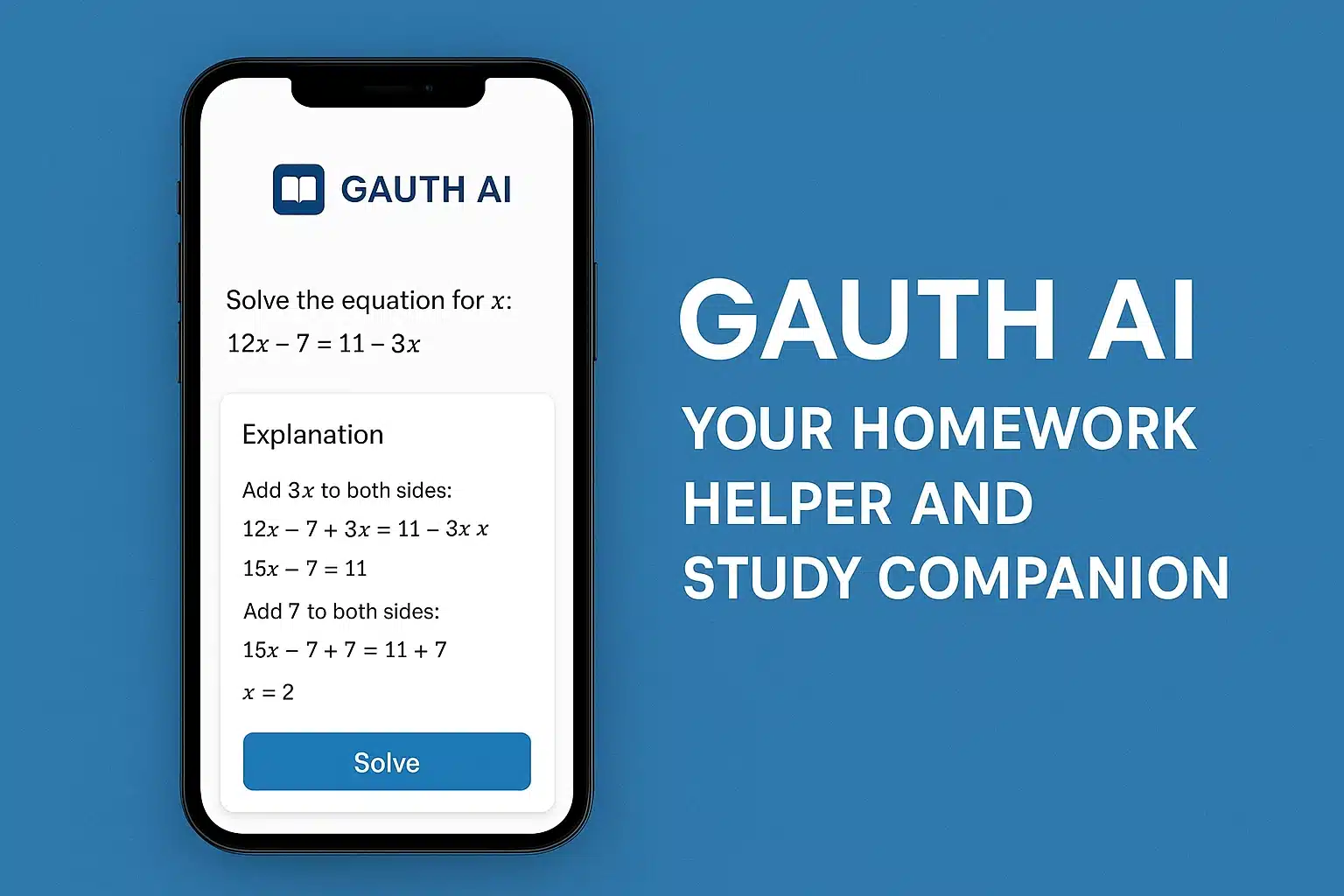
Let’s be honest: homework piles up fast. You’re staring at a calculus problem at 11 PM (we’ve all been there), and suddenly you snap a photo with your phone and boom, step-by-step solution in seconds. Sounds almost too good to be true, right? That’s Gauth AI for you, an app that’s become something of a phenomenon among students worldwide, though it’s also sparked its fair share of heated debates in classrooms.
Whether folks call it Gauthmath AI, Gauth math AI, or just the Gauth AI homework helper, this study companion has genuinely changed how millions tackle their STEM assignments. So let’s dig into what it actually offers, who it’s really for, and (perhaps most importantly) whether it lives up to all that hype.
What Is Gauth AI?
Gauth AI started out as Gauthmath way back in 2019 and has since evolved into this AI-powered study platform that tackles problems across math, science, and honestly, a bunch of other subjects too.
The folks at GAUTHTECH PTE. LTD. built it by mixing optical character recognition (fancy term for reading text from images), artificial intelligence, and here’s the kicker: actual human tutors you can chat with, all wrapped up in one mobile app.
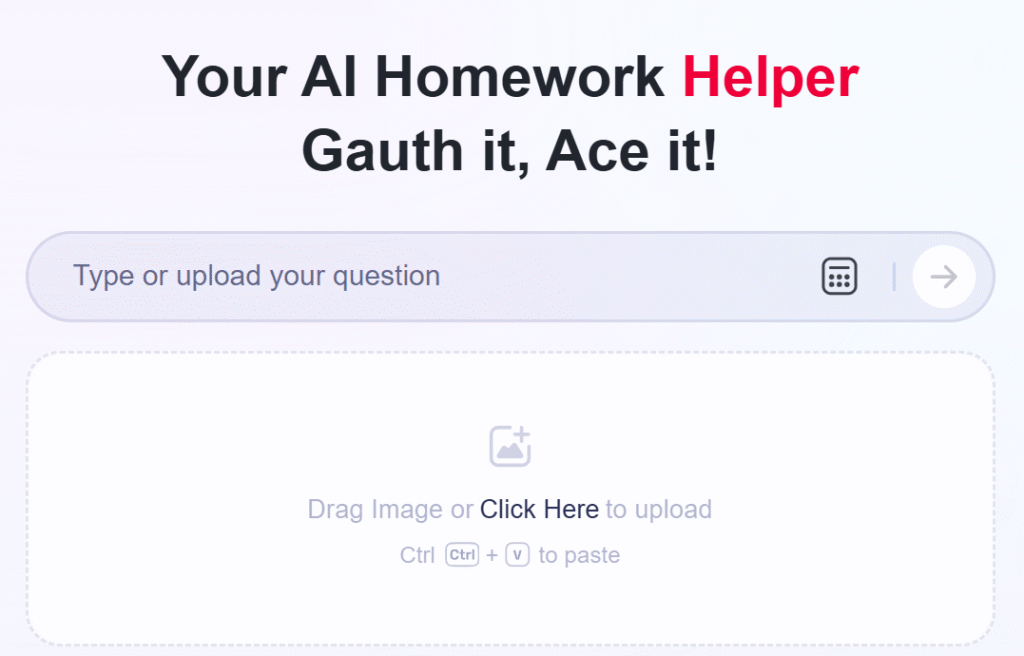
Students can photograph handwritten or printed questions, upload entire PDF worksheets, or just type queries straight into an AI chat.
The Gauth AI study companion markets itself as the “#1 AI study companion powered by newest AI model” (which, yeah, sounds a bit marketing-speak to me), but millions do trust it for instant homework help. And it’s not just some glorified calculator, either. Think of it more like having a pocket tutor who never sleeps, ready to break down everything from basic algebra to organic chemistry.
Know more about: Homeworkify: Transforming Student Support in Education
Key Features of Gauth AI
So, what makes the Gauth AI homework helper stand out? I mean, there’s no shortage of study apps out there.
Here’s what caught my eye:
Snap-and-Solve Camera: You literally just point your phone at a problem, and the app’s OCR tech extracts all the text and symbols, then runs it through their AI engine (they call it “Gauth GPT”… creative, huh?) for a solution.
AI Chat Mode: Got follow-up questions? Confused about a step? Want to see a different method? Just ask; no need to leave the app or start over.
Live Expert Tutors: When the AI can’t figure something out (happens about 5% of the time, apparently), a global network of human tutors steps in. They usually respond in 5-10 minutes, which is… pretty impressive, actually.
PDF & Image Upload: Upload entire worksheets or scanned pages and the app extracts individual problems automatically. Saves a ton of time.
Question Bank Access: Gauth Plus subscribers get access to over 100 million previously solved questions. That’s a lot of homework solutions.
Video Tutorials: More than 20 million tutorial videos covering everything from basic arithmetic to advanced calculus. Though honestly, I wonder who’s watching all those.
Multi-Subject Support: It’s not just math anymore; Gauth handles physics, chemistry, biology, and even dips into humanities topics.
Scientific Calculator & Tools: Built-in graphing, formula sheets, unit converters… basically all the little extras you’d want.
You must know: Understanding ChatGOT
How Gauth AI Works?
Using Gauth math AI is pretty straightforward, even if you’re not particularly tech-savvy.
Here’s basically how it goes:
- Open the app and pick how you want to input your problem: camera scan, file upload, or just type it out.
- Capture the problem. The OCR reads it (printed or handwritten) and converts it into text the AI can work with.
- AI processes your query through Gauth GPT, figuring out what kind of question it is and what subject.
- Review the solution: You’ll get a step-by-step breakdown with explanations for each stage. Usually pretty clear.
- Ask follow-ups through the chat if something’s still fuzzy or you want to explore different approaches.
- Escalate to a tutor if the AI solution doesn’t cut it or the problem’s particularly gnarly.
The whole thing (from snap to solution) typically takes under 30 seconds for standard problems. Tougher questions that need human experts? Maybe 5-10 minutes. Not bad for midnight panic sessions.
Gauth AI Download and Installation Guide
Alright, ready to grab the Gauth AI study companion apk? Here’s how to get it on your device. (And please, stick to official stores; we’ll talk about why in a sec.)
iOS (iPhone/iPad)
- Open the App Store on your device.
- Tap that Search tab at the bottom.
- Type “Gauth” in the search bar (simple enough).
- Select Gauth: AI Study Companion from the results.
- Tap Get and wait for it to download.
- You’ll need to authenticate with Face ID, Touch ID, or your Apple ID password.
- Once it’s done installing, tap Open and you’re good to go.
Android
- Fire up Google Play Store.
- Tap the search icon and type in “Gauth”.
- Pick Gauth: AI Study Companion from the list.
- Hit Install and confirm with your Google password if it asks.
- When it finishes, tap Open to start.
The app’s free to download on both platforms, though you’ll see in-app purchases for premium features.
Quick note: I’ve seen people searching for a Gauth AI mod apk to dodge subscription fees. Don’t do it. Modified APKs are security nightmares, violate terms of service, and can pack malware. Just… not worth it.
Also read: What Is Magic School AI?
Benefits of Using Gauth AI
So why are students flocking to Gauth AI? I mean, beyond the obvious “I need answers NOW” factor.
Here’s what actually makes it useful:
Instant Feedback: No more waiting hours for a tutor appointment or your professor’s office hours. Answers show up in seconds.
Step-by-Step Learning: This is key. You don’t just get final answers. Gauth shows you the how and why, which honestly matters way more if you actually want to learn.
24/7 Availability: It’s 2 AM and you’re panicking before an exam? The app doesn’t sleep. Ever.
Multi-Subject Coverage: One app for math, physics, chemistry, biology, and more. No juggling five different tools.
Cost-Effective: Compare this to private tutoring at $30-$100 per hour. Gauth’s free tier or subscription is way more budget-friendly.
Confidence Builder: Sometimes just seeing a problem broken down makes it way less intimidating. Reduces that test anxiety.
Flexible Learning: Study at your own pace, revisit explanations as many times as you need, try different approaches.
Subjects and Topics Gauth Math AI Covers
Gauth AI has expanded way beyond just math. Here’s the full rundown:
Mathematics
- Word Problems: Those real-world scenarios teachers love
- Algebra: Real numbers, expressions, logarithms, complex numbers (the works)
- Functions: Linear, quadratic, polynomial, exponential, rational
- Geometry: Both plane and solid, plus transformations and spatial stuff
- Trigonometry: Ratios, law of sines and cosines, all those reciprocal properties
- Calculus: Derivatives, integrals, limits, tangent and area problems
- Statistics & Data Analysis: Probability, distributions (Poisson, normal), data representation
- Matrix Algebra: Systems of linear equations, matrix operations
- Logic: Reasoning and proof techniques (my least favorite in school, honestly)
Sciences
- Physics: Mechanics, thermodynamics, electromagnetism, waves, quantum basics
- Chemistry: Stoichiometry, organic chemistry, chemical bonding, reaction kinetics
- Biology: Cell biology, genetics, ecology, anatomy, physiology
Other Subjects
Gauth also tries to tackle economics, some history questions, and basic language assignments, though (let’s be real) STEM is where it shines.
Pricing and Subscription Plans
Gauth AI runs on that freemium model everyone’s doing these days. Here’s the breakdown:
Free Plan ($0/month)
- 11 questions per day through the AI solver
- Basic step-by-step explanations
- Limited question bank access
- Ads (yeah, they’ve gotta make money somehow)
- Earn extra credits by inviting friends (classic growth hack)
Gauth PLUS (Premium)
Pricing bounces around depending on where you are:
- U.S.: About $11.99/month, $31.99 quarterly, or $99.99 annually
- Singapore: SGD 6.98/month or SGD 49.98/year
What premium gets you:
- Unlimited questions and solutions
- Ad-free experience (finally!)
- Advanced AI tutor with supposedly better accuracy
- Priority access to live tutors during peak hours
- All 20M+ video tutorials
- Full 100M+ question bank
- Discounts on extra purchases
One-Time Ticket Packs
Around $9.99 for 10-12 extra solutions if subscriptions aren’t your thing.
Is it worth it? For occasional use, the free tier’s pretty generous. If you’re hitting exams hard, though, the annual plan costs way less than even a few tutoring sessions.
Check here: Is The Rundown University Free?
Is Gauthmath AI Reliable for Students?
Short answer: mostly, yeah, but with some caveats. Gauth AI does really well on standard textbook stuff: algebra through early calculus, routine physics problems, basic chemistry stoichiometry. Reviews generally praise the accuracy for common question types and the clarity of those step-by-step breakdowns.
Where it stumbles (and this matters):
- Complex or weird notation: Handwritten problems with tons of subscripts or non-standard symbols can confuse the OCR.
- Advanced topics: Some users report hit-or-miss results on abstract algebra, advanced organic chemistry mechanisms, or theoretical physics.
- Subject mix-ups: A few testers mentioned getting math solutions for history questions or science answers for Spanish homework. One person said accuracy felt “80% off-target”. Yikes.
Tips for better results:
- Write clearly if you’re uploading handwritten work (messy handwriting = messy results).
- Crop tight to one problem at a time.
- Double-check AI answers against your textbook. I can’t stress this enough.
- Use the human tutor option for critical assignments or concepts you’re really struggling with.
Gauth’s a solid study aid for routine homework and reviewing concepts, but it’s not perfect. Treat it like a study buddy: helpful, but you still want to verify what it tells you.
Why Is Gauth Getting Banned?
Ah, here’s where things get political. In January 2025, Gauth AI got caught up in geopolitical drama when the U.S. government moved to ban most ByteDance-affiliated apps over national security concerns. Now, Gauth isn’t actually owned by ByteDance, but the broader regulatory sweep raised questions about apps storing student data on servers that might be outside U.S. jurisdiction.
What’s driving these bans:
Data Privacy: Schools and policymakers are worried about sensitive student info (uploaded homework, personal details, usage patterns) potentially being accessible to foreign entities.
Academic Integrity: Universities and high schools have tightened their rules around AI homework helpers. The fear? Students copying solutions without actually learning anything.
Cheating Detection: Educators are increasingly using AI detection tools (GPTZero, Turnitin, etc.) to flag AI-assisted work, and some institutions just ban apps like Gauth outright.
Regional Enforcement: Bans are… inconsistent, to put it mildly. Some U.S. school districts block Gauth on campus networks, while the app runs fine in Europe, Asia, and other regions.
What this means for you: If you’re in a place with active restrictions, the app might not work on school devices or networks. Outside those areas, Gauth’s operating normally; just check your school’s specific policies on AI study tools.
Alternatives to Gauth AI
If Gauth AI doesn’t fit your needs (or isn’t available where you are), there are plenty of other options:
Photomath (now Google-owned): Known for clean, animated step-by-step solutions and top-notch OCR. Great for middle and high school math.
Mathway (Chegg): Broad calculator-style coverage across algebra, trig, calculus, chemistry, physics. Feels a bit mechanical but handles diverse problems.
Symbolab (Learneo/Course Hero): Shines at college-level calculus, linear algebra, symbolic manipulation. Shows multiple solution methods.
Wolfram Alpha: The heavyweight champion for computational knowledge. Handles everything from math to unit conversions, though the interface can be intimidating.
Khan Academy: Free, nonprofit platform with video lessons and practice exercises. More about learning than instant answers.
Chegg Study: Subscription service with textbook solutions and expert Q&A. Pricier but comprehensive for college students.
Socratic by Google: AI-driven homework helper across subjects with strong integration into Google search and YouTube tutorials.
Each has trade-offs. Gauth’s edge is blending AI chat, human tutor backup, and multi-subject coverage in one place.
Gauth AI for Teachers and Parents
Can Gauth AI actually serve educators and families, not just students? Yeah, surprisingly, with the right guardrails in place.
For Teachers
Flip the script: Instead of banning Gauth, some teachers are incorporating it into lessons. Students use the app to check work, then explain the AI’s steps to the class. Reinforces understanding.
Rethink assessments: Craft questions that need synthesis, creativity, or real-world application (stuff where just copying an AI solution won’t cut it).
Model responsible use: Show students how to use Gauth as a learning tool, not a crutch. Attempt problems first, compare your method to the AI’s, identify gaps.
Watch for patterns: Sudden grade spikes or identical step patterns across students’ work? Might signal over-reliance.
For Parents
Set boundaries: Family rules work, like “Try the problem for 10 minutes before using Gauth” or “Only for practice, not graded homework”.
Review together: Sit with your kid occasionally while they use the app. Have them explain the AI’s steps in their own words. You’ll quickly tell if they’re learning or just copying.
Check privacy settings: Review what data the app collects (check those App Privacy labels on iOS and Data Safety on Android) and adjust device permissions.
Encourage balance: Mix app use with old-school study methods: flashcards, textbook reading, study groups. Build well-rounded skills.
Keep talking: Have honest conversations about academic integrity and why learning the process matters more than just getting answers.
Used thoughtfully, Gauth can supplement learning and help struggling students. But only if adults stay involved and set clear expectations.
Pros and Cons of Gauth AI
Let’s be objective about the Gauth AI study companion for a minute.
| Pros | Cons |
| Speed: Instant solutions = less time stuck, more time actually learning. | Accuracy gaps: Advanced or unusual problems can trip up the AI pretty badly. |
| Comprehensive: Math, science, and more in one app. | Academic integrity risk: Way too easy to abuse by just copying answers |
| Affordable: Free tier’s usable; paid plans cost way less than private tutors . | Subscription pressure: Free tier’s 11-question limit disappears fast; constant upsells get annoying |
| Step-by-step clarity: Explanations break complex problems into manageable chunks | Data privacy concerns: Student data handling raises red flags for some families and schools |
| Human backup: Live tutors provide a safety net when AI fails | Dependency: Over-reliance weakens problem-solving muscles. |
| Always available: Study on your schedule, not someone else’s (24/7 access) | OCR limitations: Messy handwriting or complex diagrams need multiple attempts sometimes |
| Massive question bank: 100M+ solved problems for practice | Regional bans: Availability varies depending on where you live due to regulatory stuff |
Conclusion
Gauth AI has carved out a pretty significant spot in the edtech world by delivering fast, accessible help across multiple subjects to millions of students. The blend of AI problem-solving, live tutor access, and that extensive question bank makes it a versatile Gauth AI study companion for learners from middle school all the way through college.
Common FAQs About Gauth AI
Is Gauth AI free?
Yep, there’s a free tier with 11 questions daily. Premium subscriptions (Gauth PLUS) unlock unlimited questions, no ads, and advanced features.
Does Gauth AI work for subjects other than math?
Absolutely. It covers physics, chemistry, biology, and even some humanities, though STEM is definitely its strong suit.
Can Gauth AI solve handwritten problems?
Yes, the OCR reads handwritten questions; just make sure your writing’s neat and clear.
Is using Gauth AI considered cheating?
Depends on your school’s policy. Using it to understand concepts? Usually fine. Copying answers without learning? That’s gonna violate most academic integrity standards.
How accurate is Gauth AI?
Pretty accurate for standard textbook problems, but it can struggle with advanced or unusual questions. Always double-check important work.
Where can I download the Gauth AI study companion APK?
Download from the official Google Play Store (Android) or App Store (iOS). Seriously, avoid third-party APK sites (security nightmare).
Why is Gauth banned in some places?
Data privacy concerns and academic integrity policies have led some schools and jurisdictions to restrict or ban homework helper apps.
Can teachers and parents monitor Gauth AI usage?
The app doesn’t have built-in parental controls, but you can use device-level restrictions and (probably more importantly) open communication.
