
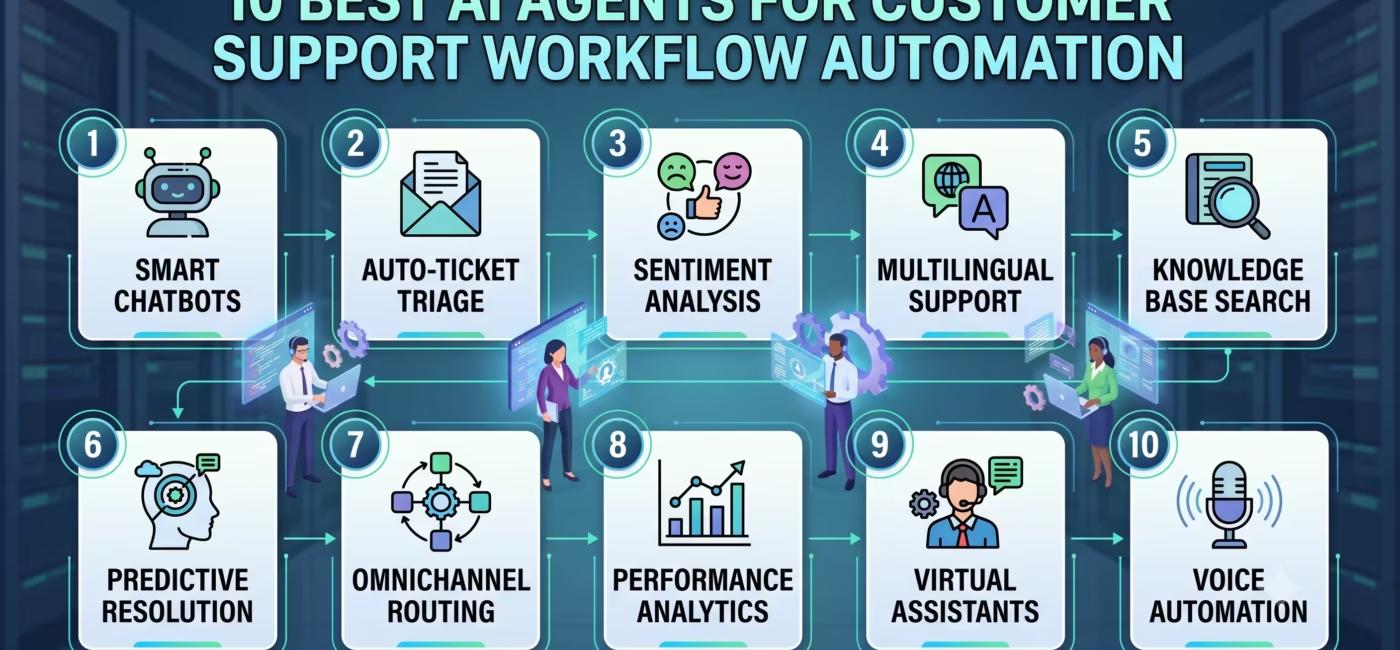
If you run a customer support or CX operation, you already know the core problem: traditional chatbots do not scale.
Static decision trees, scripted FAQs and basic deflection bots only frustrate customers who need actual problems solved. Modern support teams are shifting from passive deflection tools to autonomous AI support agents, intelligent layers capable of understanding intent, reasoning across multiple knowledge bases and executing complex workflows directly inside your backend stack.
Whether your goal is to handle refunds end-to-end, update CRM records, route multi-channel tickets, or execute custom API calls, selecting the right platform is critical.
Here is the quick shortlist of top-performing customer support AI agents based on core operational strengths:
- Best Overall for High-Volume B2B SaaS: Intercom Fin AI Agent
- Best for Omnichannel Enterprise Orchestration: Zendesk AI Agents
- Best for Complex Workflow Reasoning & Compliance: Fini
- Best Visual Developer Studio & $0/Seat Pricing: Botpress
- Best for CRM-Centric Enterprise Ecosystems: Salesforce Agentforce
- Best for E-Commerce & Shopify Automation: Gorgias
- Best for No-Code Visual Conversation Design: Ada
- Best for Managed Support & Human-in-the-Loop Ops: Crescendo.ai
- Best Mid-Market Helpdesk Automation: Freshdesk Freddy AI
- Best for End-to-End Enterprise RPA & Back-Office Workflows: Automation Anywhere
How We Evaluated These AI Support Platforms?
Most reviews judge tools on surface-level features like response speed or canned template libraries. Support operations leaders require deeper operational guarantees:
- Autonomous Action Execution: Does the agent merely answer questions, or can it perform multi-step actions (e.g., issue refunds, modify subscriptions, trigger webhooks) autonomously?
- Handoff Quality & Context Retention: How smoothly does the agent transition complex cases to human representatives without losing intent, context, or conversation history?
- Integration & API Flexibility: Does it seamlessly connect to major CRMs, helpdesks, payment gateways (Stripe) and custom internal endpoints?
- Transparent Resolution Economics: Is pricing based on actual successful resolutions, or are you locked into fixed per-seat overhead?
What Should a Customer Support AI Agent Actually Do?
A customer support AI agent should understand requests, retrieve accurate information, take approved actions across business systems, maintain conversation context, escalate sensitive cases and record every important step for review. The strongest platforms combine knowledge retrieval with controlled workflows rather than relying on free-form answers alone.
Comparison of The Top 10 Customer Support AI Agents
| Platform | Primary Focus | Standout Workflow Capability | Pricing Model | Ideal Team Size |
| Intercom Fin | B2B SaaS In-App Support | Automatic knowledge base synthesis & resolution tracking | $0.99 / resolved conversation | Growth to Enterprise |
| Zendesk AI | Omnichannel Enterprise | Advanced triage, sentiment routing, & agent assistance | Seat-based + AI add-on options | Enterprise |
| Fini | Enterprise Compliance & Reasoning | 99% accuracy across complex multi-step workflows & PII redaction | Outcome-based / Usage tier | Mid-Market to Enterprise |
| Botpress | Custom AI Agent Development | Action-required ticket execution & zero-markup LLM pass-through | $0 per seat + usage credits | Technical Ops / Dev Teams |
| Salesforce Agentforce | CRM-Native Automation | Deep integration with Salesforce Customer 360 data | Enterprise Licensing / Custom | Large Enterprise |
| Gorgias | E-Commerce Support | Native order lookups, tracking and refund processing | Ticket-volume tiers | DTC / Shopify Brands |
| Ada | Non-Technical CX Management | Visual drag-and-drop workflow builder across 50+ languages | Custom usage-based | Mid-Market |
| Crescendo.ai | Human-in-the-Loop Managed AI | Managed operational delivery combining AI with QA supervision | Custom managed tiers | Scaling Operations |
| Freshdesk Freddy AI | Integrated Helpdesk Automation | Generative replies, ticket categorization and agent assistance | Per-agent add-on | SMB to Mid-Market |
| Automation Anywhere | Complex Back-Office RPA | Multi-system enterprise workflow orchestration (EHR, ERP, CRM) | Custom Enterprise | Global Enterprise |
1. Intercom Fin AI Agent – Best for Autonomous B2B SaaS Support
Intercom transformed its platform around Fin, an AI support agent that functions autonomously rather than acting as a static decision tree. It synthesizes help documentation, past tickets and internal guides to resolve incoming queries without human intervention.
- Key Strengths: Fin provides transparent resolution metrics, ensuring you only pay when an issue is definitively resolved. It connects to custom endpoints via Intercom’s Procedures tool to handle actions like plan changes or billing updates directly.
- Operational Edge: Seamless context carry-over when handing tickets off to human agents within the same native interface.
- Limitations: Usage costs ($0.99/resolution) add up quickly for high-volume consumer apps handling simple repetitive volume.
- Pricing: Standard seat pricing plus $0.99 per resolved conversation.
2. Zendesk AI Agents – Best for Omnichannel Enterprise Ecosystems
For enterprises with legacy support operations across email, voice, WhatsApp and live chat, Zendesk AI offers a unified orchestration engine powered by its native platform and the acquisition of Ultimate.ai.
- Key Strengths: Pre-built intent detection trained on millions of historical interactions across specific verticals (e.g., retail, SaaS, travel).
- Operational Edge: Strong sentiment analysis automatically tags high-churn-risk customers and immediately routes them to senior human teams with full context summaries.
- Limitations: Requires dedicated administration resources to set up advanced workflow routes and custom API connections properly.
- Pricing: Base Suite tiers start around $55/agent/month, with AI Agent features billed via custom enterprise add-ons.
3. Fini – Best for Complex Workflow Reasoning & Compliance
Fini is an enterprise agentic AI platform designed for regulated industries like Fintech, Healthcare and SaaS. Built on a reasoning-first engine, Fini parses multi-source documentation alongside user history before executing backend actions.
- Key Strengths: Comprehensive compliance footprint including SOC 2 Type II, HIPAA eligibility, ISO 27001 and native real-time PII redaction before data hits foundational LLMs.
- Operational Edge: Integrates with complex backend environments (EHRs, banking portals, custom SQL layers) to execute multi-step workflows autonomously.
- Limitations: Higher entry price point makes it less practical for small SMBs.
- Pricing: Outcome-based pricing with Growth plans starting at $0.69 per resolution ($1,799/month minimum).
Read these related articles:
Managed K8s for Enterprise Applications: What CIOs and IT Heads Must Know
Role of AI in Data Analytics: Transforming Enterprise Insight
How AI Is Transforming Managed Helpdesk Services for Modern Enterprises
4. Botpress – Best Visual Developer Studio & $0/Seat Model
Botpress provides a flexible, developer-friendly visual builder for teams that want total control over conversation logic, LLM model choice and custom API execution paths.
- Key Strengths: Operates as a standalone helpdesk or sits on top of existing tools (like Zendesk or Intercom) via OAuth. It offers zero-markup LLM pass-through pricing, allowing teams to pay raw provider costs.
- Operational Edge: “Hot Handoff” technology ensures the AI agent stays active during human escalations, continuously summarizing conversation state in real-time.
- Limitations: Requires non-technical teams to work alongside engineers or technical administrators during initial workflow setup.
- Pricing: $0 per seat; Free tier includes 100 conversations, with paid tiers starting at $150/month.
5. Salesforce Agentforce – Best for CRM-Native Enterprises
Salesforce Agentforce enables enterprises using the Salesforce ecosystem to build autonomous AI support agents directly on top of Customer 360 data.
- Key Strengths: Unrivaled access to CRM records, order histories, account hierarchies and custom Salesforce objects without needing third-party API middleware.
- Operational Edge: Operates natively within Salesforce Service Cloud, allowing smooth collaboration between human reps and AI agents on unified cases.
- Limitations: Heavy reliance on the broader Salesforce tech stack; non-Salesforce users will face significant lock-in.
- Pricing: Custom enterprise quotes tied to usage and existing Service Cloud tier.
6. Gorgias – Best for E-Commerce & DTC Brands
Gorgias is designed specifically for e-commerce support operations, featuring deep native integrations with Shopify, BigCommerce and Magento.
- Key Strengths: The AI agent directly accesses order details, tracking information and inventory data out of the box.
- Operational Edge: Automates common e-commerce workflows (e.g., order tracking, address changes, order cancellations and exchange processing) without custom code.
- Limitations: Broad B2B SaaS workflows or non-retail use cases fall outside its core design parameters.
- Pricing: Tiers depend on monthly ticket volume, starting around $50/month for small stores.
7. Ada – Best No-Code Builder for CX Teams
Ada provides an intuitive no-code platform that allows non-technical CX managers to design, test and deploy AI customer service workflows independently.
- Key Strengths: Visual flow editing across 50+ languages with automated translation alignment.
- Operational Edge: Strong proactive messaging capabilities, allowing teams to initiate workflow prompts based on user behavior on web pages or apps.
- Limitations: Custom backend API integration options are less flexible than open developer studios like Botpress.
- Pricing: Custom usage-based model requiring sales engagement.
8. Crescendo.ai – Best for Managed AI Agent Operations
Crescendo.ai provides a hybrid model that blends autonomous AI execution with active human supervision and managed operations.
- Key Strengths: Offers a managed deployment model where quality assurance teams continuously audit AI resolutions to prevent hallucinations or incorrect edge-case execution.
- Operational Edge: Ideal for brands that want to deploy autonomous workflows quickly without risking customer satisfaction drops during the ramp-up phase.
- Limitations: Custom managed operational layer results in higher enterprise contract minimums.
- Pricing: Enterprise custom pricing based on managed support volume.
9. Freshdesk Freddy AI – Best for Mid-Market Efficiency
Freshworks offers Freddy AI, embedded within Freshdesk to deliver agent co-pilots alongside customer-facing automation.
- Key Strengths: Fast time-to-value for existing Freshworks customers, offering ticket classification, response drafting and automated resolution paths out of the box.
- Operational Edge: Agent Copilot functions speed up human agent onboarding by suggesting real-time resolutions during manual ticket handoffs.
- Limitations: Complex enterprise reasoning across disparate third-party backends requires custom extensions.
- Pricing: Freshdesk plans start at $15/agent/month, with Freddy AI capabilities offered as add-on packages.
10. Automation Anywhere – Best for Complex Enterprise RPA & Back-Office Support
Automation Anywhere combines generative AI agents with enterprise Robotic Process Automation (RPA) to handle backend support operations.
- Key Strengths: Capable of interacting with legacy mainframes, ERPs and desktop applications that lack modern REST APIs.
- Operational Edge: Achieves high autonomous resolution rates (up to 80-90%) on legacy enterprise processes where back-office data entry is the primary support bottleneck.
- Limitations: Requires significant technical deployment time and dedicated RPA development resources.
- Pricing: Enterprise-level custom deployment quotes.
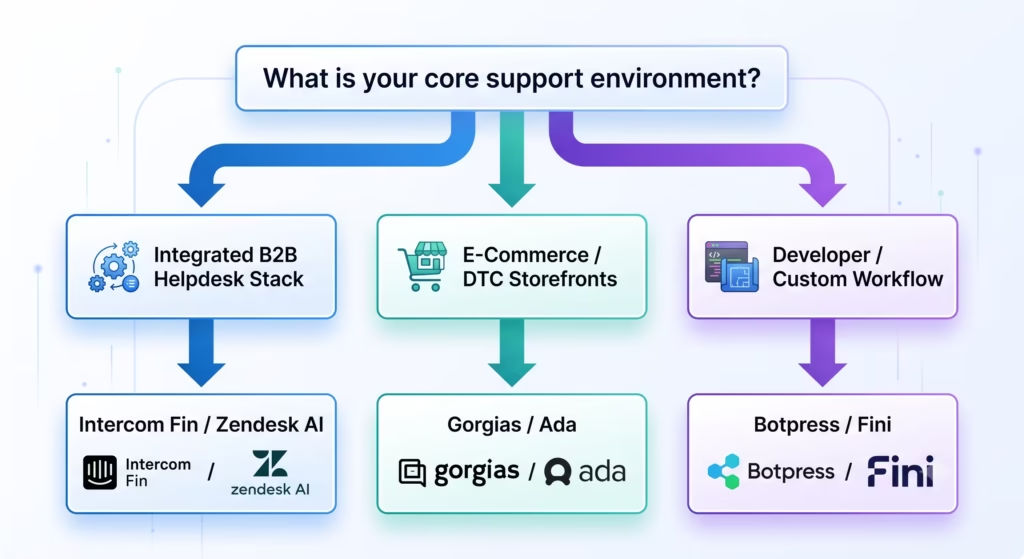
Decision Framework: Selecting Your AI Support Tool
Choose your platform based on your support team’s core technical requirements and channels:
Conclusion
The transition from static, rule-based chatbots to autonomous AI Agents for Customer Support Workflow Automation marks a permanent shift in customer service operations. Deploying an AI agent is no longer just about deflecting tickets to lower cost; it is about providing instantaneous, highly accurate and multi-step issue resolution directly inside backend systems whether through processing refunds, updating subscriptions, or routing complex enterprise cases.
Frequently Asked Questions (FAQs)
What is an AI customer support agent?
An AI support agent is an autonomous program that uses large language models (LLMs) and integrations to resolve customer issues, answer questions and execute backend tasks without human intervention.
How does an AI agent differ from a traditional chatbot?
Traditional chatbots follow rigid, pre-scripted decision trees to answer basic FAQs, while AI agents reason through complex queries, execute API actions and adapt dynamically to context.
What percentage of support tickets can AI agents resolve automatically?
Modern customer support AI agents typically automate 40% to 80% of routine Tier-1 and Tier-2 tickets, depending on knowledge base quality and system integrations.
How do AI agents prevent hallucinations in customer interactions?
AI agents use Retrieval-Augmented Generation (RAG) to ground their answers strictly in verified company documentation, help articles and real-time backend API data.
What backend actions can an AI support agent perform?
AI agents can handle multi-step actions such as issuing refunds, updating account information, tracking order shipments, modifying subscriptions and tagging CRM records.
How does the handoff from an AI agent to a human agent work?
When an AI agent encounters a complex edge case, it transfers the conversation to a human rep alongside a detailed summary and full context history so the customer doesn’t have to repeat themselves.
What pricing models do AI support agents use?
Common pricing structures include per-seat licensing, usage-credit models, per-conversation tiers, or outcome-based pricing charged per resolved issue.
Are customer support AI agents secure and compliant?
Leading enterprise platforms comply with SOC 2 Type II, GDPR and HIPAA standards, incorporating real-time PII (Personally Identifiable Information) redaction before processing data.
Which AI agent is best for e-commerce brands?
Platforms like Gorgias and Ada are tailored for e-commerce, offering native, out-of-the-box integrations with Shopify, BigCommerce and order management systems.
