

Salesforce Agentforce
Salesforce's platform for building autonomous AI agents that connect to CRM data and take real actions
Starting price Free + From $500
Tool Information
What Is Salesforce Agentforce?
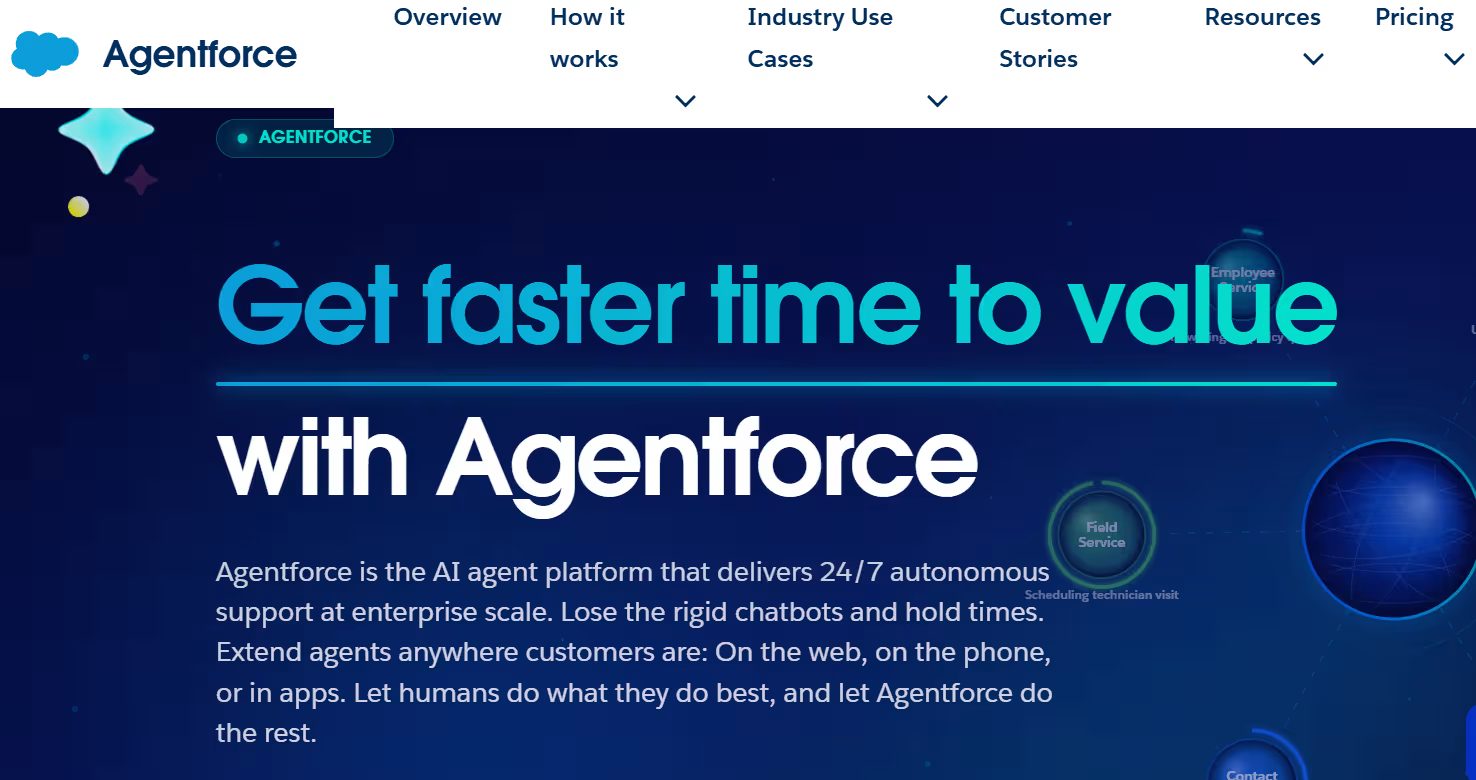
Salesforce Agentforce is a platform for building and deploying autonomous AI agents, or "digital labor," that can connect to any data source, reason over it in real time, and take real actions across sales, service, marketing and other functions. Agents need three things to get work done: data, reasoning, and actions, and Agentforce is built to let agents access data grounded in a company's own CRM records rather than generic training data.
The platform spans three architectural layers: an autonomous Service Agent, a Service Assistant copilot for human agents, and an action framework built on Apex, Flow, Prompt Templates, MuleSoft, and native MCP support, all monitored through a Command Center dashboard for session tracing and analytics.
Who Owns Salesforce Agentforce?
Agentforce is owned and developed by Salesforce, the enterprise CRM company. It launched publicly in October 2024, and has since expanded rapidly with new agent types, pricing models, and industry-specific capabilities through 2025 and 2026.
Key Features of Salesforce Agentforce
- Agent Builder: A low-code tool for building, customizing, testing, deploying, and monitoring AI-powered agents.
- Prompt Builder: Lets teams design and manage prompts that guide agent behavior.
- Einstein Trust Layer: A set of guardrails that protect data privacy and security, improve the safety and accuracy of AI results, and promote responsible AI use across Salesforce.
- Autonomous execution: Agents can operate around the clock, handling tasks independently without constant human supervision.
- Omnichannel support: Provides support across web, mobile, messaging apps, and other channels, unifying customer communication.
- CRM data integration: Grounds agent responses in real business context by integrating directly with CRM data.
- Agentforce Voice: Enables voice-based AI agent interactions, currently available in the US and Canada.
- Digital Wallet: Provides usage tracking for credits and actions consumed across the platform.
- Multilingual support: Allows agents to interact with customers in multiple languages.
- Seamless human escalation: Hands off conversations to human agents when needed, preserving context.
- Native MCP support: Connects agents to external tools and systems using the Model Context Protocol, alongside Apex, Flow, and MuleSoft integrations.
- Command Center: A dashboard for session tracing, monitoring, and analytics across deployed agents.
- Agentforce Coworker and Vibes: Tools included in the free tier for building and testing agents before committing to paid usage.
Salesforce Agentforce Pricing
Agentforce pricing has shifted multiple times since its 2024 launch and now spans three overlapping models: Flex Credits, Conversations, and per-user licensing.
| Pricing Option | List Price | Billing Model | What It Covers |
|---|---|---|---|
| Salesforce Foundations | $0 | Free | Agent Builder, Prompt Builder, Agent Script, Coworker, Vibes, 200k Flex Credits, 250k Data Cloud credits |
| Flex Credits | $500 per 100,000 credits (~$0.10/action) | Pre-Purchase, Pre-Commit, or PayGo | Pay-per-action across Actions, Prompts, Translations, and Voice Actions |
| Conversations | $2/conversation | Pre-Purchase only | Flat-rate pricing for customer-facing agents (original 2024 model) |
| Agentforce User License | $5/user/month | Pre-Purchase + metered | Limited CRM object access, still draws down Flex Credits |
| Agentforce Add-ons (Sales/Service/Field Service) | $125/user/month | Pre-Purchase | Unmetered employee-facing usage |
| Agentforce Industries Add-ons | $150/user/month | Pre-Purchase | Unmetered usage plus industry-specific AI capabilities |
| Agentforce 1 Editions | From $550/user/month | Pre-Purchase | Add-on included, plus 2.5M Flex Credits per org per year |
| Help Agent Resolutions | $2/resolution | Pay-per-resolution | Billed only when an issue is fully resolved without human help; became generally available in July 2026 |
Voice actions consume 30 Flex Credits ($0.15) compared to 20 credits ($0.10) for standard actions. Enterprise customers can also negotiate a custom Agentic Enterprise License Agreement with no public rate, bundling Agentforce, Data 360, MuleSoft, and Slack.
Best Use Cases of Salesforce Agentforce
Agentforce is best suited for enterprises already invested in the Salesforce ecosystem that want AI agents deeply grounded in their existing CRM data across sales, service, and field operations. It fits organizations wanting flexibility in how they pay, whether through predictable per-user licensing, flat-rate conversations, or granular pay-per-action or pay-per-resolution models. Given the reported 5-11 month implementation timelines, it's best approached by teams prepared for a longer rollout rather than those needing an immediate, lightweight chatbot solution.
F.A.Q (11)
Pros and Cons
Pros
- Free Entry Tier With Meaningful Included Credits (Salesforce Foundations)
- Deep Native CRM Data Integration
- Einstein Trust Layer For Security And Governance
- Multiple Pricing Models To Fit Different Usage Patterns
- Pay-Per-Resolution Option Ties Cost To Outcomes
- Low-Code Agent Builder Plus Pro-Code Options (Apex
- Flow
- MuleSoft)
- Broad Partner And Integration Ecosystem
- Supports Both Customer-Facing And Employee-Facing Agents
Cons
- Pricing Structure Genuinely Complex With Three Overlapping Models
- Costs Can Escalate Quickly At Scale With Metered Credits
- Requires Service Cloud Or Related Salesforce Products For Full Value
- Long Implementation Timelines Reported (5 To 11 Months)
- Under 10% Of Customers Reported To Have Fully Scaled Usage
- Voice Actions Limited To US And Canada Currently
Reviews
You must be logged in to submit a review.
No reviews yet. Be the first to review!


Similar Tools

AI photo generator that turns a selfie into stylized portraits and avatars
2026-07-13
from $9.9

Speak your thoughts and turn them into editable text directly in your browser. Zahvox is a free voice-to-writing tool built for faster everyday writing
2026-10-05
Free

Enterprise AI platform for search, answers and task automation
2026-07-14
Free