
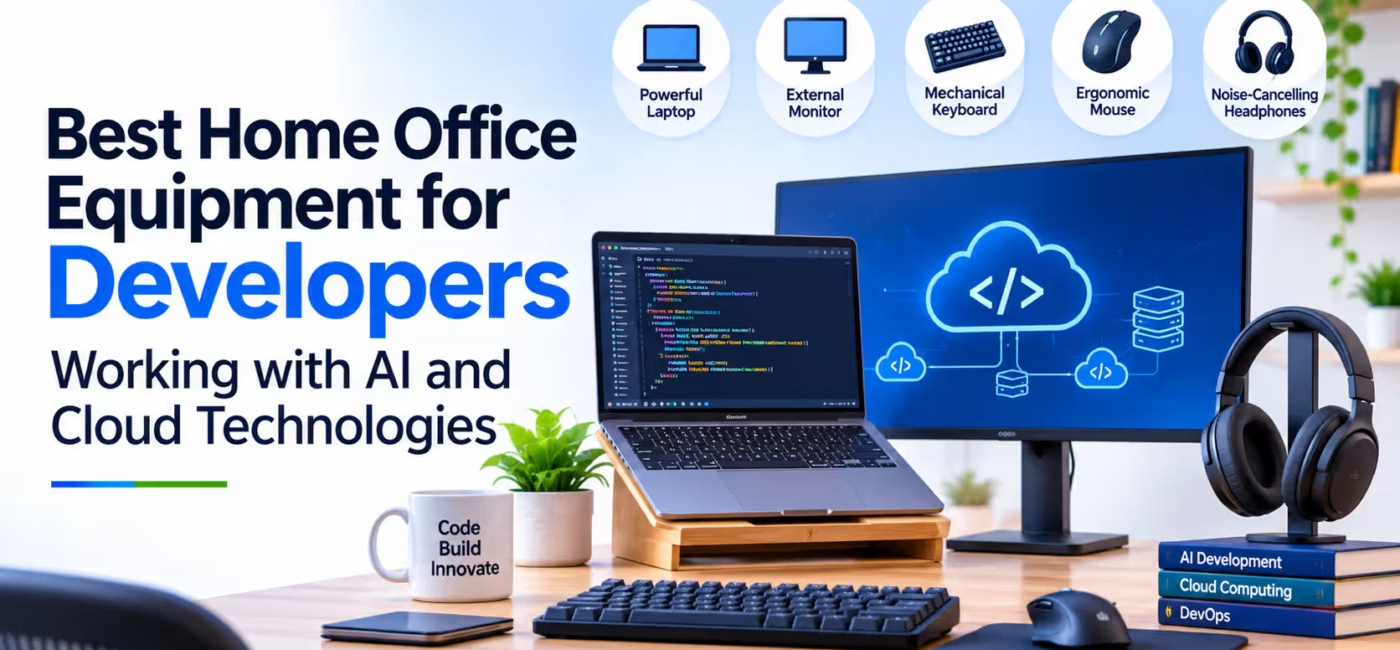
Which properties are required to be suitable for developers using AI and cloud technologies in their home office? Ultimately, a quick computer is important, but efficient working conditions isn’t just about how quickly a computer works.
Development of AI, cloud infrastructure management, software testing, and remote collaboration frequently involves the concurrent use of several applications. The wrong equipment combination can cause slower development, screen area limitations and delays.
The top home office products for developers ought to allow for more difficult and technical jobs whilst maintaining convenience throughout longer operating hours. However, selecting appropriate computers, monitors, accessories, and networking gear should enhance the productivity of the system without making the system unnecessarily costly.
What Should Developers Consider Before Choosing Home Office Equipment?
Various hardware requirements are applicable to developers dealing with AI and cloud technologies, and various roles in both areas also have specific hardware needs. The local computing infrastructure requirements of cloud engineers who are looking after remote infrastructure might not be as great as a developer’s requirements for training machine learning models.
Equipment selection needs to be influenced by such things as processing capacity, memory, display quality, connectivity, and ergonomic comfort. A balanced set-up typically helps to achieve a more practical outcome than investing heavily in a single piece of equipment.
Best Home Office Equipment for AI and Cloud Developers
When creating a trustworthy development workstation, there are several types of devices that warrant attention. Thanks to the options below, these are common tasks that can be managed, making life with a Raspberry Pi easier:
1. High-Performance Laptop or Desktop Computer
Make sure that the laptop or desktop computer is high-performance.Ensure that the laptop or desktop is high-performance.
The core of any development workspace is a reliable computer! Integrated Development Environments (IDEs), Virtual machines, Databases, containers, and Web browsers are among the tools that are commonly used by developers.
In the most simple terms, a modern multi-core processor, 32GB RAM and 1TB SSD can be used practically for most professional development tasks. You may require additional memory if you want to use more intensive workloads.
The GPU capabilities are something that needs to be taken into consideration by local developers. Many machine learning frameworks require a dedicated NVIDIA GPU with different video memory sizes, but the amount of memory and its configuration are also important.
Cloud-based development can decrease the requirement for costly graphics hardware in situ since the computing-intensive calculations can be carried out at remote places.
2. 4K External Monitor for Programming and Multitasking
A larger display can enhance workspace organisation by providing an ability to have more applications shown on the display at the same time. One example is the Dell UltraSharp U2723QE, which features a 4K IPS Black display and USB-C port, while also having an adjustable stand.
It is high resolution which allows to view the code in detail, dashboards for infrastructure and technical documentation. USB-C connections also make it easy to connect compatible laptop devices.
A good business monitor will include features that make the text easy to read and allow you to move the image around and have enough screen real estate.The important features of a good business monitor are not the features that are geared towards games; they are the features that make the text easy to read, allow for the image to be moved around, and have enough room on the screen.
3. Portable Monitor for Flexible Development Setups
A portable monitor gives extra display area without the need of a large permanent installation. It can be used to show terminal windows, cloud monitoring dashboards or API documentation, while the main laptop is used for coding.
Brands like UPERFECT feature small external displays that come with a resolution of 16″ x 1600 for up to 2560 and support USB-C. These setups can appeal to developers who are looking for extra screen real estate when they’re on the go. But, it is advisable to verify compatibility with laptops, connection support and power supply specifications before the buy.
4. Ergonomic Keyboard and Precision Mouse
Programming involves extensive keyboard use, making comfortable input devices important for daily productivity. A keyboard with responsive keys and a comfortable layout can support prolonged typing sessions. Compact mechanical keyboards, low-profile models, and split ergonomic keyboards address different preferences.
A precision mouse with programmable buttons may also improve interaction with development tools and technical dashboards. Comfort remains subjective, so keyboard dimensions, hand positioning, and desk height deserve consideration alongside product features.
5. Reliable Router and Wired Internet Connection
Programming is a lot of typing, so comfortable typing devices are essential for everyday productivity. A comfortable layout and responsive keys can facilitate long typing sessions. There are compact mechanical keyboards, low-profile ones, and split ergonomic keyboards to suit various preferences.
A programmable mouse with extra buttons could also enhance interactions with technical dashboards and development tools. While features are important, the dimensions and positioning of the hands on the keyboard and the height of the desk can also be a factor in comfort.
6. USB-C Docking Station and External SSD
Cable clutter can occur when there are several devices, and it can make the workstation connections more complicated. External portable monitor, keyboards, storage devices, and networking equipment can be plugged in via a central connection using either a USB-C or Thunderbolt docking station.
In other cases, Ethernet connections can ensure more stable latency and fewer interruptions in wireless signals when workers are working on a single, fixed workstation. If remote support and/or production incident handling are an element of your job, and it requires a set amount of time, it might be worthwhile to have a second internet connection.
7. UPS and Backup Equipment
If local servers or desktop workstations are running, interruptions in the power may cause some disruptions to the development environment. Small to medium size uninterruptible power supplies (UPS) can be used to only temporarily support equipment with batteries in case of a power loss to shut down the equipment safely.
Backups are also a must, but this time automated. Source control is for preserving code history and separate backups are for preserving databases, configuration files, etc. that are not stored in source control. Staggered restoration tests are key as part of restoring arrangements as they should be periodically tested to ensure information can actually be recovered in the event of a failure.
8. Adjustable Desk, Supportive Chair and Lighting
Performance may be important, but comfort is a contributing factor for long hours of productivity. The correct set-up of an adjustable chair that provides proper lower back support along with a desk at the proper height and screen placement can eliminate unnecessary physical stress.
Work area lighting cannot cause distracting reflections. When using a monitor arm, there’s no need to sacrifice essential desk space and the height or angle of the screen is controlled. A clear microphone and comfortable headset also can be a boon to the many developers who meet remotely on a very regular basis.
Conclusion
Developers using AI and cloud technologies will find the ideal home office setup when it comes to the balance of reliable performance, user-friendly displays, stable connectivity, and comfort. Efficient technical work can be facilitated by the proper use of a suitable laptop or a desktop, an additional monitor, reliable networking equipment and suitable backup systems.
Ultimately, the equipment selected should mirror real development needs (space, and budget) and not look at the need for specific specification that is not necessary.
Recommended Articles To Read:
What is the Difference Between DMOS, VMOS, LDMOS?
5 Best Router Settings That Help Keeping Hackers Off Cameras
Complete list of Technologies used in developing IoT Apps
