
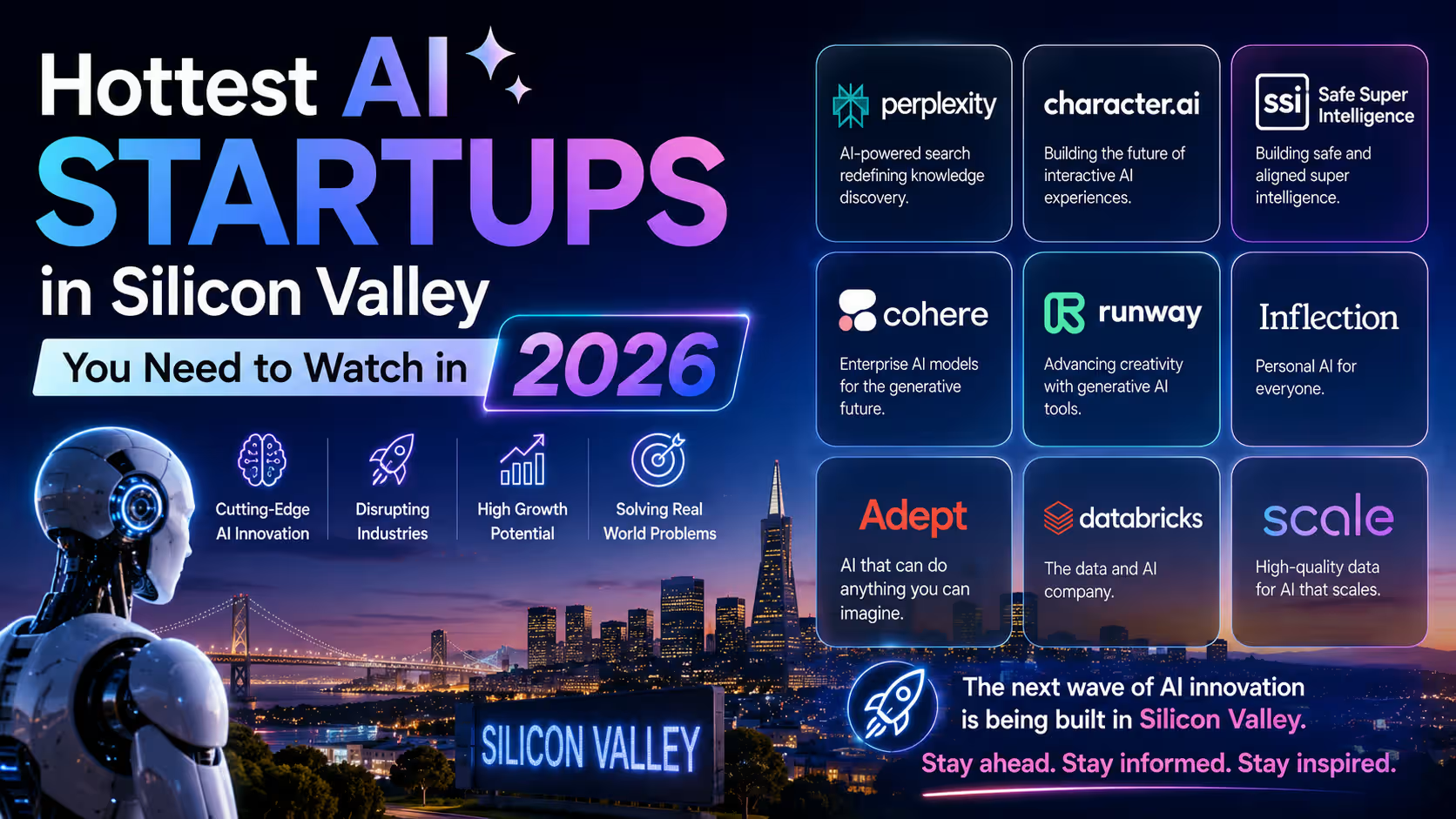
Silicon Valley’s AI startup scene in 2026 looks nothing like it did two years ago. The gold rush around large language models has matured into a diversified bet across infrastructure, voice AI, vertical markets, developer tools, and humanoid robotics. The hottest startups right now are not the loudest ones. They’re the ones with actual revenue, real enterprise customers, and technical moats that competitors can’t easily copy.
I want to tell you something that most Silicon Valley coverage gets wrong. The hottest AI startups right now are not the ones with the biggest Twitter followings or the most dramatic product demos. They’re the ones quietly signing multi-year enterprise contracts, crossing $100 million in annual recurring revenue, and building technical infrastructure that every other company needs to run on.
The Bay Area AI boom has entered its second chapter. And this chapter is far more interesting than the first.
Why Silicon Valley Still Leads Global AI in 2026?
Silicon Valley remains the world’s most productive engine for AI startups in 2026 because it concentrates talent, capital, and customers in a single ecosystem. Founders draw on dense networks of former Google, Meta, Apple, and OpenAI engineers. Investors from Sequoia, Andreessen Horowitz, and Accel operate within miles of each other. The result is a compounding flywheel that still outpaces every other region on earth for frontier AI company formation.
Despite years of predictions that AI innovation would spread globally and evenly, the numbers tell a different story. The Bay Area still houses the majority of the world’s most consequential privately held AI companies.
The composition has shifted though. In 2023, the hottest startups were all building foundation models. In 2026, the hottest startups are building specialized chips, agentic workflows, vertical AI for healthcare and legal, voice interfaces, and humanoid robots.
The Categories Driving the Current Wave
Before I walk you through specific companies, here’s how I’d map the current startup landscape:
- Frontier model labs – New foundation models challenging OpenAI and Google
- AI infrastructure and compute – Specialized chips and cloud platforms for inference
- Voice AI – Real-time conversational agents and speech synthesis at scale
- Developer and coding tools – Platforms making software creation faster and more autonomous
- Enterprise workflow AI – Agents automating document handling, search, and business operations
- Vertical AI – Specialized models for healthcare, legal, finance, and other regulated industries
- Robotics and embodied AI – Physical AI systems entering warehouses and factories
The Hottest AI Startups in Silicon Valley Right Now
1. Anthropic – The Most Credible OpenAI Challenger
Location: San Francisco | Founded: 2021 | Valuation: $350 billion
Anthropic is the startup that has done more to reshape the AI competitive landscape than any other company not named OpenAI. Founded by former OpenAI researchers including Dario Amodei, the company built its entire identity around one concept: safe AI that enterprises can actually trust.
The numbers back that identity up. In April 2026, Google agreed to invest up to $40 billion in Anthropic, providing $10 billion immediately at that $350 billion valuation. Amazon had already pledged up to $25 billion in a separate deal. Anthropic’s annual revenue run rate reportedly topped $30 billion in 2026, up from $9 billion at the end of 2025.
Claude Code, Anthropic’s developer tool, has become one of the most used AI coding assistants in professional environments. Multi-year compute deals with CoreWeave and Google lock in the infrastructure Anthropic needs to scale.
Why it’s hot: Revenue trajectory, enterprise trust, and a safety narrative that resonates with regulated industry buyers.
Do you know: OpenAI Releases GPT-5.5 Just Days After Anthropic’s Opus 4.7
2. Perplexity — AI Search That Actually Cites Its Sources
Location: San Francisco | Founded: 2022 | Valuation: $20 billion
Perplexity built something that sounds simple and turned out to be genuinely hard: a search engine that gives you a real answer with citations instead of ten blue links.
By September 2025, the company secured commitments for $200 million at a $20 billion valuation, with Nvidia and Jeff Bezos among its investors. Apple was reported to be considering Perplexity as the default search option in Safari. Perplexity even made an unsolicited $34.5 billion offer to buy Alphabet’s Chrome browser.
Its Deep Research feature automates background research by running dozens of parallel web searches and compiling a synthesized report. For professionals who spend hours on research tasks, this is immediately valuable.
Why it’s hot: Real consumer traction, bold strategic moves, and a defensible position at the intersection of AI and search.
3. Glean — Enterprise Search Evolving Into Agentic Workflows
Location: Redwood City | Founded: 2019 | Valuation: $7.2 billion
Glean started as semantic search for internal company knowledge. It became something bigger.
By mid-2025, Glean surpassed $100 million in annual recurring revenue and launched Glean Agents, a suite of AI agents automating onboarding and operational tasks. The platform expected to support one billion agent actions by the end of 2025. Customers include Databricks and Plaid, where Glean generates personalized answers across hundreds of SaaS apps simultaneously.
This is the most important thing I can tell you about Glean: it represents how enterprise software is being rebuilt from the ground up around AI agents rather than dashboards and menus.
Why it’s hot: Crossed $100 million ARR, genuine enterprise adoption, and a product that proves agentic AI is already in production.
4. Figure — Humanoid Robots Funded at Software Scale
Location: Sunnyvale | Founded: 2022 | Valuation: $39 billion
Humanoid robots were considered a science fiction category until very recently. Figure changed that perception.
In September 2025, the company raised over $1 billion in a Series C round that valued it at $39 billion. Nvidia, Intel, LG, and Salesforce participated as investors. Microsoft and Jeff Bezos had already backed the company at a $2.6 billion valuation in 2024, meaning the valuation increased fifteen times in roughly a year. [Source]
Figure’s Helix platform targets warehouse and factory environments first, with consumer and home applications planned for later phases. The investor list reads like a who’s who of everyone who believes physical AI is the next major platform after software AI.
Why it’s hot: Fastest valuation appreciation of any Silicon Valley AI startup in the past 12 months.
5. Groq — Custom Chips for the Inference Era
Location: Mountain View | Founded: 2016 | Valuation: $6.9 billion
Training AI models gets all the attention. Running them at scale is actually the harder business problem. Groq built specialized inference processors to solve exactly that.
In September 2025, Groq raised $750 million led by Disruptive, with participation from BlackRock and Samsung, doubling its valuation to $6.9 billion. Founded by a former Alphabet engineer, Groq claims its chips deliver low-cost, high-speed inference that addresses the industry’s shift from training to deployment.
With Nvidia GPU shortages still creating procurement headaches and cloud inference costs eating enterprise budgets, Groq sits at a bottleneck that every company building AI products needs to solve.
Why it’s hot: Infrastructure position at the most critical AI bottleneck right now.
Do you know: The Grok AI Undressing Scandal: How One Chatbot Sparked Global Safety Laws
6. Harvey — Legal AI With Real Revenue
Location: San Francisco | Founded: 2022 | Valuation: $11 billion
The legal industry seems conservative. Harvey made it move fast.
By May 2025, Harvey was seeking more than $250 million at a $5 billion valuation after reaching $75 million in annual recurring revenue. By March 2026, it closed a $200 million round co-led by GIC and Sequoia at an $11 billion valuation, doubling in less than a year.
Harvey builds AI modules for document review, contract drafting, and regulatory compliance. It integrates models from OpenAI, Anthropic, and Google rather than building its own foundation model, focusing instead on the legal workflow layer where the real value lives. Goldman Sachs estimates 44% of legal work could be automated, and Harvey’s traction supports that thesis directly.
Why it’s hot: Fastest valuation doubling in the vertical AI segment, combined with real $75 million ARR.
7. Hippocratic AI — AI Healthcare Agents Filling Staffing Gaps
Location: Palo Alto | Founded: 2022 | Valuation: $3.5 billion
Healthcare is facing one of the worst staffing crises in modern history. Hippocratic AI is building AI agents to fill the gap.
In November 2025, the company raised $126 million at a $3.5 billion valuation. Co-founded by physicians and researchers from Johns Hopkins, Microsoft, and Google, Hippocratic has partnerships with more than 50 healthcare organizations including Cleveland Clinic and Northwestern Medicine.
The agents handle pre- and post-surgical calls, nursing triage, and insurance authorizations. By delegating these routine tasks, hospitals can ease clinician burnout and improve patient throughput without hiring more staff.
Why it’s hot: Real hospital partnerships, founder credibility, and a clear answer to a healthcare crisis that isn’t going away.
8. Replit — Vibe Coding at Scale
Location: San Francisco | Founded: 2016 | Valuation: $3 billion
Replit coined the term “vibe coding” before the rest of the industry caught up to what it meant.
The company’s annualized revenue jumped from $2.8 million to $150 million in roughly a year. A $250 million raise at a $3 billion valuation followed in September 2025, backed by Google’s AI Futures Fund and Andreessen Horowitz. Customers include Duolingo and Zillow.
Replit’s Agent 3 tool automatically writes, tests, and debugs code. Its platform lets both professional developers and non-technical users build and deploy software using natural language, making it one of the clearest examples of AI democratizing software creation rather than just accelerating it.
Why it’s hot: Revenue growth from $2.8 million to $150 million annualized in twelve months says everything.
9. Deepgram — Voice AI Gone Mainstream
Location: San Francisco | Founded: 2015 | Valuation: $1.3 billion
Voice has quietly become one of the most contested battlegrounds in AI, and Deepgram holds a strong position in it.
In January 2026, the startup raised $130 million in a Series C at a $1.3 billion valuation, with investors including Tiger Global, Citi Ventures, and Alumni Ventures. More than 1,300 organizations use its API platform, including NASA and Amazon Web Services. Deepgram also acquired OfOne to expand into restaurant voice ordering, showing how voice AI is spreading beyond contact centers.
Why it’s hot: Over 1,300 enterprise customers and a valuation that reflects mainstream adoption, not early hype.
10. Vercel — The Infrastructure Layer for AI Web Apps
Location: San Francisco | Founded: 2015 | Valuation: $9.3 billion
Most people building AI applications need to deploy them somewhere. Vercel is increasingly that somewhere.
An oversubscribed $300 million Series F in September 2025 valued Vercel at $9.3 billion, with revenue up 82% year-over-year. Customers include OpenAI, Anthropic, PayPal, Nike, and Walmart. Vercel specializes in edge deployments and serverless infrastructure, making it easy to integrate generative AI models in production with low latency.
The company’s user base doubled year-over-year. When OpenAI and Anthropic are both customers, you know you’re infrastructure they can’t do without.
Why it’s hot: 82% revenue growth and the customer list that signals it’s embedded in the critical path of AI deployment.
Rising Stars Worth Watching Early
These companies are smaller but represent where the next wave is forming:
- Giga (San Francisco) — AI agents for customer support; raised $61 million at a $350 million valuation. Founded 2024, already generating traction with enterprise customers who need agentic workflows rather than scripted bots.
- Irregular (San Francisco) — Tools to test AI models for risks and weaknesses; raised $80 million at a $450 million valuation. As enterprises adopt generative models, red-teaming AI becomes a compliance requirement.
- Latent Health (San Francisco) — AI agents that fill out insurance paperwork to speed up drug approvals; raised $80 million at a $600 million valuation. Targets one of the most painful bottlenecks in pharmaceutical processes.
- Safe Superintelligence (Palo Alto) — Founded by former OpenAI chief scientist Ilya Sutskever; among the most anticipated stealth-stage AI labs in the region with enormous talent density.
What Makes a Silicon Valley AI Startup Actually Hot vs. Just Hyped
I want to be direct with you about this. Venture funding and press coverage do not equal durable value.
Humane raised $241 million for the AI Pin. Scathing reviews and poor sales followed. The company sold its assets to HP for $116 million in February 2025. The demo looked incredible. The product didn’t work in real life.
The startups with real staying power in 2026 share these traits:
- Repeatable enterprise revenue — Glean over $100 million ARR. Harvey at $75 million ARR. Replit from $2.8 million to $150 million annualized in one year.
- Technical moats that can’t be copied — Groq’s custom silicon. Deepgram’s proprietary speech models built on years of real-world audio data.
- Multi-year commercial agreements — Locking in demand before competitors catch up.
- Regulatory acceptance for vertical AI — Hippocratic’s hospital partnerships. Harvey’s law firm contracts. These involve compliance requirements that take time and credibility to satisfy.
The common denominator is simple: real customers paying real money for something they can’t easily get elsewhere.
The Bigger Picture: How Silicon Valley’s AI Boom Has Matured
Here’s what I think is the most important pattern across everything I’ve covered in this article.
The first chapter of the AI boom was about foundation models. Who could build the most capable large language model. How much compute could you throw at it. How far could you push benchmark scores.
The second chapter, which is the chapter we’re in right now, is about everything else. The chips you need to run those models affordably. The voice interfaces users actually prefer. The vertical applications that solve genuine industry pain. The developer tools that let more people build more things faster. The robots that will eventually carry this intelligence into the physical world.
Silicon Valley isn’t slowing down. It’s diversifying. And the startups that understand which chapter we’re in are the ones building the most defensible businesses of the next decade.
“The Bay Area remains the world’s most productive engine for artificial intelligence startups, but the composition of its hottest companies has shifted. In 2026 the region’s AI boom looks less like a gold rush around large language models and more like a diversified set of bets across infrastructure, voice, coding tools, enterprise software, vertical healthcare and legal applications, and even humanoid robots.”
— Intersog, Hottest AI Startups in Silicon Valley 2026
Common Questions Asked
What are the hottest AI startups in Silicon Valley right now?
Anthropic, Perplexity, Glean, Figure, Groq, Harvey, Hippocratic AI, Replit, Deepgram, and Vercel are among the hottest in 2026. Each holds real revenue and enterprise traction.
Which Silicon Valley AI startup has the highest valuation in 2026?
Anthropic leads at $350 billion following Google’s $40 billion investment commitment in April 2026. Figure follows at $39 billion after its September 2025 Series C round.
What is the best AI startup for enterprise software in Silicon Valley?
Glean is widely considered the leading enterprise AI startup, having crossed $100 million ARR with AI search and agentic workflow tools deployed inside major companies.
Which Silicon Valley AI startup is growing the fastest right now?
Replit grew annualized revenue from $2.8 million to $150 million in roughly one year, making it the fastest-growing Bay Area AI startup by revenue trajectory in 2025-2026.
Is Anthropic based in Silicon Valley?
Yes. Anthropic is headquartered in San Francisco, California. It was founded in 2021 by former OpenAI researchers including CEO Dario Amodei and President Daniela Amodei.
What AI startups in Silicon Valley are working on robotics?
Figure, based in Sunnyvale, is the leading humanoid robotics startup, valued at $39 billion. Tesla and Neuralink also operate in the broader Bay Area ecosystem.
Which AI infrastructure startups in Silicon Valley should I watch?
Groq (custom inference chips, $6.9B valuation) and Vercel (AI app deployment infrastructure, $9.3B valuation) are the most important infrastructure-layer startups right now.
What is the best AI startup for healthcare in Silicon Valley?
Hippocratic AI (Palo Alto, $3.5B valuation) leads with AI healthcare agents deployed across 50-plus hospital systems including Cleveland Clinic and Northwestern Medicine.
Are there AI startups in Silicon Valley focused on legal work?
Harvey is the standout, valued at $11 billion after reaching $75 million ARR. It automates document review, contract drafting, and compliance work for law firms.
What early-stage AI startups in Silicon Valley are worth watching in 2026?
Giga (customer support agents, $350M), Irregular (AI risk testing, $450M), Latent Health (insurance AI, $600M), and Safe Superintelligence (Ilya Sutskever’s stealth lab) are top early-stage picks.
Disclaimer
This article is based on publicly available information from Intersog, Built In SF, Forbes AI 50, Failory, Hyscaler, Blockchain Council, and SummaryAI as of May 2026. Startup valuations, funding rounds, revenue figures, and product availability are subject to change. Inclusion in this article does not constitute an investment recommendation. Always conduct independent due diligence before making investment or business decisions. This article is for informational purposes only.
