

Monitoring AI systems presents unique challenges that traditional IT monitoring fails to address. You face complex model behavior, hidden biases, and regulatory requirements that demand specialized approaches. Over 40% of AI monitoring failures trace back to misconfigured alerts and inadequate strategies. This guide provides actionable steps to implement robust AI monitoring that catches issues before they impact users while maintaining compliance and fairness.
Key takeaways
| Point | Details |
|---|---|
| Infrastructure readiness | Access to data pipelines, monitoring platforms, and defined stakeholder roles forms the foundation for effective AI monitoring. |
| Systematic monitoring | Implementing stepwise processes covering performance, fairness, and compliance ensures comprehensive system oversight. |
| Real-time alerting | Properly configured anomaly detection and alerts reduce failures by catching issues early without causing alert fatigue. |
| Tool selection | Balancing cost, scalability, and integration capabilities helps organizations choose optimal monitoring solutions. |
| Common pitfalls | Alert misconfiguration, ignoring data quality, and overlooking bias monitoring account for most AI system failures. |
Prerequisites for monitoring AI systems
Before implementing monitoring, you need foundational infrastructure and organizational alignment. Start by securing access to your data pipelines where model inputs and outputs flow. Your monitoring platform must integrate with these pipelines to capture real-time data without introducing latency.
Stakeholder roles require clear definition from the outset. Assign data scientists to define model performance thresholds, DevOps engineers to maintain infrastructure, and compliance officers to oversee regulatory requirements. Without this clarity, monitoring efforts fragment across teams and miss critical issues.
Baseline metrics and KPIs must be established before monitoring begins. Document your model’s current accuracy, latency, throughput, and fairness metrics under normal conditions. These baselines become your reference points for detecting anomalies and degradation over time.
Familiarity with AI-specific metrics separates effective monitoring from generic system checks. You need to understand precision, recall, F1 scores, Area Under the Curve (AUC), and fairness indicators like demographic parity and equal opportunity. Traditional uptime and response time metrics alone miss model-specific failures.
Pro Tip: Validate your monitoring setup in a staging environment first. Run historical data through your monitoring pipeline to verify it catches known issues before deploying to production. This prevents blind spots that only emerge under production load.
- Ensure monitoring tools have API access to model endpoints
- Document data schemas and expected input distributions
- Establish incident response procedures before alerts fire
- Configure log aggregation for centralized analysis
- Test monitoring under various load conditions
Core steps for monitoring AI systems
Implementing effective monitoring follows a structured workflow. First, define clear monitoring objectives aligned with business requirements. Determine which model behaviors matter most, such as maintaining 95% accuracy or detecting bias within 24 hours of deployment. These objectives drive your KPI selection.

Second, set up bias and data quality monitoring as foundational layers. Deploy tools that automatically detect statistical bias across demographic groups and flag data drift when input distributions shift. These tools should run continuously, not just during initial deployment.
Third, deploy anomaly detection and real-time alerts focused on actionable issues. Configure thresholds based on your baseline metrics, ensuring alerts fire only when intervention is needed. Integrate these alerts with incident management systems for rapid response.
Fourth, integrate compliance logging and audit trails that capture every model decision with full context. Log inputs, outputs, model versions, and timestamps in tamper-proof storage. This documentation proves essential during regulatory audits.
Fifth, establish regular model retraining and monitoring update cycles. Schedule quarterly reviews of monitoring effectiveness, adjusting thresholds as model behavior evolves. Update monitoring logic whenever you retrain models or modify features.
Pro Tip: Start monitoring simple metrics first, then layer complexity. Begin with latency and throughput before adding sophisticated bias detection. This phased approach prevents overwhelming your team while building monitoring muscle.
- Define monitoring objectives and success criteria
- Implement data quality checks on inputs and outputs
- Deploy bias detection across protected attributes
- Configure anomaly detection for performance metrics
- Set up real-time alerting with proper escalation paths
- Establish compliance logging infrastructure
- Schedule regular monitoring review cycles
- Document monitoring procedures and runbooks
Consult the AI tools checklist 2026 for comprehensive monitoring platform options.
Implementing real-time alerts and anomaly detection
Effective alerting balances sensitivity with practicality. Statistical anomaly detection techniques like z-score analysis, isolation forests, and autoencoders identify unusual patterns in model behavior. These methods adapt to your specific model characteristics rather than applying generic thresholds.
Configure alerts to prevent overload by implementing tiered severity levels. Critical alerts demand immediate response, such as model accuracy dropping below 85%. Warning alerts indicate trends requiring investigation within 24 hours, like gradual latency increases. Information alerts log events without triggering notifications.
Over 40% of AI monitoring failures stem from inadequate alert configuration, causing teams to ignore notifications or miss genuine issues. Combat this by grouping related alerts and using time-based aggregation. If five models show similar anomalies simultaneously, one grouped alert proves more actionable than five separate notifications.
Real-time monitoring reduces mean time to detection (MTTD) from hours to minutes. When your fraud detection model starts flagging legitimate transactions at elevated rates, immediate alerts enable rapid rollback before customer impact spreads. This proactive approach prevents the cascading failures common in AI systems.
“The best monitoring systems catch issues before users notice them. Configure alerts to fire when metrics trend toward thresholds, not just when thresholds breach.”
- Use machine learning for dynamic threshold adjustment
- Implement alert suppression during planned maintenance
- Configure escalation paths for unacknowledged alerts
- Test alert channels regularly to verify delivery
- Document alert response procedures in runbooks
- Review alert fatigue prevention strategies quarterly
Incorporate AI error troubleshooting workflows into your alert response procedures for faster resolution.
Bias and fairness monitoring
Bias detection requires continuous statistical analysis across demographic groups. Monitor disparate impact ratios, which compare model outcomes for protected groups against baseline populations. A ratio below 0.8 typically signals problematic bias requiring immediate investigation.
Track demographic shifts in your input data that impact fairness. If your hiring model was trained on 60% male candidates but production data shifts to 70%, fairness metrics will drift even without model changes. Detect these distribution shifts using Kolmogorov-Smirnov tests or Population Stability Index (PSI) calculations.
Incorporate bias mitigation feedback loops that automatically trigger when fairness metrics degrade. These loops can adjust model weights, resample training data, or flag problematic features for data science review. Automated mitigation prevents bias from accumulating between manual review cycles.
Improving fairness metrics over time maintains stakeholder trust and regulatory compliance. Document fairness improvements in monthly reports showing trend lines for key indicators. This transparency demonstrates your commitment to ethical AI practices.
- Calculate demographic parity across all protected attributes
- Monitor equal opportunity metrics for positive outcomes
- Track calibration across demographic groups
- Measure individual fairness using similarity metrics
- Document fairness tradeoffs in model decisions
- Conduct regular bias audits with diverse stakeholders
Compliance and regulatory monitoring
Audit trails provide accountability by documenting every model decision with complete context. Capture input features, output predictions, model version, timestamp, and user identity for each inference. Store these logs in immutable storage that prevents tampering or deletion.
Data lineage tracking maps how data flows from source systems through transformations to model inputs. This transparency proves critical when regulators question how specific decisions were reached. Implement automated lineage tools that visualize data provenance without manual documentation.
Key regulatory standards shape monitoring requirements across industries. GDPR mandates explainability for automated decisions affecting EU citizens. CCPA requires disclosure of data usage in California. Industry-specific rules like FCRA for lending or HIPAA for healthcare impose additional constraints.
Tools supporting compliance documentation include MLflow for model versioning, Apache Atlas for data lineage, and Splunk for log management. Combine these platforms to create comprehensive compliance ecosystems meeting multiple regulatory frameworks simultaneously.
- Implement tamper-proof logging infrastructure
- Document model governance procedures
- Maintain version control for all model artifacts
- Establish data retention policies aligned with regulations
- Conduct regular compliance audits
- Train teams on regulatory requirements
| Regulation | Key Requirements | Monitoring Focus |
|---|---|---|
| GDPR | Right to explanation, data minimization | Decision logging, feature tracking |
| CCPA | Data usage disclosure, opt-out rights | Data lineage, consent tracking |
| FCRA | Adverse action notices, accuracy | Decision audit trails, accuracy monitoring |
| HIPAA | Protected health information security | Access logging, encryption verification |
Choosing tools and technologies
Cloud-native platforms like AWS SageMaker Model Monitor, Azure ML Monitoring, and Google Cloud AI Platform provide integrated monitoring with minimal setup. These services automatically track drift, bias, and performance metrics while scaling with your infrastructure. They cost more but reduce engineering overhead significantly.
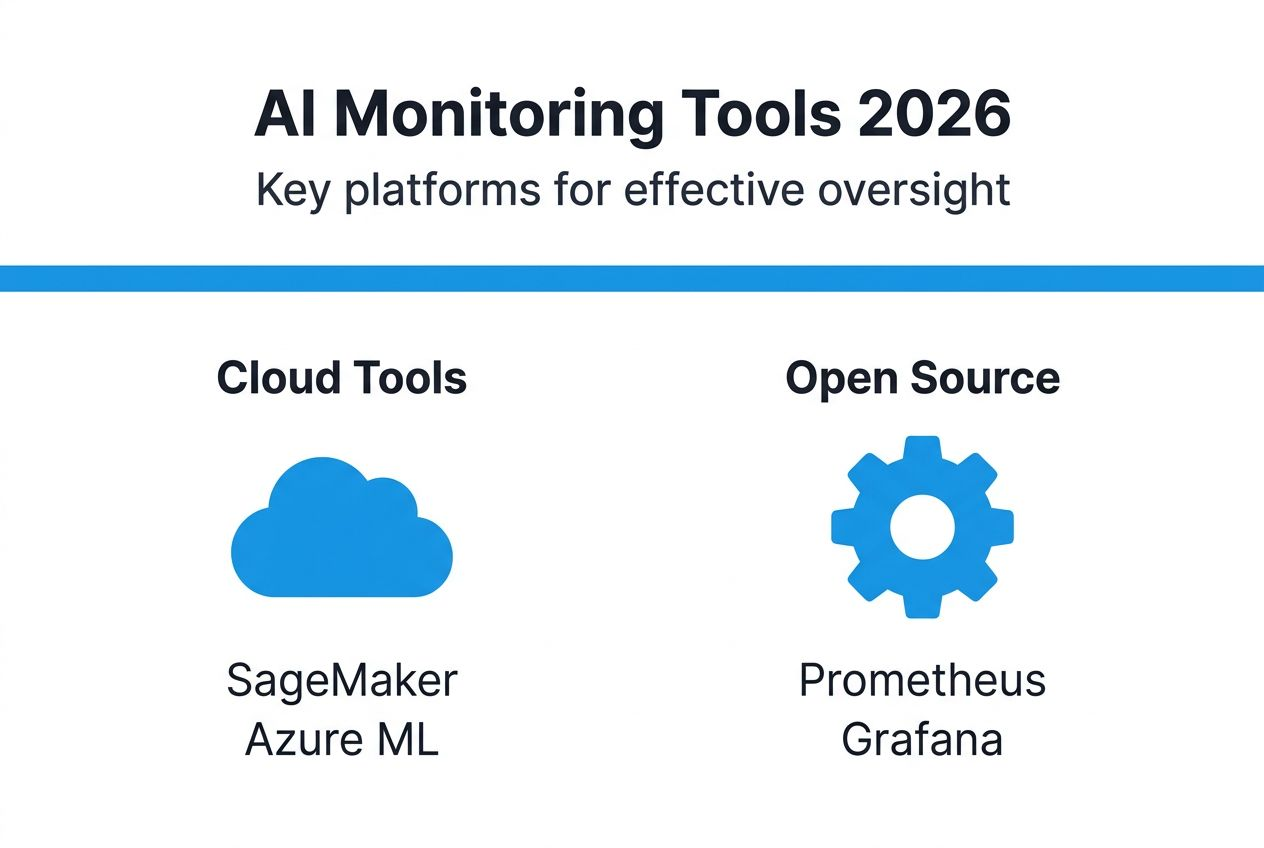
Open-source tools like Prometheus, Grafana, and Evidently AI offer flexibility and cost savings. You configure exactly what to monitor without vendor lock-in. However, they require more engineering effort to implement and maintain compared to cloud solutions.
Comparing key features helps match tools to your needs. Enterprise organizations prioritize compliance features and support contracts. Startups value rapid deployment and low initial costs. Cost-effective AI monitoring combines open-source tools with cloud platforms, reducing expenses by 25% while maintaining enterprise capabilities.
Combining tools creates optimized ecosystems. Use Prometheus for metrics collection, Grafana for visualization, and specialized AI tools like Fiddler or Arize for bias detection. This layered approach balances cost, functionality, and maintainability.
Pro Tip: Start with cloud-native solutions if you lack dedicated monitoring engineers. Migrate to hybrid architectures as your team matures and cost optimization becomes critical.
| Tool Category | Cloud-Native | Open Source | Best For |
|---|---|---|---|
| Metrics Collection | CloudWatch, Azure Monitor | Prometheus, InfluxDB | Infrastructure monitoring |
| Visualization | Vendor dashboards | Grafana, Kibana | Custom dashboards |
| Bias Detection | AWS Clarify, Azure Fairlearn | Fairlearn, AIF360 | Fairness auditing |
| Drift Detection | SageMaker Monitor | Evidently AI, WhyLabs | Data quality |
- Evaluate tools based on integration complexity
- Consider long-term total cost of ownership
- Test tools with your actual data before committing
- Verify vendor compliance certifications
- Check community support and documentation quality
Review the AI tools checklist 2026 for detailed comparisons and explore AI tools for developers for implementation guides.
Troubleshooting and common pitfalls
Alert misconfiguration creates the most frequent monitoring failures. Teams set thresholds too sensitive, generating hundreds of false positives daily. Alternatively, insensitive thresholds miss genuine issues until customer complaints arrive. Calibrate thresholds using historical data and adjust based on alert response rates.
Ignoring data quality monitoring allows garbage inputs to corrupt model outputs silently. Implement schema validation, range checks, and distribution monitoring on every input feature. Catch data pipeline failures before they poison model predictions.
Overlooking model drift lets performance degrade gradually. Models trained on 2024 data perform poorly on 2026 patterns as user behavior and market conditions evolve. Monitor prediction distributions and feature importance shifts to detect drift early.
“The most dangerous monitoring gap is the one you don’t know exists. Regularly audit your monitoring coverage to identify blind spots before they cause incidents.”
Strategies fixing alert fatigue include implementing smart grouping, adjusting severity levels based on business impact, and automating remediation for common issues. If latency spikes resolve within seconds, suppress alerts unless the pattern persists.
Continuous data validation prevents silent failures. Run statistical tests on every batch of input data comparing distributions to training data. Flag significant deviations for investigation before they impact model performance.
Watching for model drift involves tracking performance metrics over rolling windows. If accuracy drops 2% over two weeks, investigate potential causes like data drift or concept drift. Establish retraining triggers based on these drift indicators.
- Set up monitoring coverage reviews quarterly
- Document known monitoring blind spots
- Implement canary deployments for monitoring changes
- Test alert response procedures regularly
- Review alert fatigue solutions with your team
- Maintain incident postmortem databases
Leverage AI error troubleshooting resources to accelerate problem resolution.
Expected outcomes and success metrics
Benchmarks for response time should target detection within 5 minutes and resolution within 1 hour for critical issues. Measure mean time to detection (MTTD) and mean time to resolution (MTTR) across all incidents. Improve these metrics through automated detection and response procedures.
Maintaining AI model accuracy above 90% requires continuous monitoring and periodic retraining. Track accuracy trends over 30-day windows to detect gradual degradation. Establish retraining triggers when accuracy drops 3% below baseline or remains below threshold for 7 days.
Reducing alert fatigue percentage effectively means achieving a true positive rate above 80% for all alerts. If your team ignores more than 20% of alerts as false positives, recalibrate thresholds immediately. Survey responders monthly about alert quality and adjust based on feedback.
Ensuring compliance audit success requires maintaining complete audit trails with zero gaps. Conduct internal audits quarterly using the same criteria external auditors apply. Address any documentation gaps before regulatory reviews.
- Track model performance against SLA commitments
- Monitor fairness metrics monthly for trend analysis
- Measure monitoring system uptime and reliability
- Calculate ROI of monitoring investments
- Document incident reduction rates
- Benchmark against industry performance standards
Utilize AI visibility metrics to measure broader system impact and consult AI visibility archives for historical benchmarking data.
Enhance your AI monitoring with AICloudIT
Implementing comprehensive AI monitoring requires specialized expertise and proven tools. AICloudIT provides scalable monitoring solutions designed specifically for AI systems in production. Our platform supports compliance requirements, real-time alerting, and bias detection out of the box.
We offer tailored consulting to optimize your monitoring setup based on your specific models and infrastructure. Our team helps you implement best practices while avoiding common pitfalls that derail monitoring initiatives. Whether you’re monitoring your first model or managing hundreds, AICloudIT adapts to your scale and complexity.
FAQ
What are the essential metrics to monitor for AI system health?
Performance KPIs like accuracy, precision, recall, and latency form the foundation. Bias metrics across demographic groups ensure fairness, while data quality indicators catch input issues. Compliance logs provide audit trails for regulatory requirements. Monitoring these four categories supports both reliability and trustworthiness.
How can I reduce alert fatigue when monitoring AI systems?
Tuning alert thresholds based on historical data eliminates most false positives. Prioritize alerts by business impact, reserving critical severity for issues affecting users. Combine related alerts into grouped notifications and automate escalations for unacknowledged incidents. Regular threshold reviews maintain relevance as systems evolve.
What tools are recommended for compliance monitoring of AI systems?
Tools enabling audit trails, data lineage tracking, and tamper-proof logs are crucial for regulatory compliance. Platforms like MLflow, Apache Atlas, and specialized governance tools provide these capabilities. Choose solutions with relevant compliance certifications matching your industry requirements. Cloud vendors often provide built-in compliance features that streamline adherence to GDPR, HIPAA, and other regulations.
Recommended
- Alternatives Archives – AICloudIT
- How to Analyze AI Performance for Accurate Results
- AI Data Security Guide: Safeguard Enterprise AI Systems
- Best AI Content Detector Tools in 2026 (Free + Paid) – AICloudIT
