Your AI Slop Bores Me: The Meme, Game and Meaning Explained
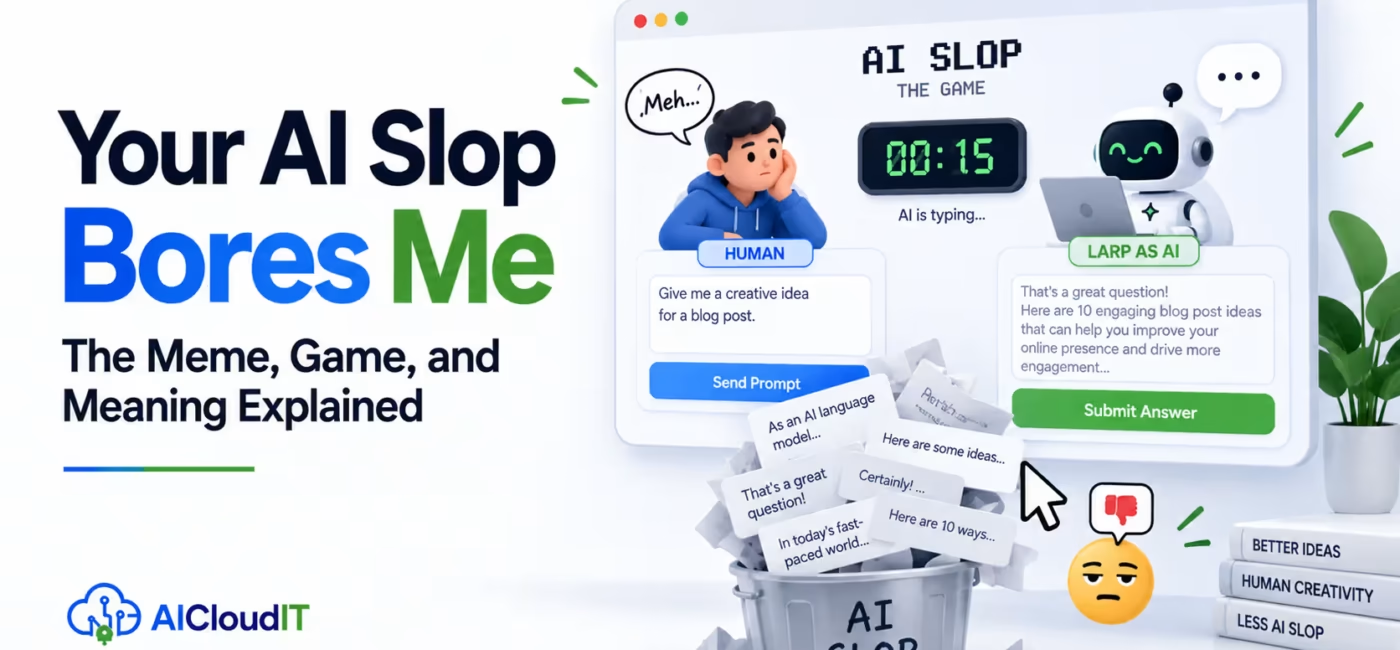
“Your AI Slop Bores Me” is an online anti-AI catchphrase and a viral browser game launched in March 2026 by programmer Mihir Maroju at youraislopbores.me. The game flips the traditional chatbot experience: instead of an algorithm answering user inputs, random humans answer questions and draw sketches under a 75-second timer while pretending to be an artificial intelligence. During its launch week, the project recorded 50 million page views and 16,000 concurrent players.
I spend most of my work days analyzing search systems, generative workflows, and content quality. Over the last 2 years, automated output has flooded search indexes and social feeds. When thousands of creators publish text generated from identical prompts, readers notice quickly.
“Your AI Slop Bores Me” captured that public fatigue and turned it into an interactive cultural moment.
1st it serves as a dismissive reaction to uninspired machine-made images, articles, and social media posts. 2nd it is the name of an online browser game that parodies tools like ChatGPTand Claude.
Instead of sending your query to a machine learning cluster, the website sends your text or drawing prompt to an anonymous person connected to the server. That player must respond while imitating an automated chatbot.
If you ask for a relationship guide, another person types out advice in real time. If you request a picture of a cat playing guitar, they sketch it on a basic digital canvas with a mouse or touchscreen.
What does “AI slop” mean?
The word “slop” describes low-effort, mass-produced digital material made with generative AI. It appears across feeds as synthetic clickbait pictures, robotic social media updates, and shallow blog summaries built purely to target keywords.
The public pushback is not about technology itself. The problem is predictable, formulaic writing. Automated drafts often carry repetitive rhythm, constant politeness, and zero original perspective. When web users see those patterns repeatedly, they look for AI content detector tools to filter out the noise.
According to a national survey by Elon University’s Imagining the Digital Future Center, 52% of American adults use AI large language models, making it one of the fastest adoption rates in technology history. Yet that same report noted that 35% of users feel frustrated or confused by these systems, and 33% worry about becoming too dependent on them. The game taps straight into that shared cultural fatigue.
Where did the ‘Your AI Slop Bores Me’ phrase come from?
The phrase started as a reaction image months before the website went live.
On October 17, 2025, the Facebook community page Artists Against Generative AI posted an adapted version of the older “Your Politics Bore Me” meme. The original template featured a photograph of a young boy sitting on a tall throne constructed from soda cases. In the modified version, the text read: “Your AI slop bores me.”
Within 5 months, the Facebook post gathered 4,300 reactions and 3,200 shares. Commenters began dropping the image directly under AI art shares, synthetic video clips, and automated marketing copy. It became an instant visual shortcut for telling someone their automated creation was bland.
October 2025: Artists Against Generative AI posts the soda-throne meme │ ▼ Late 2025 – Early 2026: Phrase spreads across Reddit, X, and Tumblr │ ▼ March 2, 2026: Mihir Maroju launches youraislopbores.me │ ▼ Mid-March 2026: 50 million page views and mainstream press coverage
How does the browser game work?
In early March 2026, programmer Mihir Maroju released the browser project at youraislopbores.me.
The site uses a credit system to keep participation balanced. When you join, you receive 1 free starting credit. Submitting a prompt costs 1 credit. If your credit count drops to 0, the platform gives you 2 credits every 10 minutes up to a cap of 6, or you can earn them immediately by answering other players’ prompts.
Here is how a round runs:
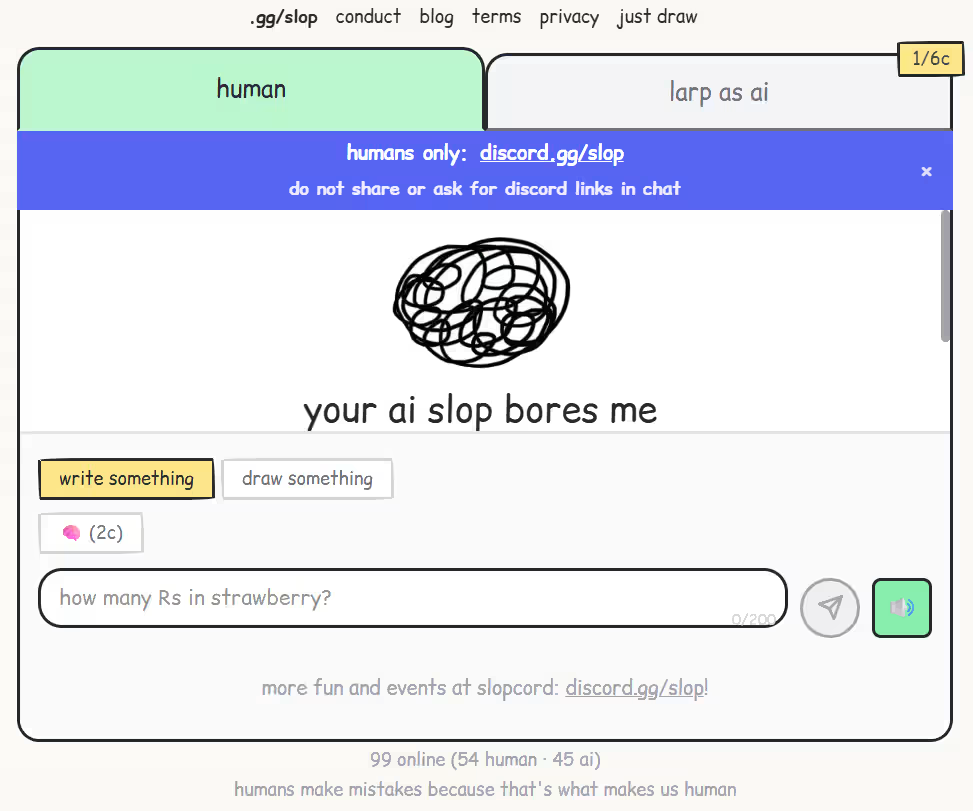
Submit a prompt: You type a text question or ask for a drawing.
Match with another player: The platform pairs your prompt with an active user in the queue.
Answer under a timer: The responder gets 75 seconds to type a reply or draw an image. Prompters can spend 2 credits to activate “thinking mode,” which gives the responder 150 seconds for complex requests.
Choose between writing and drawing: Users can type out text or use a freehand canvas depending on what the prompt asks for.
The maximum number of banked credits is capped at 10. This rule prevents players from hoarding credits without contributing back to the queue.
What does “LARPing as AI” mean?
LARP stands for Live Action Role-Playing. On the site, it means adopting the voice and mannerisms of an artificial assistant.
Players lean into recognizable habits from popular large language models. They start sentences with phrases like “Certainly! Here are 5 points to consider,” create lists, and maintain neutral tone. When drawing, users mimic the flaws of image generators by sketching hands with 7 fingers or adding chaotic background details.
The comedy comes from human limitations. A software model calculates answers across billions of parameters in seconds. A real person with 75 seconds on a countdown timer has to think quickly, guess facts, and type fast, which produces bizarre and funny results.
Why did the game go viral?
During its first week, youraislopbores.me recorded 50 million hits and sustained 16,000 concurrent players. The traffic surge briefly crashed the application’s servers when the host facility ran out of CPU cores.
Media outlets including Fast Company, Mashable, The Daily Dot, and Tom’s Guide covered the site. The popularity grew from 3 distinct factors:
Backlash against robotic content: Web users were exhausted by generic automated articles and synthetic social posts.
Unfiltered human humor: Real people produce strange, witty, and imperfect answers that software models never generate.
Shareable social screenshots: Players shared their funniest exchanges across X, Bluesky, and Tumblr.
A post from user @centipedehugs captured the early community push to get people involved:
“need more people to play this little browser funnie so it can be more fun and active. come larp as an ai to a human asking for a prompt.”
When someone asked for a picture of John Lennon, a player drew a minimalist stick figure in a stride pose, earning 24,000 likes on X within 24 hours. Another exchange showing an “AI” giving up halfway through explaining a math problem gained 41,000 likes.
In a March 2026 report by The Daily Dot on the game’s sudden rise, player @andykitkatt shared on X how the website stood out from regular chatbot platforms:
“The ‘your ai slop bores me’ site has given me such an appreciation for humanity and just being human. It’s such a beautiful thing my heart is warm and full of love.”
the “your ai slop bores me” site has given me such an appreciation for humanity and just. being human. it’s such a beautiful thing my heart is warm and full of love pic.twitter.com/nMCVCtH3x2
The site reminds people of early internet spaces like Cleverbot and Broken Picture Telephone. It uses simple Comic Sans text and plain boxes, focusing entirely on person-to-person interaction.
Who created the game?
Programmer Mihir Maroju built the project.
In an interview with Fast Company, Maroju explained that his motivation came from frustration with AI art and low-effort generic media filling the internet. He wanted to highlight that human creativity remains interesting precisely because it is unpredictable.
As the platform expanded past 10,000 concurrent players, Maroju brought on volunteers to build a moderation portal, set up a community Discord server, and write a code of conduct to keep user exchanges safe.
Your AI Slop Bores Me vs. standard AI chatbots
Putting the mechanics of the viral game alongside conventional AI models highlights why the project caught on:
Feature
Standard AI Chatbots
Your AI Slop Bores Me
Response Source
Large language models
Random human players
Response Time
1 to 3 seconds
75 to 150 seconds
Tone
Polished, polite, and predictable
Chaotic, funny, and improvised
Image Generation
Diffusion neural networks
Freehand mouse sketches
Primary Function
Task execution and answers
Satire, game play, and humor
Knowing how automated systems construct sentences helps businesses avoid publishing sterile text. If you want to understand how modern models generate language and where genuine utility begins, review our breakdown on agentic AI vs generative AI.
Frequently asked questions
Is Your AI Slop Bores Me actually powered by AI?
No. Every response and sketch on youraislopbores.me comes from another human player participating in real time.
How do you earn credits in the game?
You earn credits by answering prompts submitted by other users while roleplaying as an AI under a 75-second timer. The platform also gives you 2 credits every 10 minutes if your balance hits 0.
Can players draw pictures instead of typing?
Yes. The platform includes a freehand drawing canvas so players can sketch answers to image prompts.
If your team uses artificial intelligence to solve practical business problems rather than churning out generic filler, find our AICloudIT AI Tools Directory to find software evaluated for real-world work. If you have developed an application that provides genuine business utility, you can also list your AI tool to connect with our audience.
I'm Prabhakar Atla, an AI enthusiast and digital marketing strategist with over a decade of hands-on experience in transforming how businesses approach SEO and content optimization. As the founder of AICloudIT.com, I've made it my mission to bridge the gap between cutting-edge AI technology and practical business applications.
Whether you're a content creator, educator, business analyst, software developer, healthcare professional, or entrepreneur, I specialize in showing you how to leverage AI tools like ChatGPT, Google Gemini, and Microsoft Copilot to revolutionize your workflow. My decade-plus experience in implementing AI-powered strategies has helped professionals in diverse fields automate routine tasks, enhance creativity, improve decision-making, and achieve breakthrough results.