

Forecasting accuracy can jump to 85% when AI powers your business intelligence systems, far beyond what traditional analytics deliver. As data volumes explode and competitive pressure mounts in 2026, enterprises are turning to artificial intelligence to transform raw information into strategic advantage. This article walks you through AI’s specific technologies, realistic capabilities, implementation frameworks, and measurable business outcomes in modern BI environments.
Key takeaways
| Point | Details |
|---|---|
| AI enhances BI capabilities | Machine learning, natural language processing, and automation improve forecasting, speed data processing, and augment decision making. |
| Core technologies drive value | ML enables predictive analytics, NLP facilitates natural querying, and automation streamlines data preparation workflows. |
| AI augments, not replaces | Human analysts remain essential for oversight, context, and judgement despite AI’s advanced pattern recognition. |
| Phased adoption succeeds | Start with data audits, pilot projects, stakeholder alignment, and governance before scaling AI across BI systems. |
| Measurable ROI is proven | Organizations report 40% to 60% reductions in data prep time and significant gains in forecast accuracy. |
Introduction to AI in business intelligence
Business intelligence transforms raw data into actionable insights that drive strategic decisions. Traditional BI relies on historical reporting and manual analysis, but modern enterprises face data volumes that overwhelm conventional methods. Application of artificial intelligence introduces machine learning for pattern recognition, natural language processing for intuitive querying, and automation for data preparation. These technologies shift BI from reactive reporting to predictive, real time analytics. Market pressures in 2026 accelerate adoption as companies compete on speed and precision.
Several trends push AI integration into BI platforms. Data explosion from IoT sensors, social media, and transactional systems creates volumes impossible for human analysts alone to process efficiently. Business leaders demand instant insights to respond to market shifts, and competitors already deploying AI gain measurable advantages. Cloud infrastructure maturity lowers barriers to entry, making sophisticated AI tools accessible to mid market firms. Regulatory requirements around data governance simultaneously demand more rigorous analytics, which AI can support through automated compliance checks.
Key drivers include:
- Exponential growth in data volumes requiring automated processing
- Competitive pressure to deliver insights faster than rivals
- Cloud platforms reducing AI implementation costs and complexity
- Stakeholder expectations for predictive, not just descriptive, analytics
Core AI technologies enhancing business intelligence
Machine learning algorithms analyze historical patterns to forecast future trends with precision traditional statistics cannot match. These models identify non linear relationships in complex datasets, revealing insights human analysts might miss. Artificial intelligence tools enable BI systems to continuously learn from new data, refining predictions as market conditions evolve. Regression models predict sales, classification algorithms segment customers, and clustering techniques uncover hidden market segments.
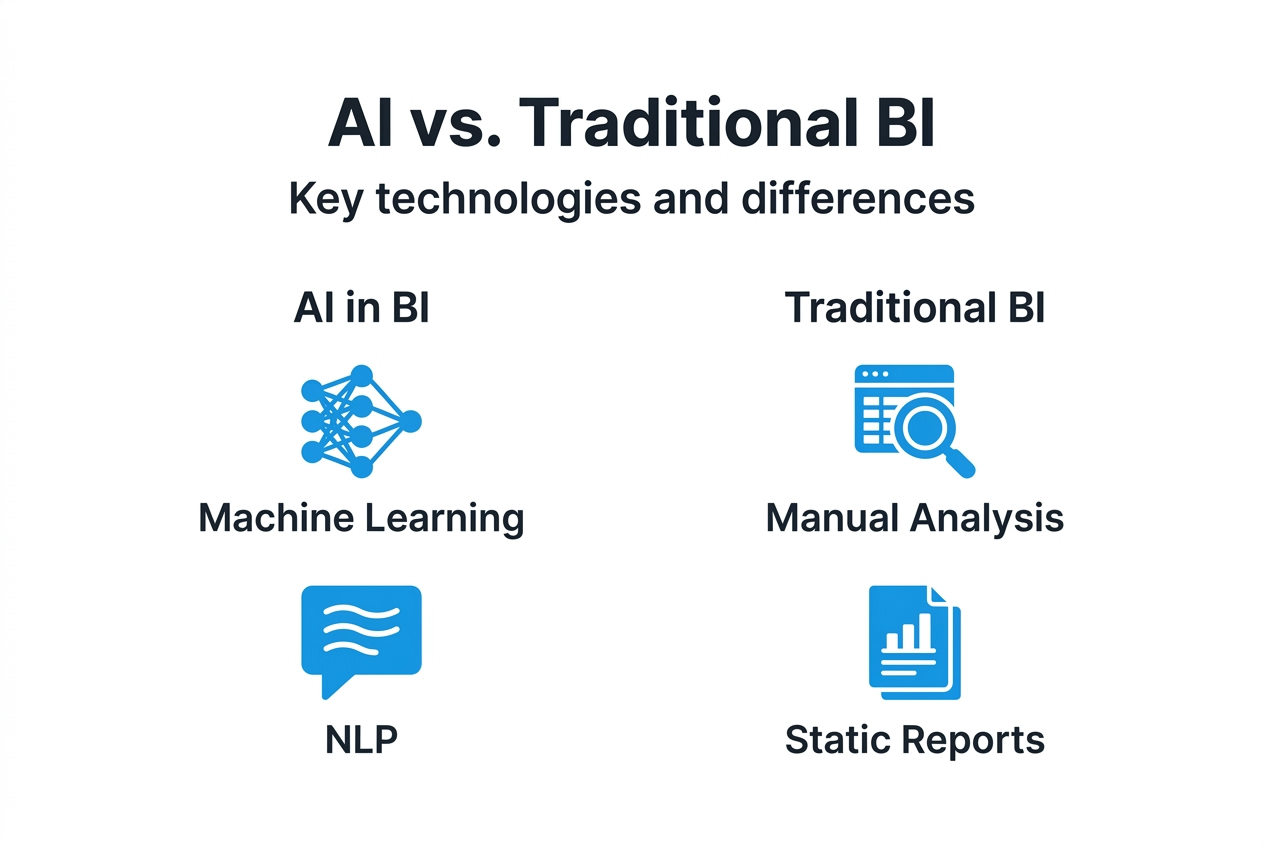
Natural language processing removes technical barriers between business users and data. Instead of writing SQL queries, stakeholders ask questions in plain English like “Which products drove Q4 revenue growth?” NLP engines parse intent, translate queries into database operations, and return visualized answers. This democratizes data access across organizations, letting marketing managers and operations directors explore insights without IT intermediaries. Voice activated BI dashboards further accelerate this trend in 2026.
Automation tackles the tedious data preparation work that consumes up to 80% of analysts’ time. AI driven tools cleanse inconsistent entries, validate data quality, and merge sources automatically. They flag anomalies requiring human review while handling routine transformations at scale. This frees BI professionals to focus on interpretation and strategy rather than spreadsheet wrangling. Automated data pipelines run continuously, ensuring dashboards reflect current reality.
Pro Tip: Start your AI journey with automation to quickly demonstrate value and build organizational confidence before tackling complex predictive models.
Key technologies driving BI advancement:
- Machine learning models delivering predictive insights from historical data
- Natural language interfaces lowering barriers to data access
- Automated data preparation reducing manual effort and errors
- Real time processing engines enabling instant analytics
How AI transforms data analysis and decision making in BI
Traditional forecasting relies on linear trends and seasonal adjustments, often missing complex interactions between variables. AI backed predictive analytics boost accuracy to 85%, surpassing conventional methods by recognizing subtle patterns in customer behavior, market dynamics, and operational metrics. Retailers use ML models to optimize inventory, anticipating demand spikes before they occur. Financial institutions detect fraud patterns invisible to rule based systems.

Speed separates winners from followers in modern markets. AI accelerates real time data processing by parallelizing computations across cloud infrastructure, delivering insights in seconds rather than hours. This enables dynamic pricing adjustments, immediate supply chain responses, and instant marketing campaign optimization. Organizations shift from reviewing yesterday’s performance to steering today’s operations based on current conditions.
Data fusion multiplies AI’s value by combining structured databases with unstructured sources like social media sentiment, customer reviews, and market reports. AI models synthesize these disparate inputs into unified intelligence. A product manager sees not just sales figures but customer satisfaction trends, competitive positioning, and emerging feature requests in one view. This contextual richness improves decision quality.
Crucially, AI augments rather than replaces human judgement. Algorithms surface insights and recommendations, but executives apply strategic context, ethical considerations, and industry expertise. The human AI partnership outperforms either alone, combining computational power with experience and intuition.
Transformative impacts include:
- Forecasting models capturing non linear patterns traditional methods miss
- Real time analytics enabling immediate operational responses
- Multi source data fusion providing comprehensive decision context
- Augmented intelligence enhancing human judgement with computational insights
Common misconceptions and realistic limitations of AI in BI
Many executives believe AI will eliminate BI analyst roles, but reality proves different. AI augments decision making rather than replacing human expertise. Analysts evolve from data gatherers to strategic interpreters who validate AI outputs, challenge assumptions, and provide business context algorithms cannot grasp. The most effective BI teams combine AI’s pattern recognition with human creativity and critical thinking.
Another myth suggests AI automates entire BI processes end to end. While automation handles data preparation and routine reporting, strategic analysis requires human oversight. Algorithms cannot understand organizational politics, industry nuances, or ethical implications of recommendations. AI might flag declining customer satisfaction, but experienced managers determine whether to adjust pricing, improve service, or revise product features.
Data biases and integration challenges limit AI autonomy in BI environments. Models trained on historical data perpetuate past biases, potentially reinforcing discriminatory patterns in hiring, lending, or resource allocation. Legacy BI systems often resist integration with modern AI platforms, requiring substantial middleware development. Data quality issues plague many organizations, and AI models amplify garbage in, garbage out problems.
“AI must be viewed as an augmentation tool that enhances human decision making capabilities, not an autonomous replacement that eliminates the need for experienced analysts and strategic thinkers.”
Realistic limitations to manage:
- AI inherits biases present in training data, requiring ongoing monitoring
- Integration with legacy systems demands technical investment and patience
- Human oversight remains essential for context, ethics, and strategic alignment
- Data governance challenges grow as AI consumes more diverse sources
Comparative frameworks for evaluating AI and traditional BI tools
Choosing between AI powered and traditional BI platforms requires structured evaluation. The table below compares key criteria:
| Criteria | AI BI Tools | Traditional BI Tools |
|---|---|---|
| Prediction Accuracy | 75% to 85% for complex patterns | 60% to 70% using statistical methods |
| Processing Speed | Real time or near real time | Batch processing, hourly to daily updates |
| User Accessibility | Natural language queries, voice interfaces | SQL knowledge or technical training required |
| Integration Complexity | Moderate to high, requires API and data pipeline work | Lower, established connectors for common sources |
| Cost and ROI | Higher upfront investment, faster long term ROI | Lower initial costs, incremental improvement |
AI powered BI tools outperform traditional options in prediction accuracy and speed but involve steeper learning curves. Organizations must weigh these trade offs against current capabilities and strategic priorities. A company with mature data infrastructure and skilled teams gains more from AI investments than one struggling with basic data quality.
Traditional BI excels in simplicity and predictability. Established tools offer proven reliability, extensive vendor support, and familiar interfaces. For organizations with stable reporting needs and limited data science resources, conventional platforms may suffice. However, competitive dynamics in 2026 increasingly favor AI adopters who extract insights faster and more accurately.
Pro Tip: Match BI tool selection to your organization’s data maturity level and avoid over engineering solutions that exceed current capabilities.
Key considerations for evaluation:
- Assess internal skills and training requirements before committing to AI platforms
- Calculate total cost of ownership including implementation, training, and ongoing maintenance
- Pilot AI tools on specific use cases to validate benefits before enterprise rollout
- Ensure vendor roadmaps align with your long term BI strategy
Practical steps and frameworks for implementing AI in BI systems
Successful AI integration starts with robust foundations. Establish clean, well governed data infrastructure before deploying models. Align stakeholders across IT, analytics, and business units on objectives and success metrics. Build AI literacy through training so teams understand capabilities and limitations. Define clear governance policies covering data access, model validation, and ethical use.
Phased AI integration ensures adoption success. Follow this stepwise approach:
- Conduct a comprehensive data audit identifying quality issues, gaps, and governance weaknesses
- Launch a pilot AI project in BI focusing on one high value use case with measurable outcomes
- Train BI users on new AI tools through hands on workshops and continuous support
- Establish ongoing governance including model monitoring, bias detection, and performance reviews
- Scale successful pilots across departments while maintaining rigorous oversight and feedback loops
Common pitfalls derail many AI initiatives. Organizations neglect data governance, discovering too late that poor quality inputs produce unreliable outputs. Teams overestimate AI autonomy, expecting plug and play solutions that actually require substantial customization. Lack of stakeholder buy in creates resistance when operational changes threaten established workflows.
Pro Tip: Engage cross functional teams early in the planning process and maintain transparent communication to build trust and avoid project delays.
Implementation best practices:
- Start with automation and quick wins to build momentum and demonstrate value
- Invest in change management to help teams adapt to new AI powered workflows
- Establish clear metrics for evaluating AI performance against baseline BI capabilities
- Create feedback channels so users report issues and suggest improvements
- Document lessons learned from pilots to accelerate subsequent deployments
Quantifiable business impact and future outlook of AI in BI
AI driven BI reduces data prep time by up to 60%, freeing analysts to focus on strategic interpretation rather than manual cleansing. This productivity gain translates directly to faster insights and better resource allocation. Forecasting accuracy improvements of up to 85% enable more confident inventory decisions, reducing waste and stockouts simultaneously. Marketing teams optimize campaigns in real time, improving conversion rates by 20% to 40% in documented cases.
Enterprise ROI from AI led BI initiatives shows measurable returns within 12 to 18 months for most organizations. Retailers report margin improvements through dynamic pricing, manufacturers reduce downtime via predictive maintenance, and financial services detect fraud faster while cutting false positives. AI adoption increases business agility, enabling faster responses to market shifts and competitive moves.
Decision cycles accelerate dramatically with real time analytics. Executives review current performance during morning meetings rather than waiting for yesterday’s reports. Supply chain managers reroute shipments based on weather predictions and demand signals. Product teams test pricing strategies and measure results within hours.
Emerging AI trends in 2026 point toward explainable AI models that reveal reasoning behind recommendations, building user trust. Deeper integration with BI governance automates compliance reporting and audit trails. Hybrid human AI workflows evolve as interfaces become more intuitive and collaborative. Edge AI brings analytics closer to data sources, reducing latency for IoT and mobile applications.
Future AI BI potentials and challenges:
- Explainable AI increases transparency and builds confidence in model outputs
- AutoML platforms democratize model building beyond data science specialists
- Federated learning enables insights across organizations while preserving data privacy
- Quantum computing may revolutionize optimization problems in supply chain and logistics
- Ethical AI frameworks become mandatory as regulatory scrutiny intensifies
Explore AI powered business intelligence solutions
AICloudIT helps organizations navigate the complexities of integrating AI into business intelligence systems. Our platform delivers tailored solutions that align with your unique data landscape and strategic objectives. Whether you need predictive analytics, automated reporting, or natural language interfaces, we provide expert guidance and proven tools. Visit AICloudIT to discover how AI powered BI transforms your decision making capabilities and competitive position. Our team accelerates implementation while avoiding common pitfalls that delay ROI. Start your AI journey with partners who understand both the technology and your business challenges.
FAQ
What are the main AI technologies used in business intelligence?
Machine learning, natural language processing, and AI driven automation represent the primary technologies powering modern BI systems. Machine learning enables predictive analytics that forecast trends and identify patterns. NLP allows users to query data using everyday language rather than technical SQL. Automation streamlines data preparation by cleansing, validating, and merging sources without manual intervention.
Can AI fully replace BI analysts in the decision making process?
AI enhances analyst productivity and decision quality but does not eliminate the need for human expertise. Algorithms excel at pattern recognition and processing speed, while humans provide strategic context, ethical judgement, and industry knowledge. The most effective BI teams combine AI’s computational power with experienced analysts who interpret results and guide organizational responses.
What are the biggest challenges when integrating AI into BI systems?
Ensuring data quality and governance prevents biased AI outputs that undermine trust and accuracy. Organizations must cleanse historical data and establish ongoing monitoring to catch errors early. Aligning IT and business stakeholders around objectives and success metrics avoids project delays and scope creep. Managing expectations prevents overreliance on AI autonomy, ensuring teams understand human oversight remains essential for strategic decisions.
How can organizations measure the success of AI adoption in BI?
Track reduction in data preparation time, improvements in forecasting accuracy, and user adoption rates across departments. Monitor return on investment by comparing AI project costs against measurable business outcomes like margin improvements or efficiency gains. Measure reductions in data bias incidents and compliance violations to ensure governance objectives are met. Survey users regularly to assess satisfaction with new AI powered workflows and identify areas needing additional training or support.
Recommended
- Role of AI in Decision Making: Enterprise Impact
- application of artificial intelligence Archives – AICloudIT
- Role of AI in Business: Unlocking Efficiency and Growth
- AI Archives – AICloudIT
- 7 Key Advantages of AI in Sales for B2B Success
