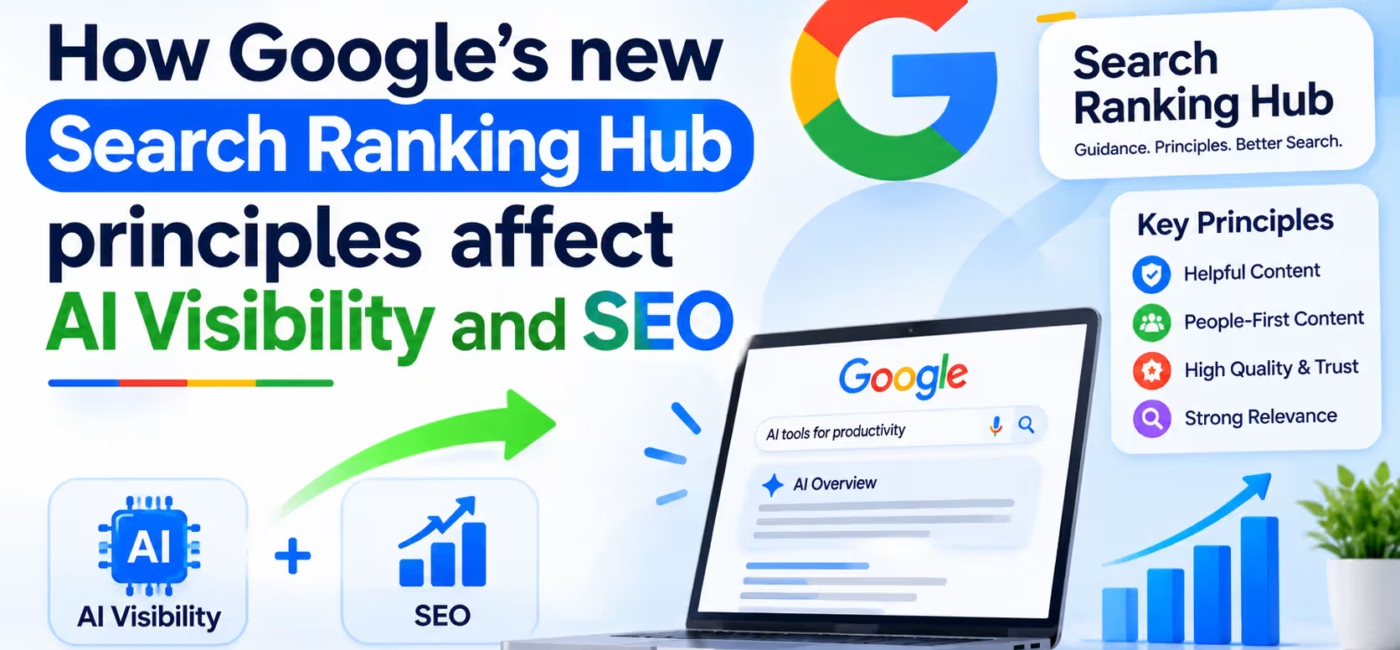
How Google’s new Search Ranking Hub principles affect AI visibility and SEO
Google’s new Search Ranking Hub, launched on November 24, 2026, confirms that classic blue links, AI Overviews, and AI Mode all rely on the same core ranking systems and usefulness standards. There are no separate rules or special shortcuts for earning AI citations. A November 2026 Surfer AI study of 405,576 searches found that 52% of pages cited in AI Overviews also rank in the top 10 organic results.
Google changed how it documents search rankings on November 24, 2026. The company published the Google Search Ranking Hub, along with a dedicated page covering its ranking principles and fresh documentation on how links are selected in AI Overviews and AI Mode.
If you run a website or manage SEO, you have probably seen dozens of competing theories about getting cited by AI search features. Some writers rely on custom markdown files, while others chase new formatting tricks every month.
I read through the new documentation as soon as it went live. Here at AICloudIT, we spend a lot of time testing how traditional search connects with generative AI features, and this update clears up a lot of the guesswork.
What Google added in the Search Ranking Hub
The hub brings Google’s ranking documentation, Status Dashboard notices, and update feedback channels into one central page. Google also started preannouncing major algorithm changes there, beginning with the December 2026 core update, as reported in Search Engine Roundtable’s breakdown of the launch.
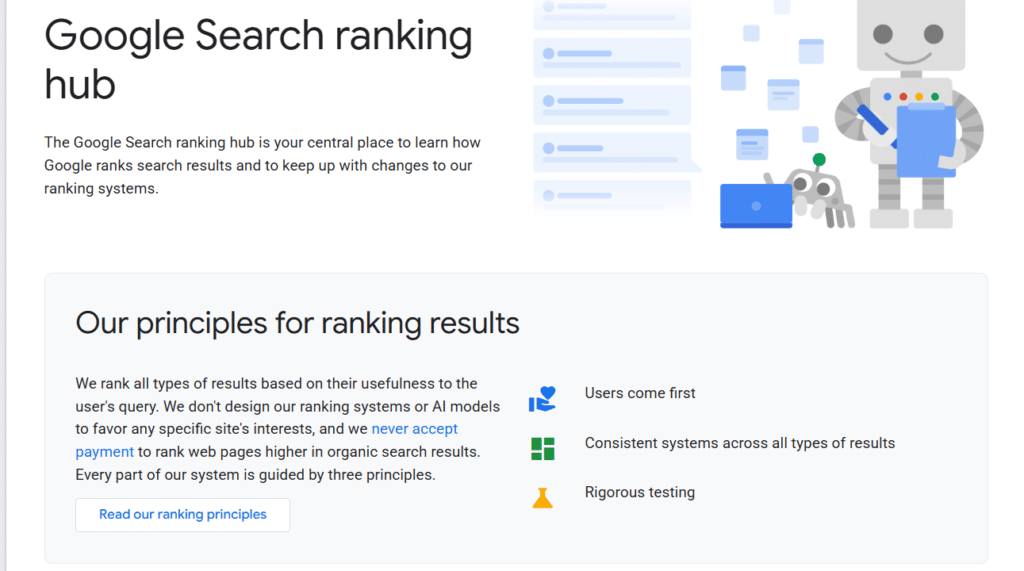
Users come first: Google ranks pages to give searchers helpful, reliable answers rather than favoring specific websites.
Consistent systems across all result types: Classic web listings, AI Overviews, AI Mode, images, videos, and carousels are judged by the same usefulness criteria from Google’s Search Quality Rater Guidelines. No result type gets preferential treatment, and payment never influences organic rankings.
Rigorous testing: Every ranking update goes through live utility measurements and quality rater checks before rollout.
Google also clarified how the Google-Extended crawler control works. Blocking Google-Extended controls whether your content is used for model training, not whether your site appears in Search results or AI grounding. Using it does not remove your pages from Google Search and is not a ranking signal.
You can see why foundational SEO still mattersso much right now. Google put in writing that AI search features sit directly on top of its core ranking and quality systems.
How AI Overviews and AI Mode pick which pages to cite
Alongside the hub, Google published a guide on attribution and factuality in Search generative AI features, detailed in Barry Schwartz’s analysis of AI link selection. It explains the exact 4-stage pipeline Google uses to pull and display links:
Ranked search results: For AI Overviews, Google first checks the ranked organic pages for the query and passes relevant snippets to the model.
Query fan-out: The model may run related sub-queries across Google’s index to find pages that answer different parts of a complex question.
Grounding and corroboration: The model writes its answer from those retrieved pages and attaches links to sources that back up specific statements.
Display selection: Google decides which supporting links to show (as inline icons, source cards, or carousels) based on relevance, quality, source variety, and screen space on mobile or desktop.
So, what does this mean for smaller websites? Smaller sites can still earn citations when a page answers a specific sub-question clearly.
In its November 2026 study of 405,576 English AI Overviews, Surfer AI found that 52% of cited sources ranked in the top 10 organic results, sitting around position 5 on average. In 69% of cases, the top-10 domains had higher overall traffic than the domains cited inside the AI Overview.
That tells me authority still helps you enter the source pool, yet clear, specific answers on a subtopic can still win a citation over a bigger domain. If you want to go deeper into how models retrieve sources, we also covered practical strategies to get ranked in LLMs and increase traffic.
Why click behavior raises the stakes for citations
AI summaries have already changed how often people click traditional links. A Pew Research Center study of 68,879 Google searches across 900 U.S. adults shows the gap clearly:
Search behavior metric
With AI summary
Without AI summary
Clicks on traditional search results
8% of visits
15% of visits
Clicks on links inside the AI summary
1% of visits
N/A
Browsing session ended without a click
26% of visits
16% of visits
Query phrasing also drives how often an AI summary appears. In the same Pew Research dataset, 60% of searches starting with question words (“who,” “what,” “when,” or “why”) and 53% of queries with 10 or more words produced an AI summary, compared to just 8% of 1-word or 2-word searches.
I’ve noticed this exact shift on informational queries. Quick factual lookups rarely send traffic anymore. When someone clicks through from a modern results page, they usually want practical detail, verified data, or a brand they recognize from the citations. Tracking impressions and citations separately matters now, which is why we broke down the core AI search visibility metrics and KPIs teams should monitor.
How Google’s 5 ranking signals apply to your content
Google’s How Search Works page on ranking results breaks automated evaluation down into 5 core signals. Because AI Overviews and AI Mode draw directly from those same systems, every article you publish needs to pass all 5 checks.
1. Meaning of the query
Google’s language models match search intent and synonyms even when exact words differ. Someone searching “change laptop brightness” still gets pages written around “adjust laptop brightness.”
Write around the real problem and use natural phrasing. Cover the follow-up questions a reader asks next instead of repeating one exact keyword phrase in every paragraph.
2. Relevance of content
Matching keywords in headings and body copy is just the basic check. Google’s systems look for supporting material that proves a page answers the topic properly, including examples, comparisons, and structured details.
Surfer AI’s November 2026 study found that 78% of AI Overviews include a list (61% unordered, 12% ordered, and 6% both), with an average answer length of 157 words. Clear subheadings and concise explanations make individual claims easy for both readers and retrieval systems to verify.
3. Quality of content (E-E-A-T)
After finding relevant pages, Google prioritizes sources showing experience, expertise, authoritativeness, and trustworthiness. In its new attribution guidance, Google specifically points to clear sourcing, visible author credentials, an About page, and factual accuracy.
Every statistic needs a primary source next to it. Double-check product names, dates, and numbers before hitting publish, especially if AI tools assisted with research or outlining.
4. Usability of content
When relevance and quality are close between two pages, the page that loads fast and reads cleanly on mobile wins. Keep paragraphs short, put the direct answer at the top, and use tables or bullet lists when they genuinely make comparisons easier to scan.
5. Context, freshness, and firsthand perspective
Freshness carries heavier weight on fast-changing subjects like AI models, software updates, and SEO policies. Update articles when real facts change, and leave the publish date alone when you only make minor wording tweaks.
Google has also been vocal about putting real human voices and preferred sources in front of searchers. A post from Nick Fox, Google’s SVP of Knowledge and Information, sums up that direction directly:
“One of the areas we’ve been pushing on in Search is making it easy for you to find relevant sites, first-hand perspectives, and content from sources you love.” (Nick Fox,@thefox on X)
One of the areas we’ve been pushing on in Search is making it easy for you to find relevant sites, first-hand perspectives, and content from sources you love. And we’re seeing that this work is resonating – the number of people who’ve used Preferred Sources to select sites they… pic.twitter.com/87xjPMVR6O
That matches what Google published in the new Search Ranking Hub. Sharing genuine practitioner experience and building a recognizable site gives users a clear reason to pick your brand over generic summaries.
Practical steps for SEO and AI visibility
If you want your site ready for both classic rankings and AI citations under these updated principles, focus on 5 concrete actions:
Confirm technical eligibility: Make sure your key pages are indexed, allow standard search snippets, and stay included in Search generative AI features inside Google Search Console.
Check the Generative AI performance report: Review which pages already show up in Search Console’s generative AI data, and use dedicated tracking when you need query-level detail. Our guide on comparing AI search tools and our list of SEO tools for ranking on Google can help you choose the right stack.
Consolidate sub-questions into thorough pages: Google’s spam policies target scaled content abuse, including publishing dozens of thin pages for slight keyword variations. Answer related sub-questions cleanly inside one well-structured article so query fan-out has strong passages to cite.
Put verifiable answers first: Start key sections with a direct 1-sentence or 2-sentence answer before adding nuance, examples, or caveats.
Audit author trust signals: Make sure every article links to a real author bio, cites primary external data, and shows accurate last-updated dates only after substantive edits.
Practical takeaway
Google’s Search Ranking Hub closes the gap between traditional SEO and AI visibility. Classic rankings, AI Overviews, and AI Mode now share the same bar: technical access, direct utility, verified facts, and genuine human perspective.
From my experience, sites hold their visibility through core updates when they stop chasing temporary formatting gimmicks and focus on publishing answers a reader would actually trust and bookmark. Pick your top 10 informational pages this week, check them for outdated claims, tighten the opening answers, and make your sourcing and author details unmistakable.
If you are looking for software to speed up research, audits, or content workflows, browse the AICloudIT AI Tools Directory to compare tools across categories. If you built an AI tool yourself, you can submit your AI tool on AICloudIT to reach marketers, developers, and business owners looking for practical solutions.
For more context straight from Google’s Search Relations team on how generative features fit into traditional search, watch How AI Is Changing Google Search and SEO.
I'm Prabhakar Atla, an AI enthusiast and digital marketing strategist with over a decade of hands-on experience in transforming how businesses approach SEO and content optimization. As the founder of AICloudIT.com, I've made it my mission to bridge the gap between cutting-edge AI technology and practical business applications.
Whether you're a content creator, educator, business analyst, software developer, healthcare professional, or entrepreneur, I specialize in showing you how to leverage AI tools like ChatGPT, Google Gemini, and Microsoft Copilot to revolutionize your workflow. My decade-plus experience in implementing AI-powered strategies has helped professionals in diverse fields automate routine tasks, enhance creativity, improve decision-making, and achieve breakthrough results.