
I’ve been architecting distributed systems for over 15 years, starting with the heavy SOAP/XML days of early SOA when services felt more like academic theory than production reality. Fast forward to 2026, and SOA OS23 finally delivers what Service-Oriented Architecture promised all those years ago, a practical, scalable framework that bridges enterprise complexity with cloud-native speed.
This isn’t just “SOA 2.0” hype. OS23 is a specific evolution that actually works in messy real-world environments, balancing business alignment with technical excellence. Whether you’re untangling a legacy monolith or building greenfield cloud systems, this guide gives you the blueprint.
What Is SOA OS23?
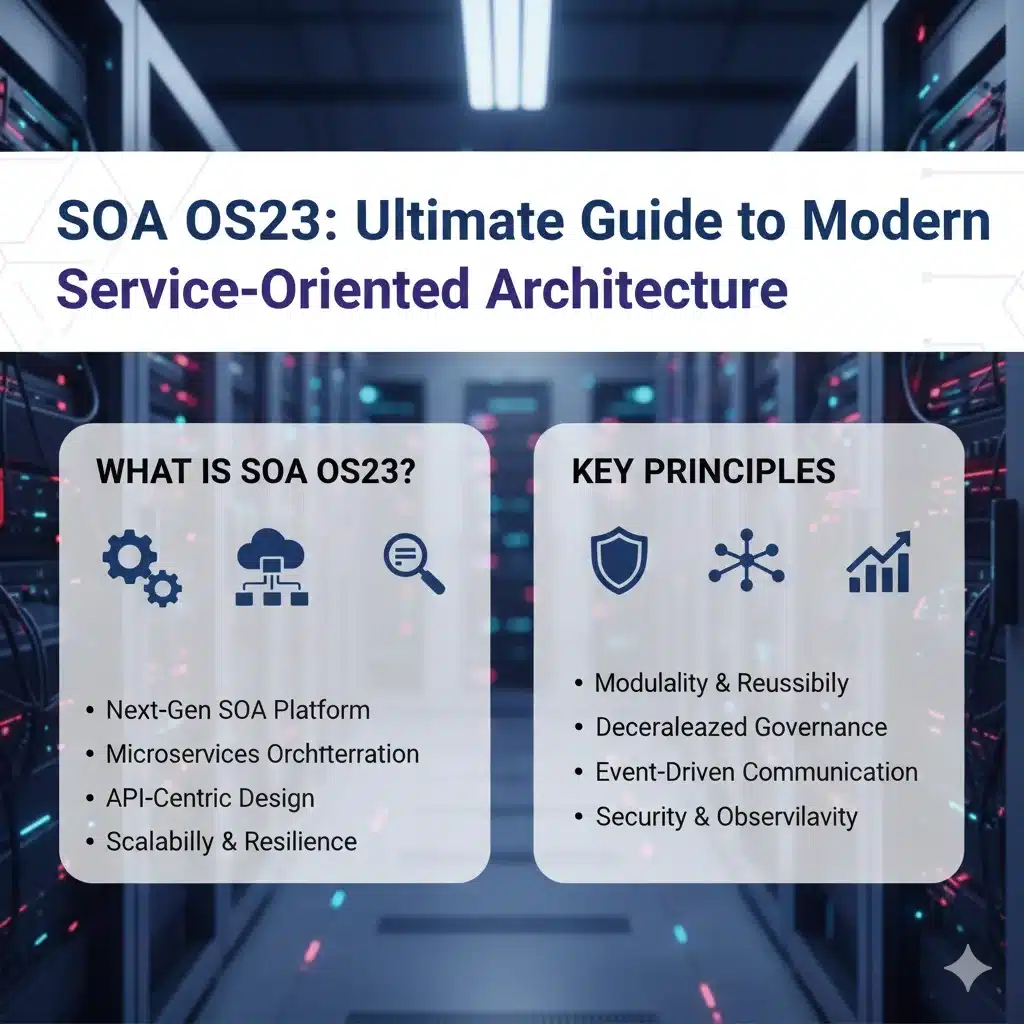
SOA OS23 refers to Service-Oriented Architecture Open Standard 2023, a modern specification that updates SOA principles for containerized, cloud-native deployments. Launched as an industry response to microservices chaos, OS23 standardizes how services communicate, scale, and observe each other in production.
Unlike traditional SOA’s Enterprise Service Buses (ESBs) and rigid contracts, OS23 emphasizes:
- Lightweight protocols (REST, GraphQL, gRPC)
- Service mesh patterns for traffic management
- Business capability boundaries over technical decomposition
- Cloud-native runtime support (Kubernetes, serverless)
How It Evolved From Traditional SOA?
Classic SOA (2000s) promised reusability but delivered coupling hell. Here’s the evolution:
| Era | Communication | Orchestration | Deployment | Governance |
|---|---|---|---|---|
| Classic SOA (2005) | SOAP/XML over HTTP | Centralized ESB | Monolithic WAR/EAR | WSDL contracts |
| Microservices (2015) | REST/JSON | Choreography | Docker Swarm | Anarchy |
| SOA OS23 (2023+) | REST/GraphQL/gRPC + Events | Service Mesh | Kubernetes | OpenAPI + AsyncAPI |
OS23 keeps SOA’s business alignment (services = business capabilities) but ditches the XML baggage for modern tooling.
SOA OS23 in Modern Architecture Trends
OS23 sits at the “Goldilocks zone” between:
- Monoliths: Too slow to change
- Microservices: Too fragmented
- Event sourcing: Too complex for most
It converges with Domain-Driven Design (services = bounded contexts), Kubernetes (runtime), and service mesh (networking), making it perfect for hybrid cloud migrations.
Learn about: What Is Cloud Architecture
Core Features of SOA OS23
Modular & Reusable Services
OS23 services map directly to business capabilities, not technical layers. Examples:
Payment Processing Service
├── Handles all payment flows (credit card, ACH, crypto)
├── Owns payment data
├── Exposes APIs + events
└── Deployed independently
Why this matters: A 500k-line monolith becomes 15-20 focused services. Each team owns their capability end-to-end.
API-First Communication
Contract-first development using:
- OpenAPI 3.1 for REST APIs
- AsyncAPI for event schemas
- GraphQL for federated queries
- gRPC for high-performance internal calls
apiVersion: v1
services:
  - name: "customer-onboarding"
    endpoints:
      - path: "/v1/customers"
        method: POST
        contract: "openapi-customer-v1.yaml"
      - events:
        - "customer.created"
        - "customer.verified"
Cloud-Native Support
OS23 assumes containers-first:
├── Docker for packaging
├── Kubernetes for orchestration
├── Helm charts for service deployment
├── Knative for serverless functions
└── Istio/Linkerd for service mesh
Multi-cloud portability via CNCF standards ensures you’re not locked into AWS, Azure, or GCP.
Observability & Monitoring
Four Golden Signals baked into every service:
Latency: p95 < 200ms
Traffic: RPS per service
Errors: < 0.1% failure rate
Saturation: CPU/Memory < 80%
Implementation stack:
Metrics: Prometheus + Grafana
Traces: OpenTelemetry + Jaeger/Tempo
Logs: Loki + Promtail
Alerts: AlertManager
Built-in Security (Zero-Trust)
├── mTLS between all services (SPIFFE/SPIRE)
├── JWT validation at API gateways
├── RBAC + ABAC via OPA (Open Policy Agent)
├── Secrets via Vault + CSI drivers
└── Network policies (Calico/Cilium)
Do you know: Demystifying the Large Language Model Architecture
Benefits of SOA OS23:
- Scale services independently: Payment service handles Black Friday without touching inventory
- Faster deployment cycles: Teams own their services end-to-end (no monolith bottlenecks)
- Interoperability: Legacy mainframes expose OS23 services via adapters
- Cloud alignment: Native support for serverless (AWS Lambda), FaaS, and spot instances
How SOA OS23 Works (Architecture Patterns)?
Frontend (React/Vue)
    ↓ API Gateway (Kong)
    ↓ Load Balancer
Service Mesh (Istio)
    ├── Customer Service (Node.js)
    ├── Order Service (Java/Spring)
    ├── Payment Service (Go)
    └── Inventory Service (Python)
Database per service (CockroachDB, Aurora)
Event Bus (Kafka)
Communication Patterns
- Synchronous: REST/GraphQL via service mesh
- Asynchronous: Kafka events for decoupling
- Saga Pattern: Distributed transactions across services
Order Service:
1. Reserve inventory → Inventory Service (sync)
2. Process payment → Payment Service (sync)
3. Emit "order.confirmed" → Event bus
4. Customer Service reacts to event
CI/CD Per Service
Service repo → GitHub Actions → ArgoCD → Kubernetes
Independent pipelines, zero coordination
Real-World Use Cases
Enterprise IT: Bank of America-style core banking modernization
Healthcare: HL7 FHIR services for patient data exchange
Finance: Real-time fraud detection + transaction services
IoT: Edge services + cloud aggregation
SOA OS23 Compared to Other Architecture Styles
| Metric | Monolith | Microservices | SOA OS23 |
|---|---|---|---|
| Service Count | 1 | 100-500+ | 10-50 |
| Team Size | 50-200 devs | 2 devs/service | 5-15 devs/service |
| Deployment | Monthly | Daily per service | Daily per capability |
| Complexity | Low | Extreme | Medium |
| Business Alignment | Poor | Variable | Excellent |
SOA OS23 vs Microservices: Same technical patterns, but OS23 enforces business capability boundaries and governance.
SOA OS23 vs Serverless: Use OS23 services for stable workloads, FaaS for burst/spikes.
Do you know: How An AWS Multi-Region Architecture Can Strengthen DR?
Implementation Best Practices
1. Domain Discovery Workshop
Business stakeholders → Capability map
Customer Journey → Service boundaries
Avoid: Technical slicing (by layer)
2. Platform Team Setup
Golden Path APIs (SDKs, templates)
Self-service provisioning
Observability platform
Security guardrails
3. Progressive Rollout
Phase 1: Customer service (read-heavy)
Phase 2: Order service (transactional)
Phase 3: Payment service (critical)
Strangler pattern for monolith
Toolstack Recommendations
🎯 Orchestration: Kubernetes + ArgoCD
🌐 API Gateway: Kong/Ambassador
🛡️ Service Mesh: Istio (production) / Linkerd (simpler)
📊 Observability: Prometheus + Grafana + Jaeger
📨 Events: Kafka + Knative
🔐 Security: OPA + SPIRE + Vault
Challenges & Solutions
| Challenge | Impact | Solution |
|---|---|---|
| Distributed Tracing | Debugging hell | OpenTelemetry auto-instrumentation |
| Data Consistency | Eventual consistency confusion | Saga pattern + outbox |
| Service Ownership | Coordination tax | Platform team + golden paths |
| Legacy Integration | Migration paralysis | Strangler adapters |
Also check the: Top AI Cloud Business Management Platform Tools
Future Trends for SOA OS23
AI Service Orchestration
ML predicts traffic patterns
Auto-scales services preemptively
AI-driven circuit breaking
WebAssembly Integration
Polyglot services in Wasm runtime
Python + Go + Rust in single pod
Faster cold starts than containers
GitOps Everywhere
ArgoCD/Flux as deployment standard
Infrastructure + services = code
Audit trail for everything
Feature Comparison Table
| Feature | Classic SOA | Microservices | SOA OS23 |
|---|---|---|---|
| Protocol | SOAP/XML | REST/JSON | REST/GraphQL/gRPC + Events |
| Orchestration | ESB | None | Service Mesh |
| Contract | WSDL | OpenAPI | OpenAPI + AsyncAPI |
| Observability | Custom | Varies | 3 Pillars (OTel standard) |
| Security | Network-level | Per-service | Zero-trust (mTLS + OPA) |
| Deployment | Monolith | Per-service | Kubernetes + GitOps |
Industry Use Case Matrix
| Industry | Primary Services | Key Benefits |
|---|---|---|
| Finance | Payments, Risk, Compliance | Regulatory compliance + real-time fraud |
| Healthcare | Patient, Billing, Scheduling | FHIR standards + HIPAA security |
| Retail | Inventory, Orders, Pricing | Black Friday scale + personalization |
| Manufacturing | Production, Supply Chain, Quality | Real-time IoT + predictive maintenance |
Frequently Asked Questions
Monolith scalability limits, microservices governance chaos, legacy modernization paralysis.
Absolutely. Start with 3-5 capability services. Avoid premature microservices optimization.
Teams own complete services (data + logic + API). Independent deployments. Platform team handles cross-cutting concerns.
Complex domains with regulatory requirements: finance, healthcare, manufacturing, logistics.
Use OS23 if you need business alignment + governance. Pure microservices if you’re all-in on tiny services + chaos engineering.
Disclaimer: Architecture decisions depend on your specific business context, team maturity, and technical constraints. This guide reflects SOA OS23 best practices as understood in early 2026.
