
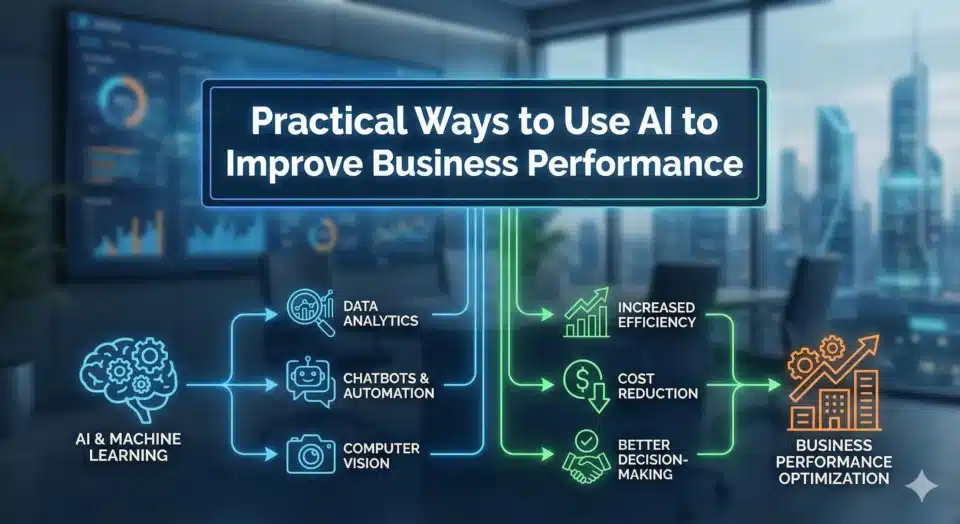
Artificial intelligence (AI) is no longer some futuristic ideal but the reality of the present that’s revolutionizing the way business organizations around the world conduct their operations. Especially in the modern business world of today, whether it’s the small business or the multinational company, the need to implement AI in their strategy or business approach has become a great pressure on all organizations to stay ahead in the competition.
This blog will examine five ways to use AI effectively to improve business performance. We will discuss how AI technology not only has the potential to move beyond the realm of pure concepts but also how success, despite the potential offered by technology itself, requires technology to be implemented strategically along with an emphasis on people.
Well-designed AI courses for employees ensures teams understand how to work alongside AI systems, apply insights effectively, and maximize the value of AI initiatives. When advanced technology is paired with the right skills and learning culture, businesses are better positioned to turn AI into a sustainable competitive advantage.
Find the: 7 Key Advantages of Generative AI for Businesses and Tech Leaders
What does AI mean for business?
AI for business is the application of intelligent machines to replicate cognitive functions and processes like learning, problem-solving, and decision-making, which are similar to those of the human brain. In the context of business, AI refers to the use of technology to automate complex business operations, derive meaning from massive sets of data, forecast market trends, and leverage customer experiences. In essence, the primary objective of AI for business is to increase efficiencies, innovate, improve decision-making, and create business growth opportunities. Falling under the AI umbrella is machine learning.
Uses of AI in improving business performance
1. Automate Customer Service and Support Operations
AI is changing the face of customer service by dealing efficiently with large volumes of work and varying levels of quality. Chat robots, developed through AI, allow instant support, 24/7, responding to frequent inquiries, as well as making payments, which has greatly improved response times. Then, of course, AI interprets consumer inquiries, routing challenging calls to top human agents. Then, it examines consumer support calls.
This enhances efficiency, reduces operational expenses, and benefits humans to concentrate on complex, empathetic problem-solving. In the end, AI lets businesses achieve consistent support on a large scale, thus increasing customer satisfaction.
2. Boost Software Development Productivity
To contemporary businesses, software applications are essential to their operations, products, and services, and the effective development of these applications is critical to businesses’ performance and scalability. The use of artificial intelligence is revolutionizing the development of software applications, as it aids teams in coding, debugging, and documentation. AI coding assistants have the ability to speed up the development process as they are able to generate, complete, and make suggestions using natural language inputs or patterns.
In addition to coding, AI improves quality by analyzing error reports, identifying vulnerabilities in codes, and suggesting repairs using information gathered by analyzing a large number of codes. Documentation tools ensure that the files are up to date as the codes change. With AI acting as a supplement to human knowledge instead of a replacement for it, releasing and developing quality software becomes faster and more reliable.
3. Enhance Marketing Content Creation and Campaign Performance
In today’s increasingly competitive digital landscape, the key to marketing success has become speed, personalization, and informed decision-making. AI makes it possible for marketers to fulfill these needs by accelerating content generation and optimizing campaign performance while still achieving a brand voice. Generative AI applications can help create a starting point for writing blogs, emails, social media updates, and advertisements according to brand voice and audience intent.
In addition to creating content, AI assists in enhancing performance using advance analytics. These predictive models predict outcomes for campaigns, ensuring optimal placement for ads, and targeting high-performing channels and messaging. AI-based sentiment analysis offers real-time insights from consumer sentiment and social media platforms. AI, when used in conjunction with human review, ensures enhanced targeting, improved efficiency, and better marketing ROI.
4. Transform Business Intelligence and Data Analysis
Data has also come to be called the “new oil” in some quarters. However, to fully understand the power of “data,” it needs to be analyzed or refined from its raw state in order to provide valuable insights. Most firms face the problems of manually analyzing their data, waiting for reports to come in, or even extracting significant patterns from their data.
AI systems leverage automated data processing, real-time reporting, and dynamic dashboards to continuously monitor key performance indicators. This saves substantial amounts of time otherwise spent compiling data, freeing up teams to focus on analysis, strategy, and execution. Advanced pattern recognition capabilities help discover trends, anomalies, and correlations not apparent through traditional analytics.
Perhaps the most significant role of AI is the support it provides to predictive analytics. With predictive analytics, businesses are able to examine past data related to sales and customer behavior to predict and plan for various aspects of the company. When combined in a business analysis plan, AI analytics powers businesses.
5. Build AI-Ready Workforce Capabilities Through Training
It is impossible for the most advanced technologies in AI to produce significant results if the workforce is not adequately trained to utilize them. The creation of an AI-ready workforce through training is a sine qua non to improve the effectiveness of the business in the AI age. It is a matter of paramount importance for businesses to implement AI literacy workshops for employees to help them grasp the capabilities, limitations, as well as applications of AI, such as prompt engineering, knowledge of data, etc.
Amidst the automation of mundane work by AI, human talents like critical thinking, innovation, empathy, and complex decision-making are in high esteem. Learning should also be concentrated on change management, cross-functional work, and safe experimentation. Enhancement of human capital is important to ensure increased productivity, innovation, and business growth through AI.
The Path Forward
The process towards harnessing AI to optimize business performance is ever-evolving, and it involves striking a right balance of adopting technology, foresight, and ongoing human resource development. The five uses of AI in practice that involve automating customer service operations, enhancing software development capabilities, improving marketing, upgrading business intelligence, and preparing an AI-ready workforce are high-impact fields that are poised to begin reaping positive results in this area. A major catalyst in this process is to develop an AI-ready workforce with training in Artificial Intelligence courses.
In the AI age, success will not be achieved by replacing human resources with technology. Instead, it will be achieved by leveraging technology to enable human resources. It is high time for businesses to adopt AI and initiate a culture of learning and development in terms of Artificial Intelligence courses to face current as well as new challenges and reach unprecedented heights of innovation and growth.
