
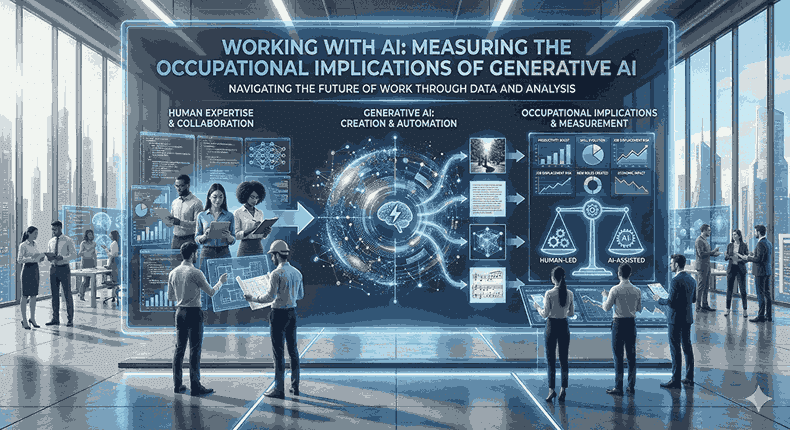
Generative AI is already embedded in everyday work. Not as a future concept, but as a present reality. The real challenge is not recognizing its existence. The challenge is measuring how it reshapes jobs, tasks, and skills without relying on oversimplified narratives.
Here’s how I picked the approach for this article.
Instead of asking whether AI replaces jobs, the focus stays on how work itself changes at the task level. That perspective produces far more accurate insights.
Working With AI: Measuring the occupational implications of generative AI requires moving beyond headline-driven fears and toward careful, task-level analysis that reflects how work actually changes in practice.
Rather than asking whether entire jobs will disappear, this perspective focuses on how generative AI reshapes specific activities inside roles, altering skill demands, productivity patterns, and human decision-making.
By examining exposure, partial automation and collaboration at the task level, organizations and policymakers gain a clearer understanding of where AI augments human effort, where it reallocates responsibilities, and why accurate measurement is essential for responsible workforce planning in an AI-enabled economy.
Why Measuring Occupational Impact Matters?
Before diving into frameworks or data, it helps to understand why measurement matters in the first place.
Why is generative AI different from earlier automation technologies?
Earlier automation focused on repetitive, predictable processes. Assembly lines, rule-based software, and basic scripts worked best when instructions were fixed.
Generative AI operates differently. It performs well in areas that rely on language, reasoning, interpretation, and synthesis. These are capabilities tied closely to professional and knowledge work.
That difference alone explains why generative AI affects office jobs more directly than past automation waves.
Why are job-level predictions often misleading?
Job titles hide variation.
Two people with the same title may perform very different tasks. When predictions focus only on occupations, they miss the first place change occurs, which is inside the task mix.
This is why job-level forecasts tend to exaggerate replacement and understate transformation.
Do you know: Generative AI Quilt Design
Generative AI in the Context of Work
Let’s dig in.
Understanding impact starts with clarity about what qualifies as generative AI and how it shows up in real workflows.
What counts as generative AI in workplace tasks?
In workforce research, generative AI refers to systems that can produce original outputs such as text, code, images, or structured reasoning based on prompts.
What matters is not the tool’s name. What matters is whether its capabilities overlap meaningfully with human tasks.
How is generative AI used across different types of work?
Usage patterns vary, but several themes appear consistently:
- Drafting and editing written content
- Summarizing information
- Supporting analysis and research
- Assisting with technical documentation
In practice, AI integrates into specific steps rather than replacing full workflows.
Generative AI vs Traditional Automation
Comparing generative AI to older automation helps clarify why measurement is difficult.
How does generative AI automate tasks differently?
Traditional automation executes predefined rules. Generative AI produces probabilistic outputs that require evaluation.
As a result, human work shifts toward reviewing, guiding, and correcting AI-generated content.
Why does generative AI affect cognitive and creative work?
Many modern jobs depend on language, abstraction, and interpretation. Generative AI overlaps with these functions even when it cannot fully replace them.
High overlap leads to influence, not automatic displacement.
Find the: Key Advantages of Generative AI for Businesses and Tech Leaders
Frameworks for Measuring Occupational Impact
Measurement requires structure.
How do researchers measure generative AI’s impact on occupations?
Most frameworks combine:
- Task-level job descriptions
- Mapping AI capabilities to those tasks
- Estimating exposure rather than full automation
This approach avoids binary thinking and reflects real workplace change.
What data is commonly used in AI workforce studies?
Common data sources include:
- Occupational task databases
- Skill taxonomies
- Time-use surveys
- Controlled productivity experiments
Each source has limits, which explains variation across studies.
Task-Based Measurement of AI Exposure
This is where analysis becomes more precise.
What is a task-based approach to measuring AI impact?
A task-based approach evaluates individual activities inside a role rather than the role as a whole.
This makes it possible to identify where AI assists, where it struggles, and where humans remain essential.
Why are tasks more informative than job titles?
Tasks reveal variation within occupations.
They explain why some workers benefit immediately from AI while others see minimal change, even with the same job title.
Learn about: STAT 8105: Generative Artificial Intelligence Principles and Practices
Task Exposure and Task Transformation
This distinction is often misunderstood.
What does “task exposure” to generative AI mean?
Task exposure measures how closely AI capabilities align with a task’s requirements.
High exposure signals potential influence, not guaranteed automation.
Can generative AI partially automate a job?
Yes. Partial automation is the dominant pattern.
It reshapes roles by accelerating some tasks while increasing the importance of oversight and judgment.
Occupational Groups Most Affected by Generative AI
Let’s narrow the scope.
Which occupations have the highest exposure to generative AI?
Which jobs are most exposed to generative AI, and why?
Occupations involving heavy language use, standardized cognitive tasks, and information synthesis tend to show the highest exposure.
This often includes analytical, professional, and communication-focused roles.
Productivity and Performance Effects
Impact is not only about risk.
How does generative AI affect worker productivity?
Research shows faster task completion, especially for mid-skill work.
AI often narrows performance gaps by supporting less-experienced workers.
Does generative AI improve speed, quality, or consistency?
Speed and consistency improve quickly. Quality improves when humans remain actively involved.
Skill Shifts and Human–AI Collaboration
This is where long-term impact becomes visible.
Which skills are most affected by generative AI?
Routine drafting, basic synthesis, and first-pass analysis become less distinctive over time.
Which skills become more valuable when working with AI?
Problem framing, evaluation, contextual reasoning, and decision-making increase in value.
Job Transformation vs Job Replacement
This distinction deserves precision.
Does generative AI replace jobs or reshape them?
Does generative AI replace jobs or transform them?
In most cases, it transforms them. Task rebalancing is far more common than full job replacement.
Implications for Workforce Planning and Policy
Measurement influences decisions.
How should organizations prepare for AI-driven job changes?
Organizations benefit from task audits, targeted reskilling, and realistic expectations.
What are the policy risks of uneven AI adoption?
Uneven adoption can widen productivity gaps, wage inequality, and regional disparities.
Limitations of Current Measurement Approaches
Most models struggle with rapid AI improvement, informal task changes, and long-term human adaptation.
Static measurement ages quickly.
Future Directions for Measuring AI and Work
How will researchers measure AI’s impact more accurately in the future?
Future methods will rely more on real-time data, longitudinal studies, and workflow-level observation.
Measurement is shifting from prediction to continuous analysis.
Final Thoughts
Working with AI isn’t about competing with machines.
It’s about understanding where AI intersects with human work and measuring that intersection accurately enough to make smart decisions.
Getting the measurement right is the difference between fear-driven forecasts and evidence-based adaptation.
Frequently Asked Questions About Generative AI and Jobs
In most cases, no. It will change how the job is done.
Jobs requiring physical presence, trust-based interaction, and situational judgment tend to face lower exposure.
Faster than past technologies, but unevenly across industries and roles.
