
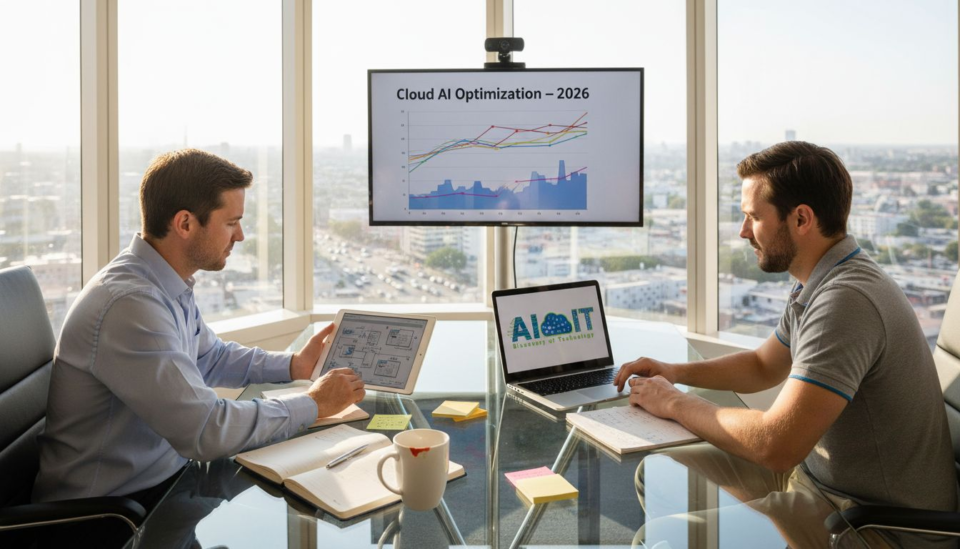
Organizations adopting AI for cloud management often face an unexpected reality: initial costs can overshoot budgets by 300% without proper optimization strategies. This counterintuitive outcome challenges the widespread belief that AI automatically delivers cost savings and operational efficiency. Understanding how to harness AI’s true potential requires recognizing both its capabilities and limitations. This guide reveals the architectural foundations, optimization strategies, and practical frameworks that enable AI to transform cloud management from a cost burden into a competitive advantage.
Key takeaways
| Point | Details |
|---|---|
| AI cost optimization requires structured management | Without proper frameworks, AI implementations can increase cloud spending by 300% before delivering savings. |
| Architecture determines AI effectiveness | High-fidelity telemetry and stable environments enable AI to detect anomalies and optimize resources accurately. |
| Continuous optimization drives massive savings | Organizations using systematic AI strategies achieve cost reductions exceeding 90% and maintain efficiency gains long term. |
| Observability is architectural, not optional | AI cannot function effectively without deterministic patterns and enforceable contracts in cloud infrastructure. |
| Strategic AI integration requires maturity alignment | Matching AI tools to your organization’s architectural readiness maximizes ROI and minimizes implementation friction. |
Understanding AI’s impact on cloud management costs
The financial reality of AI in cloud management contradicts many initial expectations. Organizations embarking on AI-driven cloud strategies frequently discover that costs initially overshoot by 300% due to inefficient implementation. However, companies that migrate to optimized models and refine their approach see dramatic reversals. CloudHealth slashed AI FinOps costs by over 90% immediately upon switching to Google’s Gemini model, demonstrating the transformative power of strategic optimization.
The path to sustainable savings requires understanding common pitfalls that inflate AI cloud costs:
- Excessive API calls generating unnecessary compute expenses
- Inefficient query structures consuming disproportionate resources
- User prompt imprecision leading to redundant processing
- Lack of token management controls allowing waste
- Inadequate monitoring systems missing optimization opportunities
AI’s cost dynamics operate fundamentally differently from traditional infrastructure. While conventional cloud resources scale predictably, AI workloads can spiral unpredictably without governance. Organizations using AI tools for cloud efficiency report that continuous optimization pushes savings beyond 99%, but only when architectural discipline supports those efforts. Without ongoing refinement, companies hemorrhage thousands monthly through preventable inefficiencies. The difference between AI as a cost center and AI as a value multiplier lies entirely in implementation rigor and architectural readiness.

Why architecture and observability are critical for AI effectiveness
Architectural integrity determines whether AI enhances or undermines cloud management capabilities. Observability represents an architectural foundation, not merely a tooling decision. AI cannot reliably detect anomalies or predict failures without high-fidelity, high-cardinality telemetry providing accurate system state visibility. Organizations lacking this telemetry foundation discover their AI investments deliver minimal value regardless of model sophistication.
The Shift Left movement, while democratizing development, created unintended consequences for AI effectiveness. Teams gained autonomy but often built incoherent environments lacking architectural authority and consistent patterns. These fragmented infrastructures prevent AI from establishing the deterministic baselines required for intelligent decision making. Undocumented exceptions and informal workarounds accumulate into noise that drowns out meaningful signals AI needs to infer intent accurately.
“Without enforceable contracts and architectural discipline, AI operates in chaos rather than clarity, leading to false positives and missed optimizations that erode trust.”
Successful AI integration demands reversing this trend. Organizations must strengthen telemetry systems to capture granular, contextual data about resource utilization, performance patterns, and dependency relationships. Architectural governance ensures consistency across teams, creating the predictable patterns AI algorithms require to function safely. This foundation transforms AI from a speculative experiment into a reliable operational partner. Monitoring AI systems effectively requires treating observability as a first-class architectural concern rather than an afterthought.
Pro Tip: Invest in architectural standardization and telemetry enhancement before scaling AI initiatives to unlock exponentially greater returns from your AI investments.
How AI enables resource allocation and continuous optimization
AI transforms cloud resource management through predictive analytics that anticipate demand patterns and optimize allocation proactively. Organizations implementing systematic AI strategies achieve remarkable results. One company reduced Bedrock costs by 47% in just six weeks, generating $294,000 in annual savings through strategic optimization.
The continuous optimization cycle follows a structured approach:
- Collect high-fidelity telemetry data across all cloud resources and workloads
- Deploy AI models to detect anomalies, usage patterns, and inefficiency signals
- Automatically adjust resource allocation based on predicted demand and actual utilization
- Validate optimization outcomes against performance and cost targets
- Iterate refinements based on validation results and emerging patterns
This framework delivers compounding improvements as AI learns from each cycle. Organizations using optimized AI model training approaches report cost savings exceeding 40% within weeks of implementation. The key lies in treating optimization as an ongoing discipline rather than a one-time project.
| Metric | Before AI Optimization | After AI Optimization | Improvement |
|---|---|---|---|
| Monthly cloud spend | $625,000 | $331,250 | 47% reduction |
| Compute utilization | 34% | 78% | 129% increase |
| Idle resource waste | $187,500 | $19,875 | 89% reduction |
| Anomaly detection time | 4.2 hours | 8 minutes | 97% faster |
Inefficient queries represent a hidden cost multiplier that AI addresses systematically. Every API call consumes resources and generates expenses, making query optimization critical. AI automation strategies identify redundant calls, consolidate requests, and cache frequently accessed data to minimize unnecessary compute overhead.
Pro Tip: Implement automated token and API call management systems that set guardrails on AI resource consumption while maintaining performance standards.
Continuous feedback loops amplify AI effectiveness exponentially over time. Models that initially achieve modest improvements evolve into sophisticated optimization engines as they process more operational data and refine their predictive accuracy.
Comparing AI cloud management strategies: benefits and trade-offs
Different AI approaches suit varying organizational contexts and maturity levels. Understanding these distinctions enables strategic tool selection aligned with your infrastructure reality.
| Strategy | Cost Impact | Implementation Complexity | Scalability | Best For |
|---|---|---|---|---|
| Rule-based automation | Low initial, limited long-term gains | Low | Moderate | Stable, predictable workloads |
| Machine learning optimization | Moderate upfront, high sustained savings | Moderate | High | Dynamic environments with pattern variability |
| Generative AI assistants | High initial, massive savings potential | High | Very high | Complex FinOps requiring natural language interfaces |
| Hybrid approach | Balanced costs and returns | Moderate to high | High | Organizations transitioning toward AI maturity |
AI-driven cloud management delivers compelling benefits when implemented strategically:
- Cost reduction through intelligent resource rightsizing and waste elimination
- Scalability enabling infrastructure that adapts automatically to demand fluctuations
- Automation reducing manual intervention and accelerating response times
- Predictive insights preventing issues before they impact operations
- Continuous improvement through learning algorithms that refine over time
These advantages come with inherent trade-offs requiring careful consideration. Architectural complexity increases as AI systems require sophisticated observability infrastructure and data pipelines. Upfront investment in telemetry, governance frameworks, and model development precedes the realization of benefits. Organizations with mature cloud architectures navigate these challenges more effectively than those attempting to compensate for foundational weaknesses.
Financial data complexity presents unique challenges for FinOps AI. Cloud billing encompasses thousands of SKUs, dynamic pricing models, and intricate usage patterns that challenge even sophisticated models. Success requires combining AI with domain expertise and clear business logic that grounds automated decisions in organizational priorities.
Pro Tip: Choose AI tools matching your current architectural maturity rather than aspirational future state to accelerate value realization and minimize implementation friction.
The strategic value of cloud AI emerges most clearly when organizations view it as an amplifier of existing capabilities rather than a replacement for foundational discipline. Companies achieving breakthrough results combine cutting-edge AI with rigorous architectural standards.
Empower your cloud management with AICloudIT
Navigating the complexities of AI-driven cloud management requires both technical expertise and strategic insight. AICloudIT delivers comprehensive solutions tailored specifically for IT managers and cloud architects confronting optimization challenges in 2026. Our platform combines cutting-edge AI automation capabilities with practical frameworks that balance cost efficiency, performance requirements, and operational complexity.
We understand the architectural foundations that enable AI to function effectively because we’ve guided hundreds of organizations through successful implementations. Whether you’re struggling with initial cost overruns or seeking to push optimization beyond 90%, AICloudIT’s resources and tools provide the actionable guidance you need. Explore our essential AI tools for technologists to discover how strategic integration transforms cloud management from reactive firefighting into proactive value creation.
Frequently asked questions
What is the primary role of AI in cloud management?
AI automates resource allocation, optimizes costs, and detects anomalies to improve cloud infrastructure efficiency. It enables continuous monitoring and proactive management that manual processes cannot achieve at scale. By analyzing usage patterns and predicting demand, AI helps organizations maintain optimal performance while minimizing waste.
How does AI reduce costs in cloud environments?
AI identifies wasteful resource usage, predicts demand fluctuations, and automates scaling to prevent overprovisioning. Optimization of API calls and query efficiency eliminates unnecessary compute spending that accumulates rapidly without oversight.
What architectural challenges limit AI’s effectiveness in cloud management?
Lack of observability and high-fidelity telemetry prevents AI from detecting anomalies and making accurate predictions. Unstable environments with undocumented exceptions and informal workarounds disrupt AI’s ability to infer operational intent safely. Without deterministic patterns and enforceable contracts, AI generates false positives and misses genuine optimization opportunities.
What are best practices for integrating AI into cloud management?
Establish strong architectural foundations featuring comprehensive observability and granular telemetry before scaling AI initiatives. Implement continuous optimization frameworks that treat improvement as an ongoing discipline rather than a one-time project. Control API usage through automated governance systems that prevent cost spirals. Align AI automation tools with your organization’s current architectural maturity level to maximize immediate value while building toward greater sophistication.
Recommended
- Role of AI in Automation: Transforming IT Efficiency
- 3 Ways AI is Transforming the Future of Cloud Management – AICloudIT
- Optimize AI model training with cloud computing in 2026
- 6 Essential AI Tools for Technologists to Boost Efficiency
- 2026 Trends in Public Speaking: AI’s Transformative Role | Pavone Academy
- AI Mock Interview – Boosting Confidence and Clarity | Pavone Academy
