

Selecting the right AI solution can make or break your operational efficiency goals. Many IT leaders struggle with vendor claims that don’t match real-world performance, leading to wasted investments and failed implementations. This guide provides a practical, step-by-step framework to evaluate AI solutions rigorously, ensuring alignment with your business goals while mitigating compliance and operational risks in cloud environments.
Key takeaways
| Point | Details |
|---|---|
| Structured evaluation reduces risk | A systematic approach prevents costly failures and ensures AI tools align with business objectives. |
| Data quality determines accuracy | Understanding training data and model transparency is critical for reliable AI performance. |
| Frameworks provide reliability | Applying standards like NIST AI RMF enables consistent, trustworthy risk management. |
| Pilot testing validates claims | Real-world testing reveals gaps between vendor promises and actual operational performance. |
| Compliance prevents issues | Early ethical and regulatory reviews protect against legal and reputational damage. |
Prerequisites for effective AI evaluation
Before diving into AI evaluation, you need the right foundation. Without proper preparation, even the most thorough assessment process falls short.
Start by building AI literacy across your evaluation team. Team members should understand how to critically assess AI reliability, recognize ethical implications, and interpret model outputs. Consider formal training programs or workshops to elevate technical understanding.
Next, clarify your specific business needs and use cases. Generic AI adoption rarely succeeds. Identify which operational pain points you’re targeting, whether it’s automating customer support, optimizing resource allocation, or enhancing data analysis. This clarity guides your entire evaluation focus.
Ensure you have access to essential documentation:
- Data governance policies and frameworks
- Privacy compliance requirements for your industry
- Current IT infrastructure specifications
- Security protocols and access controls
Your IT infrastructure must support pilot testing. Verify that you can create isolated testing environments without disrupting production systems. Cloud-based testing environments often provide the flexibility needed for safe AI experimentation.
Form a cross-functional evaluation team including IT specialists, legal advisors, compliance officers, and business leaders. Each perspective catches different risks and opportunities. Legal teams spot regulatory issues early, while business leaders ensure strategic alignment.
Pro Tip: Create an AI tools checklist 2026 specific to your organization’s needs before starting vendor conversations. This prevents getting swept up in sales presentations and keeps evaluation criteria consistent across all solutions.
Step 1: define evaluation prerequisites and objectives
Clear objectives transform vague AI aspirations into measurable outcomes. Without specific goals, you can’t determine whether an AI solution actually delivers value.
Begin by identifying operational problems that AI will address. Examine which business challenges are quantifiable and repeatable. AI excels at pattern recognition and automation, so focus on tasks involving data processing, prediction, or decision support.
Set measurable objectives that tie directly to business outcomes:
- Define performance targets such as accuracy rates, processing speed improvements, or error reduction percentages
- Establish compliance requirements including data privacy standards, industry regulations, and security protocols
- Calculate expected ROI timelines and cost savings targets
- Specify integration requirements with existing systems and workflows
Gather baseline data metrics before introducing any AI solution. Document current performance levels, processing times, error rates, and resource costs. These baselines become your comparison points for measuring AI impact.
Align evaluation goals with strategic business outcomes. If your organization prioritizes customer satisfaction, measure how AI affects response times and resolution rates. For cost-focused strategies, track operational efficiency gains and resource optimization.
Understanding key types of AI helps you match solution capabilities with your defined objectives. Machine learning models suit prediction tasks, while natural language processing excels at text analysis and communication automation.
Step 2: understand the AI model and training data
The quality of an AI solution depends entirely on its training foundation. Black-box systems that hide their training data and decision logic present significant risks.

Ground truth datasets form the foundation for AI accuracy. These datasets contain verified, correct examples that train the AI model to recognize patterns and make decisions. Poor quality or biased ground truth data produces unreliable AI outputs, regardless of algorithmic sophistication.
Demand transparency from vendors about their training data:
- Data sources and collection methods
- Dataset size and diversity
- Labeling accuracy and validation processes
- Bias mitigation strategies employed
- Update frequency and ongoing training practices
Evaluate integration capabilities with existing cloud platforms and IT infrastructure. AI solutions must work within your current technology stack without requiring extensive system overhauls. Check API compatibility, data format requirements, and computational resource needs.
Black-box AI models without data disclosure create multiple risks. You can’t verify accuracy, identify biases, or explain decisions to stakeholders or regulators. These opacity issues become critical in regulated industries where explainability is mandatory.
| Evaluation Criteria | What to Check | Red Flags |
|---|---|---|
| Training Data | Provenance, size, diversity | Undisclosed sources, small datasets |
| Model Logic | Algorithm type, decision process | Complete opacity, no explanations |
| Cloud Integration | API compatibility, data formats | Proprietary lock-in, limited options |
| Update Process | Retraining frequency, version control | Static models, no improvement path |
Pro Tip: Request sample datasets and test cases from vendors. Run these through your own validation process to independently verify claimed accuracy rates before committing to pilot testing.
For detailed guidance on training optimization, explore AI model training cloud optimization strategies that reduce costs while improving model performance.
Step 3: apply standardized evaluation frameworks
Structured frameworks prevent overlooking critical risks and ensure comprehensive AI assessment. Ad hoc evaluation methods miss important failure points.
The NIST AI Risk Management Framework provides a voluntary, structured approach for managing AI trustworthiness, safety, and compliance. This framework organizes evaluation around four core functions:
- Map: Identify AI risks in your specific context and use case
- Measure: Quantify risks using metrics and benchmarks
- Manage: Implement controls and mitigation strategies
- Govern: Establish policies and accountability structures
AI evaluation operates at multiple levels, from technical model validation to societal impact assessment. Start with output accuracy, then expand to product performance, user behavior changes, and ultimate business outcomes. Each level requires different evaluation methods and metrics.
Integrate both qualitative and quantitative criteria for complete risk analysis. Quantitative metrics include accuracy percentages, processing speeds, and error rates. Qualitative factors cover user experience, ethical considerations, and organizational fit.
“Standardized evaluation frameworks provide consistency across AI projects, enabling organizations to compare solutions objectively and build institutional knowledge about what works. Without frameworks, each evaluation starts from scratch, wasting time and increasing oversight risks.”
Your framework should address technical performance, business value, ethical implications, and regulatory compliance. Weight each category based on your organizational priorities and risk tolerance.
For implementation guidance, review the AI data security guide to ensure security considerations are integrated throughout your evaluation framework.
Step 4: conduct pilot tests in realistic environments
Vendor demos showcase ideal conditions. Pilot testing reveals real-world performance and exposes gaps between marketing claims and operational reality.
Design pilots that mirror actual operational conditions:
- Use real data samples that reflect production data quality and variety
- Involve actual end users who will operate the AI solution daily
- Test during normal business hours under typical workload conditions
- Include edge cases and unusual scenarios that stress-test AI capabilities
- Run pilots long enough to capture performance variations over time
Measure quantitative metrics systematically. Track accuracy rates, processing times, resource consumption, and error frequencies. Compare these results against your baseline data and vendor-claimed performance levels.
Gather qualitative feedback from pilot users about usability, integration friction, and workflow impact. User acceptance determines adoption success more than technical performance alone. If the AI tool frustrates users or complicates workflows, it won’t deliver value regardless of accuracy.
Iterate your evaluation based on pilot insights. If results fall short, identify whether issues stem from configuration, training data quality, or fundamental capability gaps. Some problems can be fixed through adjustment, while others indicate the solution isn’t suitable.
Pro Tip: Involve end users from the planning stage, not just during testing. Early engagement improves pilot design, increases buy-in, and accelerates adoption if you proceed with full deployment.
For practical implementation steps, consult the AI tool setup guide that walks through configuration best practices for common enterprise scenarios.
Step 5: assess compliance and ethical considerations
Compliance failures and ethical issues destroy AI initiatives faster than technical problems. Legal and reputational risks demand thorough vetting before deployment.
Verify vendor compliance with relevant regulations for your industry and geography. Privacy requirements like HIPAA for healthcare or GDPR for European data mandate specific data handling practices. Confirm vendors meet these standards through audits and certifications, not just assurances.
Demand transparency about AI decision-making processes:
- How does the AI reach conclusions or recommendations?
- What factors influence AI outputs most heavily?
- Can decisions be explained to end users and regulators?
- Who owns the data processed by the AI system?
- What happens to your data if you discontinue the service?
Identify and mitigate biases in AI outputs. Test solutions with diverse data samples representing different demographics, scenarios, and edge cases. Biased AI systems produce discriminatory outcomes that create legal liability and damage organizational reputation.
Involve legal and compliance teams early in the evaluation process. Waiting until after technical validation wastes time if compliance issues block deployment. Legal review should run parallel to technical assessment.
Avoid AI solutions with opaque features or vendors unwilling to disclose data handling practices. Transparency isn’t optional in 2026’s regulatory environment. Solutions that can’t explain their operations pose unacceptable risks.
For comprehensive security protocols, reference enterprise AI data security best practices that address compliance requirements alongside technical security measures.
Common mistakes and failure points in AI evaluation
Even experienced IT teams make predictable errors when evaluating AI solutions. Recognizing these pitfalls helps you avoid costly mistakes.
Overreliance on vendor claims without independent validation is the most common failure point. Marketing materials present best-case scenarios using curated data. Always conduct your own testing with real operational data and conditions.
Neglecting end-user engagement undermines adoption regardless of technical merit. AI tools that ignore workflow realities or user preferences face resistance and abandonment. Include change management planning from the evaluation stage forward.
Failing to track evolving regulatory requirements creates compliance gaps. AI regulations change rapidly across jurisdictions. Establish processes for monitoring regulatory updates and assessing their impact on deployed AI systems.
Ignoring transparency in training data and model logic increases multiple risks:
- Inability to identify and correct biases
- Lack of explainability for decisions
- Difficulty troubleshooting errors
- Compliance challenges in regulated industries
Avoid purchasing black-box AI solutions where vendors refuse to provide data provenance details or explain decision logic. Opacity prevents you from validating accuracy, managing risks, or satisfying regulatory requirements.
Rushing evaluation timelines to meet project deadlines compromises thoroughness. Inadequate pilot testing periods miss performance issues that emerge over time or under stress conditions. Build realistic timelines that allow comprehensive assessment.
Pro Tip: Create a standardized AI evaluation scorecard for your organization that includes technical, business, compliance, and user experience criteria. Using the same scorecard across all vendor evaluations ensures consistent, objective comparisons.
For guidance on finding the best AI tools efficiently while avoiding common selection mistakes, explore systematic discovery and vetting processes.
Measuring success and expected outcomes
Determining whether your AI solution delivers value requires clear success metrics and realistic timelines. Vague measures lead to disputes about effectiveness and ROI.
Define KPIs combining quantitative and qualitative metrics that reflect operational and strategic goals. Accuracy above 85% represents a baseline for most business applications. Precision and recall metrics matter more than raw accuracy for classification tasks.
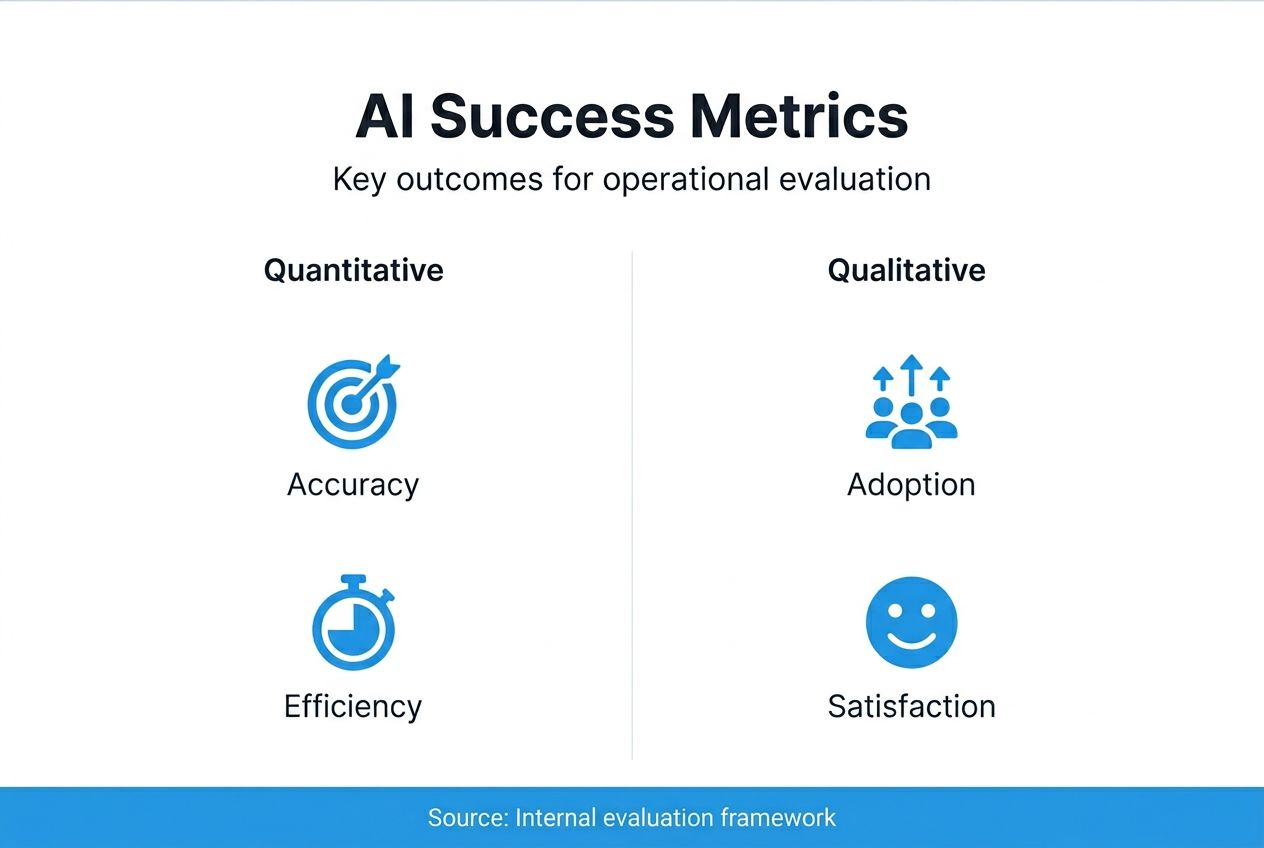
Measure operational efficiency gains targeting at least 20% improvement in relevant processes. Time savings of 6 hours weekly per user demonstrates meaningful productivity impact. Track these improvements consistently across the pilot and initial deployment phases.
User adoption and satisfaction should exceed 70% within three months of deployment. Low adoption indicates usability problems or insufficient training, regardless of technical performance. Monitor usage patterns and gather regular feedback.
Track ROI within 6 to 12 months of full deployment. Include all costs such as licensing, integration, training, and ongoing maintenance. Compare savings and revenue gains against total investment to calculate payback periods.
| Success Metric | Target Benchmark | Typical Timeline |
|---|---|---|
| Model Accuracy | >85% | Validated during pilot |
| Efficiency Gain | >20% improvement | 3 to 6 months post-deployment |
| User Adoption | >70% active usage | 3 months |
| ROI Achievement | Positive return | 6 to 12 months |
| User Satisfaction | >75% approval rating | Ongoing measurement |
Link evaluation results back to strategic business outcomes. If AI adoption aimed to improve customer satisfaction, track customer feedback scores and retention rates. For cost reduction goals, monitor operational expenses and resource utilization over time.
Document lessons learned throughout evaluation and deployment. This institutional knowledge improves future AI assessments and accelerates decision-making for subsequent projects.
For ongoing performance monitoring, use techniques from analyze AI performance to maintain accuracy and identify degradation early.
Explore AICloudIT’s expert solutions for AI evaluation
Successful AI evaluation requires expertise, tools, and frameworks that many organizations lack internally. AICloudIT provides comprehensive consulting services and cloud-based solutions tailored to AI assessment needs for U.S. enterprises.
Our experts guide you through pilot testing, performance measurement, and compliance verification using industry-standard frameworks. We help you avoid common evaluation mistakes while accelerating time to confident AI adoption decisions.
Partner with AICloudIT to streamline your AI evaluation process and maintain competitive advantage in 2026’s rapidly evolving technology landscape. Our solutions ensure your AI investments deliver measurable operational success.
Frequently asked questions
What is ground truth data and why is it important?
Ground truth data consists of verified, correct examples used to train AI models. It’s critical because AI accuracy depends entirely on learning from reliable examples. Poor quality ground truth data produces unreliable predictions regardless of algorithm sophistication.
How does pilot testing improve AI solution selection?
Pilot testing reveals gaps between vendor marketing claims and real-world performance using your actual data and workflows. It uncovers integration issues, usability problems, and accuracy limitations before committing to full deployment, reducing implementation risks significantly.
What are key regulatory compliance considerations for AI?
Verify that AI solutions comply with data privacy regulations relevant to your industry, such as HIPAA for healthcare or GDPR for European data. Ensure vendors provide transparent data handling practices, decision explainability, and clear data ownership terms to satisfy regulatory requirements.
How do I measure if an AI tool is successful after deployment?
Track quantitative metrics like accuracy rates above 85%, operational efficiency gains exceeding 20%, and positive ROI within 6 to 12 months. Also measure qualitative factors including user adoption rates above 70% and satisfaction scores exceeding 75% to ensure comprehensive success assessment.
What are typical mistakes to avoid when evaluating AI solutions?
Avoid relying solely on vendor claims without independent testing, neglecting end-user involvement during evaluation, and ignoring transparency about training data and decision logic. Also don’t rush evaluation timelines or skip compliance reviews, as these shortcuts create costly problems during deployment.
Recommended
- How to Analyze AI Performance for Accurate Results
- AI Tools Checklist 2026: Boost Efficiency by 35%
- Role of AI in Decision Making: Enterprise Impact
- AI Data Security Guide: Safeguard Enterprise AI Systems
- AI Use Case – Schlüsselrolle für sicheres VR-Training – Amlogy AR|VR
