
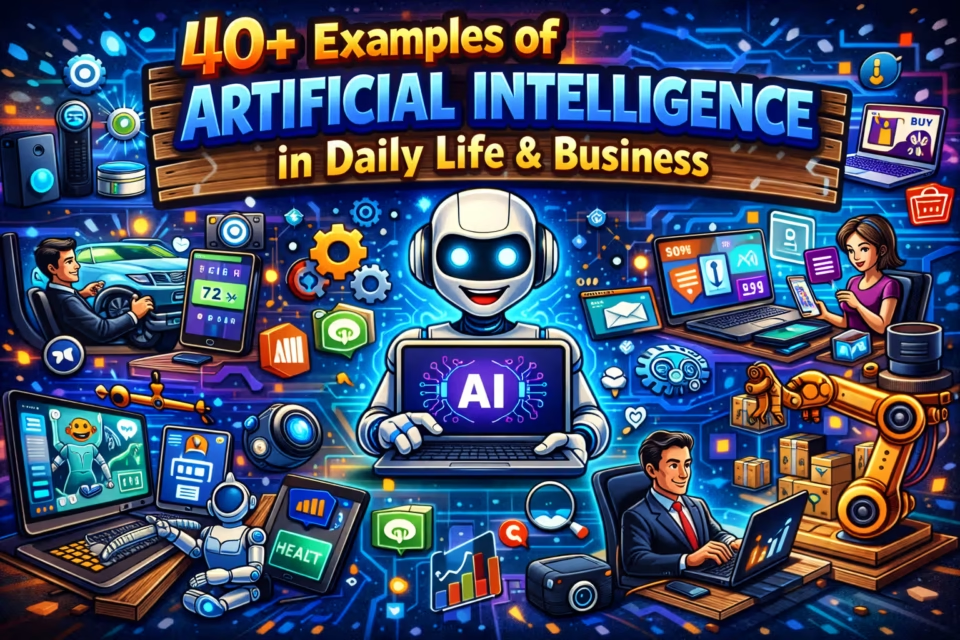
TL;DR: Artificial intelligence isn’t some distant future technology. It’s everywhere. ChatGPT and Gemini chat with you daily. Netflix’s algorithm decides what you watch. Your bank uses AI to detect fraud. Self-driving cars navigate streets autonomously. Facial recognition unlocks your phone. Healthcare AI diagnoses diseases. This guide covers 40+ concrete, real-world examples of AI you’re already using, often without realizing it.
When people talk about artificial intelligence, they often think of science fiction: robot overlords, sentient computers, AGI that solves everything. But the truth is far more mundane and honestly, more impressive. AI is already embedded in the tools and systems we use every single day.
The question isn’t “will AI change my life?” It is “how many AI systems have I used today without noticing?” The answer: probably dozens.
“Artificial intelligence is not the future. It’s happening right now, embedded in systems billions of people use daily. Most people interact with AI dozens of times without realizing it.”
— Tableau / Britannica, AI Overview 2026
What Counts as Artificial Intelligence?
Artificial intelligence is the ability of a computer or computer-controlled robot to perform tasks commonly associated with intelligent beings: reasoning, discovering meaning, generalizing, and learning from past experiences. AI includes everything from simple algorithms that recommend products to you, to complex deep learning models that drive autonomous vehicles, to generative AI that writes text and generates images.
Not everything that seems smart is AI, and not all AI requires advanced deep learning. At its core, AI is any system that can:
- Learn from data – improve its performance over time based on examples
- Recognize patterns – identify similarities and differences across large datasets
- Make predictions or decisions – use learned patterns to forecast outcomes or choose actions
- Operate with limited human direction – execute tasks autonomously once programmed
With that definition in mind, here are the AI systems you’re already interacting with.
Let’s find out the what is artificial intelligence examples below…….
AI You Use Every Day Without Realizing It
1. ChatGPT, Gemini, Claude, and Large Language Models
The obvious one.
- What it does: Generates human-like text, writes code, answers questions, creates content, translates languages, summarizes documents
- Why it’s AI: Trained on massive amounts of text data, these models learn patterns in language and predict what should come next, billions of times, building up coherent reasoning capability
- You encounter it: ChatGPT (OpenAI), Gemini (Google), Claude (Anthropic), Copilot (Microsoft)
2. Voice Assistants (Siri, Alexa, Google Assistant)
The smart speaker you talk to.
- What it does: Listens to your voice commands, understands intent, controls smart home devices, answers questions, plays music, sets reminders
- Why it’s AI: Speech recognition algorithms convert sound waves to text; natural language processing understands meaning; machine learning predicts which action you want
- You encounter it: Apple Siri, Amazon Alexa, Google Assistant, Microsoft Cortana
3. Netflix, Spotify, YouTube Recommendations
The algorithm that knows what you’ll watch before you do.
- What it does: Analyzes your watch history, ratings, and search behavior to recommend shows, movies, or music you’re statistically likely to enjoy
- Why it’s AI: Collaborative filtering algorithms identify patterns. For example, “people like you watched these things and rated them highly”
- Impact: Netflix’s recommendations account for approximately 80 percent of content viewed on the platform
4. Google Search and AI Overviews
You ask, Google shows you answers, not just links.
- What it does: Understands your query intent, crawls billions of pages, ranks results by relevance, and now generates AI summaries of answers
- Why it’s AI: Ranking algorithms use hundreds of signals to predict what result you actually want. The new AI Overview feature uses large language models to synthesize information from multiple sources into a coherent answer
- You encounter it: Google Search AI Overview, now in most regions globally
5. Email Spam Filters and Fraud Detection
Why your inbox doesn’t drown in spam. And why your bank caught that fraudulent transaction.
- What it does: Identifies suspicious emails as spam; detects unusual patterns in financial transactions that indicate fraud
- Why it’s AI: Machine learning models trained on millions of examples learn what fraud looks like: unusual geographic location, transaction size, merchant category
- Accuracy: AI fraud detection catches 95 percent or higher of fraudulent transactions while keeping false positives under 1 percent
6. Facial Recognition (Face ID, Surveillance)
Your face is your password.
- What it does: Unlocks your phone, identifies you in photos, powers airport security, enables law enforcement surveillance
- Why it’s AI: Deep convolutional neural networks trained on millions of faces learn to extract unique facial features and match them to stored templates
- Real-world use: Face ID on iPhones, facial recognition at airports, government surveillance systems worldwide
7. Social Media Feeds (Facebook, Instagram, TikTok)
The infinite scroll that won’t let go.
- What it does: Orders posts by engagement prediction. Essentially, what will keep you scrolling longest?
- Why it’s AI: Deep learning models trained on billions of user interactions learn patterns of what captures attention
- Dark side: These systems are optimized for engagement, not truth or well-being. This is why sensational and divisive content often ranks higher
8. Autocomplete and Smart Compose (Gmail, Google Docs)
The feature that finishes your emails before you do.
- What it does: Predicts the next word or phrase as you type; suggests full sentence completions
- Why it’s AI: Language prediction models trained on millions of emails and documents learn common patterns and transitions
- Powered by: Neural language models similar to what powers ChatGPT, just smaller and faster
9. Amazon, Etsy, Shopify Product Recommendations
“Customers who bought this also bought that.”
- What it does: Suggests products you’re statistically likely to buy based on your browsing, past purchases, and people similar to you
- Why it’s AI: Collaborative filtering plus content-based filtering algorithms identify hidden patterns in shopping behavior
- Business impact: Recommendation systems drive 25 to 35 percent of e-commerce revenue
10. Tesla Autopilot and Self-Driving Cars (Waymo)
The car that drives itself, mostly.
- What it does: Processes sensor data (cameras, LiDAR, radar) to detect road markings, pedestrians, other cars, traffic signs; predicts what will happen next; steers and accelerates accordingly
- Why it’s AI: Computer vision algorithms trained on millions of miles of driving data learn to recognize objects and predict dangerous situations
- Real-world deployment: Waymo operates autonomous ride-hailing in multiple cities; Tesla has semi-autonomous features in millions of vehicles
AI in Professional & Business Settings
11. Hiring and Resume Screening
The algorithm that decides if your resume gets read.
- What it does: Screens thousands of resumes, identifies qualifications matching job requirements, ranks candidates
- Problem: Often biased. Filters trained on historical hiring data can perpetuate existing discrimination
- Impact: Millions of job applications are screened by AI annually
12. Healthcare Diagnosis and Medical Imaging
AI that spots tumors, reads X-rays, and predicts disease.
- What it does: Analyzes medical images (X-rays, CT scans, MRIs) to detect abnormalities; predicts patient outcomes; identifies which drugs patients will respond to
- Why it’s AI: Convolutional neural networks trained on thousands of medical images learn to recognize patterns indicating disease
- Real-world examples: IBM Watson for Oncology helps oncologists select cancer treatments; AI radiology tools outperform radiologists on some imaging tasks
Know more about: The Role of AI in Hospital Management Systems
13. Financial Risk Assessment and Lending
Banks use AI to decide who gets a loan and on what terms.
- What it does: Analyzes applicant data (income, credit history, employment) to predict loan default risk
- Why it’s AI: Machine learning models trained on millions of loan outcomes learn what patterns correlate with success or default
- Problem: These systems can perpetuate historical lending discrimination unless carefully designed
Check the: Use of AI in Accounts and Finance
14. Manufacturing Quality Control and Robotics
Robots assemble cars. AI inspects the results.
- What it does: Computer vision inspects products on assembly lines for defects; robotic arms perform repetitive tasks; sensors predict equipment failures before they happen
- Real-world example: Procter and Gamble uses AI to predict paper towel sheet lengths with millimeter accuracy, reducing waste significantly
- Impact: Robots in manufacturing since 1961; increasingly AI-powered today
15. Supply Chain Optimization
AI predicts demand, routes shipments, minimizes waste.
- What it does: Forecasts demand for products; optimizes warehouse inventory; routes delivery trucks for efficiency
- Why it’s AI: Machine learning models trained on historical demand patterns, seasonal trends, and logistics data predict future needs accurately
16. Cybersecurity Threat Detection
AI that detects hacks and malware in real-time.
- What it does: Monitors network traffic for unusual patterns; identifies zero-day exploits; predicts attack vectors; responds to threats autonomously
- Why it’s AI: Trained on datasets of known cyberattacks, these models learn what attack signatures look like
- Real-world impact: AI security tools reduce response time from hours to seconds
AI in Creative and Entertainment Fields
17. Generative AI Art and Image Creation (DALL-E, Midjourney, Stable Diffusion)
Text prompt leads to beautiful image.
- What it does: Generates original images from text descriptions; creates artwork, illustrations, design mockups, photorealistic renders
- Why it’s AI: Diffusion models trained on billions of images learn associations between concepts and visual appearance
- Controversy: Training data includes copyrighted images; raises questions about intellectual property and artist compensation
Check the: Free AI Tools for Image Generation: Text to Image Online
18. AI Video Generation and Editing
AI that creates, edits, and deepfakes video.
- What it does: Generates videos from text prompts; automatically edits raw footage; creates realistic deepfakes; removes backgrounds or objects from video
- Technology: Video diffusion models; generative adversarial networks (GANs); neural rendering
- Ethical concern: Deepfakes enable misinformation and non-consensual abuse
Also check: The Best 10 AI Video Editing Softwares for Free
19. Gaming AI Opponents
The chess engine that beat Kasparov. The Go AI that beat Lee Sedol.
- What it does: Plays strategic games at superhuman levels; predicts player behavior; generates responsive NPC opponents
- Why it’s AI: Deep reinforcement learning shows the AI plays millions of games against itself, learning winning strategies
- Real-world examples: AlphaGo (Google DeepMind), Chess engines like Stockfish
20. Music Composition and Audio Generation
AI that writes music, remixes songs, generates sound effects.
- What it does: Generates original musical pieces; remixes existing songs; creates voice-overs and sound design
- Technology: Sequence models trained on thousands of compositions; text-to-audio models
- Adoption: Film studios, game developers, and musicians already using AI tools
“The remarkable thing about AI applications today is not that they’re sophisticated. It’s how mundane and essential they’ve become. AI is infrastructure now, not a feature.”
— Built In, AI in Industry Report
AI in Everyday Life & Smart Devices
21. Smart Home Devices (Roomba, Smart Thermostats, Ring Doorbells)
Appliances that learn your patterns.
- What it does: Robot vacuums navigate rooms, avoid obstacles, clean efficiently; smart thermostats learn when you’re home and adjust temperature automatically; smart doorbells recognize familiar faces
- Why it’s AI: Motion planning algorithms, reinforcement learning for automation, computer vision for recognition
- Market: Smart home AI is projected to reach 200 billion dollars or more by 2030
22. GPS and Navigation (Google Maps, Waze)
The app that knows traffic before traffic happens.
- What it does: Predicts traffic conditions; recommends fastest routes; learns your commute patterns
- Why it’s AI: Machine learning models trained on billions of location data points predict traffic delays based on time, weather, historical patterns
- Real-time: Processes hundreds of millions of position updates per second globally
23. Weather Forecasting
AI that predicts rain more accurately than humans.
- What it does: Predicts weather 10 or more days in advance by analyzing global atmospheric patterns and historical data
- Why it’s AI: Deep learning models like GenCast (Google DeepMind) process centuries of weather data and learn patterns
- Performance: GenCast outperforms traditional physics-based models on 97.2 percent of tested weather variables
24. Fitness Trackers and Health Monitoring (Apple Watch, Fitbit)
Your wrist tells you if you’re healthy.
- What it does: Detects irregular heartbeats, tracks sleep patterns, predicts health risks, measures stress levels
- Why it’s AI: Machine learning models trained on millions of biometric readings learn patterns indicating health problems
- Real-world impact: Some smartwatch models can detect atrial fibrillation (AFib) as accurately as clinical devices
25. Photo Recognition and Organization (Google Photos, Apple Photos)
Your phone’s photo app that sorts pictures by person, place, thing.
- What it does: Recognizes faces; categorizes photos by location, object, activity; searches by scene without you tagging anything
- Why it’s AI: Computer vision models recognize thousands of objects, places, and faces; clustering algorithms group similar photos
- Privacy note: Processing happens on-device in many cases, reducing privacy concerns compared to cloud-based photo analysis
Check the: Top 10 AI Face Swap Tools for Photos
AI in Healthcare & Science
26. Drug Discovery and Molecular Biology
AI that finds new medicines by understanding molecular structures.
- What it does: Analyzes millions of molecular compounds to predict which will be effective drugs; identifies promising candidates; predicts side effects
- Real-world example: AI models identified new antibiotics that humans had missed for 30 or more years
- Impact: Reduces drug discovery timelines from 10 years to 1 to 2 years
27. Disease Prediction and Epidemiology
AI that predicts outbreaks before they happen.
- What it does: Analyzes disease patterns, travel data, climate to predict where diseases will spread; identifies at-risk populations
- Real-world example: Google’s Flu Trends predicted flu outbreaks days before hospitals reported them
- Current use: AI disease mapping tools help governments respond to pandemics faster
28. Surgical Robots and Precision Medicine
Robot surgeons that operate with superhuman precision.
- What it does: Performs minimally invasive surgery with millimeter precision; learns from thousands of prior surgeries to optimize technique
- Real-world examples: da Vinci surgical robots assist surgeons in millions of procedures annually
- Advantage: Less tissue damage, faster recovery, lower infection rates
29. Mental Health Chatbots and Therapy AI
AI therapists that provide mental health support.
- What it does: Listens to mental health concerns, provides evidence-based therapeutic responses, tracks mood patterns, recommends help if needed
- Real-world: Woebot and other AI therapy chatbots have helped hundreds of thousands of people manage anxiety and depression
- Limitation: Can’t replace human therapists for severe conditions
30. Protein Folding (AlphaFold)
AI that solved a 50-year-old biology problem.
- What it does: Predicts how proteins fold in 3D space based on amino acid sequences, crucial for understanding diseases and designing drugs
- Impact: AlphaFold (Google DeepMind) has predicted structures of 200 million or more proteins, transforming biological research
- Recognition: Won the Breakthrough Prize in Life Sciences
AI in Agriculture
31. Crop Health Monitoring and Pest Detection
Drones and satellites that watch crops.
- What it does: Computer vision analyzes aerial imagery to detect diseased plants, pests, weeds; predicts yields; optimizes irrigation
- Impact: Reduces pesticide use by 30 to 50 percent through targeted application
- Real-world: Precision agriculture using AI is saving farmers billions annually
32. AI-Powered Pollination Robots
Robots that pollinate flowers when bees don’t.
- What it does: Uses computer vision and deep learning to identify which flowers are ready for pollination; autonomously pollinates using robotic arms
- Real-world: Costa Group’s AI pollination robots increased crop yields significantly
- Why it matters: Bee populations are declining globally; AI offers an alternative
33. Soil Analysis and Nutrient Optimization
AI that tells farmers exactly what their soil needs.
- What it does: Analyzes soil samples, sensor data, and plant health to recommend precise nutrient application
- Benefit: Reduces fertilizer waste, improves yields, lowers environmental impact
AI in Education & Learning
34. Personalized Learning Systems
AI tutors that adapt to how you learn.
- What it does: Assesses student knowledge, identifies learning gaps, recommends targeted exercises, adjusts difficulty in real-time
- Real-world: Carnegie Learning, ALEKS, and other adaptive learning platforms serve millions of students
- Effectiveness: Students using AI tutoring systems show 10 to 20 percent better learning outcomes than traditional instruction
Learn more about: advantages and disadvantages of AI in Education
35. Automated Essay and Assignment Grading
AI that grades homework and essays.
- What it does: Reads student essays, assesses quality, identifies grammar and logic errors, suggests improvements
- Benefit: Teachers save hours grading; students get instant feedback
36. AI Plagiarism Detection
Turnitin and other plagiarism checkers powered by AI.
- What it does: Compares student work against trillions of documents online; detects similarity; identifies AI-generated content
- Modern challenge: Can detect ChatGPT-generated text with reasonable accuracy, though not 100 percent
AI in Language & Translation
37. Real-Time Machine Translation
Google Translate that actually works now.
- What it does: Translates text and speech between 100 or more languages in real-time
- Why it works: Neural machine translation models trained on billions of parallel sentence pairs
- Real-world: Enables communication across language barriers globally
38. Accessibility Tools (Captioning, Text-to-Speech)
Technology that makes content accessible.
- What it does: Auto-generates captions for videos; reads text aloud with natural voices; transcribes audio
- Impact: Makes internet accessible to deaf, blind, and neurodivergent users
AI in Finance & Banking
39. Algorithmic Trading and Portfolio Management
AI that trades stocks automatically.
- What it does: Analyzes market data, identifies trading opportunities, executes trades in milliseconds
- Impact: Algorithmic trading now represents 70 percent or more of all trading volume
- Risk: Can amplify market crashes through cascading automated selling
40. Credit Scoring and Loan Approval
The AI that decides your credit score.
- What it does: Analyzes payment history, debt levels, income to predict loan default risk
- Problem: Can perpetuate discrimination if trained on biased historical data
- Regulation: Fair Lending laws now require companies to prove algorithms don’t discriminate
Looking Ahead: What is Coming?
These 40+ examples are just the current state. The next wave of AI is already arriving:
- Agentic AI – Models like GPT-5.4 that operate your computer autonomously
- Multimodal AI – Systems that seamlessly handle text, images, video, and code together
- Real-time AI – Faster inference meaning more real-time personalization and automation
- AI agents in the workplace – Autonomous systems that complete full workflows without human intervention
- Edge AI – Processing happening on your device rather than in the cloud
Few Common Questions People Also Asking
AI is software that learns from examples and improves over time. Like teaching a child to recognize cats, show it enough examples and it learns independently.
They track what you watch, compare your behavior to millions of users, and recommend shows people similar to you enjoyed. This drives 80% of Netflix viewing.
Voice assistants, spam filters, social media feeds, GPS navigation, autocomplete, facial unlock, weather forecasts, fitness trackers, and product recommendations on Amazon are all AI-powered.
Your phone uses AI for facial recognition, voice assistants, predictive text, camera optimization, photo organization, battery management, and personalized app recommendations.
AI detects bank fraud, predicts factory breakdowns, screens job applications, manages power grids, diagnoses diseases from scans, and predicts disease outbreaks invisibly.
Google Calendar, Motion, and Fantastical use AI to prioritize tasks, suggest meeting times, and adapt to your daily habits automatically.
Yes. AI trained on historical data inherits existing biases, affecting hiring, facial recognition accuracy, and loan approvals, particularly for underrepresented groups.
AI is the broad field. Machine learning is AI that learns from data. Deep learning is machine learning using multi-layered neural networks.
No. AI excels at narrow tasks like chess and fraud detection but struggles with common sense, creativity, and unfamiliar real-world situations.
No. AI also includes fraud detection, recommendation systems, robots, medical tools, and self-driving cars. Most AI you use daily isn’t a chatbot.
Disclaimer: This article reflects publicly available information about AI applications as of April 2026. Specific AI systems, their capabilities, and accuracy rates are subject to change as technology evolves. This article is for informational purposes only and does not constitute technical, investment, or employment advice. Always verify current accuracy and limitations of AI systems before making critical decisions.
