

Many IT leaders believe AI will completely automate IT operations, eliminating human oversight and handling complex troubleshooting autonomously. This misconception oversimplifies AI’s actual capabilities. AI excels at specific IT operations tasks like anomaly detection, event correlation, and automated remediation, but it works alongside human expertise rather than replacing it. Understanding AI’s practical impact helps you implement solutions that genuinely optimize your infrastructure without unrealistic expectations. This article clarifies how AI transforms IT operations, quantifies measurable improvements, addresses real-world limitations, and provides actionable implementation guidance for your organization.
Key takeaways
| Point | Details |
|---|---|
| AIOps platforms enhance visibility | AI collects and analyzes diverse IT data sources to detect anomalies and automate responses across your infrastructure. |
| Significant performance improvements | Organizations achieve 40-55% faster incident resolution and 22.88% fewer alerts per incident with AI integration. |
| Implementation challenges exist | Data quality issues, alert fatigue, and limited explainability remain obstacles requiring strategic planning. |
| Start with focused pilots | Begin with data ingestion, ML analytics for anomaly detection, and automation orchestration targeting high-impact areas. |
| Realistic expectations drive success | Understanding AI’s strengths and limitations enables practical optimization without overestimating full automation capabilities. |
How AI platforms analyze and optimize IT operations
AIOps platforms transform raw IT data into actionable insights through sophisticated machine learning algorithms. These systems ingest information from servers, networks, applications, and cloud services simultaneously. This comprehensive data collection creates a unified view of your entire IT ecosystem, enabling pattern recognition impossible through manual monitoring.
The layered process begins with data collection from diverse sources, followed by normalization and cleaning to ensure consistency. Machine learning models then analyze this prepared data to flag anomalies, correlate events across systems, and identify root causes. When the platform detects an issue, automation orchestration triggers predefined remediation workflows. This sequence happens in real time, often resolving problems before users notice degraded performance.
Event correlation stands out as particularly valuable for reducing noise in complex environments. Your systems generate thousands of alerts daily, many redundant or false positives. AI algorithms identify relationships between seemingly unrelated events, grouping them into single incidents. This consolidation dramatically reduces the alert volume your team must investigate.
Automated remediation handles repetitive responses to known issues. When AI detects a familiar pattern, it executes scripted fixes like restarting services, reallocating resources, or adjusting configurations. These actions happen within seconds, minimizing downtime and freeing your engineers to focus on complex problems requiring human judgment.
Common use cases demonstrate practical value:
- Detecting performance degradation before SLA violations occur
- Identifying security anomalies indicating potential breaches
- Predicting capacity constraints based on usage trends
- Reducing on-call fatigue through intelligent alert filtering
- Accelerating root cause analysis during outages
Pro Tip: Start your AIOps journey by connecting high-volume data sources like application logs and infrastructure metrics. This foundation enables meaningful pattern detection and delivers quick wins that build organizational confidence in AI-driven operations.
The effectiveness of these platforms depends heavily on data quality and breadth. Incomplete or inconsistent data limits what AI can learn and predict. Organizations achieving the best results invest in robust data pipelines before deploying advanced analytics. This groundwork ensures your AI systems have the information needed to deliver accurate insights and reliable automation.
Integration with existing tools matters significantly. Your AIOps platform should connect seamlessly with monitoring solutions, ticketing systems, and orchestration tools already in your environment. This interoperability allows AI to enhance current workflows rather than requiring disruptive replacements. Many enterprises run AIOps alongside traditional monitoring, gradually expanding AI’s role as teams gain experience and trust in automated decisions.
Measurable impact of AI on IT operations performance
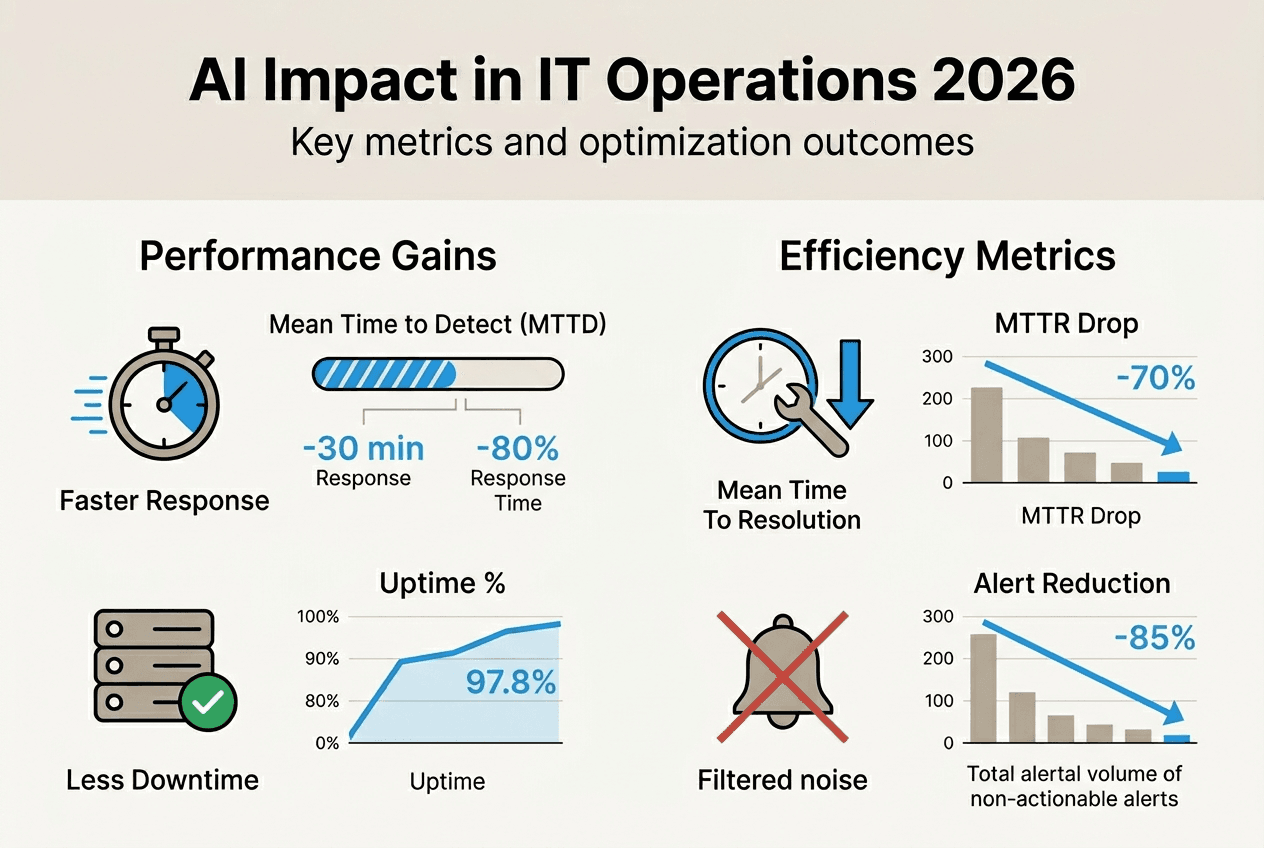
Empirical data reveals substantial improvements when organizations implement AI in IT operations. Research shows AIOps reduces MTTR by 40-55%, dramatically accelerating how quickly teams resolve incidents. This improvement stems from faster anomaly detection, automated correlation of related events, and immediate execution of remediation workflows. Every minute saved during outages translates directly to reduced business impact and lower revenue loss.
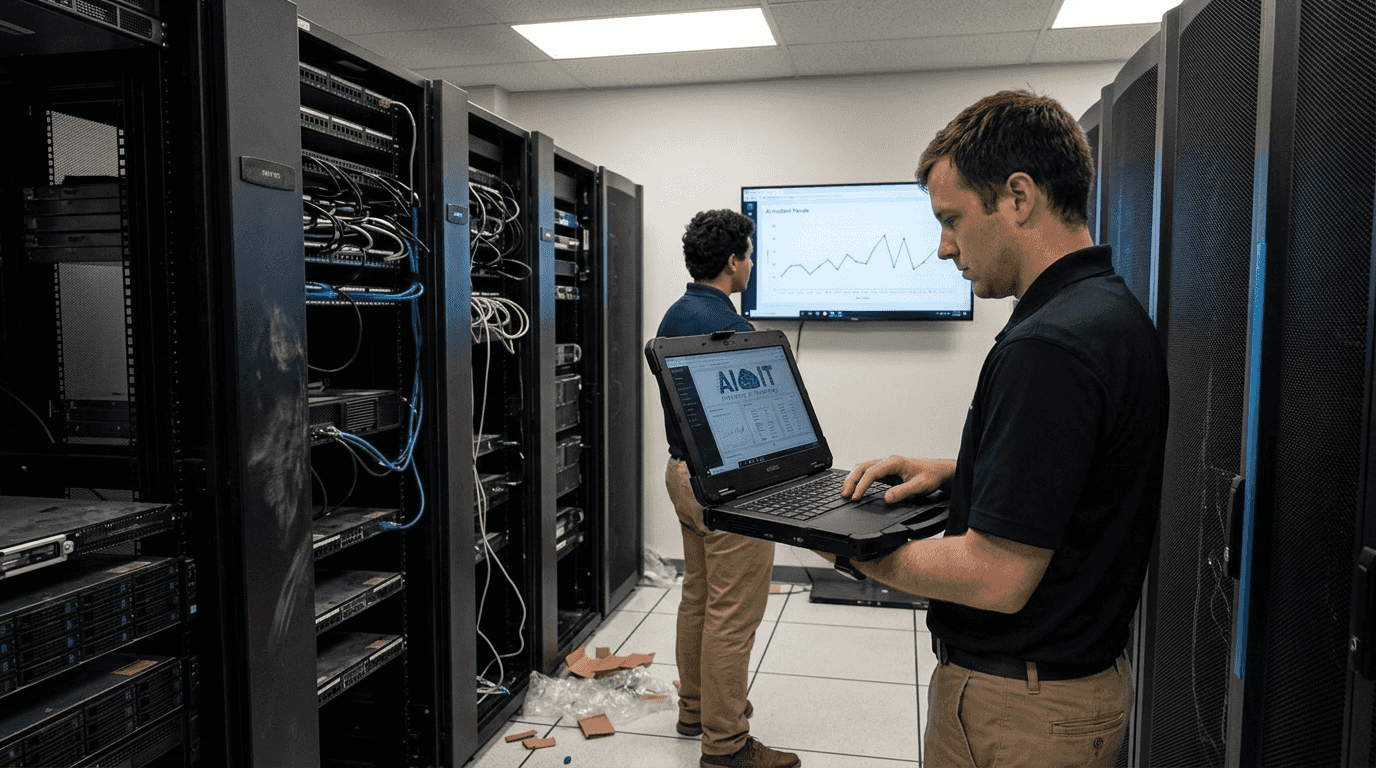
Incident detection accuracy improves by approximately 35% with AI integration. Traditional threshold-based monitoring generates numerous false positives, training your team to ignore alerts. Machine learning models learn normal behavior patterns for your specific environment, flagging genuine anomalies while filtering routine variations. This precision helps teams focus investigation efforts where they matter most.
Problem-solving accuracy increases by roughly 25% when AI assists root cause analysis. Complex issues often involve multiple contributing factors across distributed systems. AI correlates events temporally and causally, surfacing relationships human analysts might miss under pressure. This capability proves especially valuable during major incidents when rapid diagnosis determines recovery speed.
| Metric | Improvement | Impact |
|---|---|---|
| Mean Time To Resolution | 40-55% reduction | Faster incident recovery and reduced downtime costs |
| Incident Detection Accuracy | 35% improvement | Fewer false positives and better resource allocation |
| Problem-Solving Accuracy | 25% increase | More effective root cause identification |
| Ticket Deflection | 70% reduction | Lower workload on human operators |
| Alerts Per Incident | 22.88% decrease | Reduced alert fatigue and clearer priorities |
| Reopen Probability | 68% lower | More permanent fixes and fewer recurring issues |
Ticket deflection reaches 70% in well-implemented systems. AI handles routine requests and known issues automatically, routing only complex problems to human engineers. This filtering dramatically reduces workload, allowing your team to concentrate on strategic initiatives rather than repetitive troubleshooting.
Microsoft Security Copilot demonstrates AI’s effectiveness in real-world deployments. The platform reduces alerts per incident by nearly 23% and lowers the probability of ticket reopening by 68%. These improvements indicate both better initial problem resolution and more accurate alert correlation. Organizations using similar tools report significant decreases in on-call fatigue as engineers spend less time investigating false alarms.
Pro Tip: Track baseline metrics before implementing AI solutions. Document current MTTR, alert volumes, and resolution accuracy so you can quantify improvements objectively. This data proves value to stakeholders and guides optimization efforts.
SLA adherence improves substantially when AI monitors performance proactively. Predictive analytics identify degradation trends before they cause violations, triggering preventive actions. Some organizations report SLA compliance increases of 15-20 percentage points after deploying AIOps platforms. This improvement strengthens customer satisfaction and reduces penalty costs.
The financial impact extends beyond operational metrics. Faster incident resolution reduces revenue loss during outages. Lower alert volumes decrease operational costs by optimizing team utilization. Improved SLA compliance avoids penalties and preserves customer relationships. When you aggregate these benefits, many organizations achieve ROI within 12-18 months of AIOps deployment.
Challenges and limitations of AI in IT operations
Alert fatigue remains a critical obstacle despite AI’s promise to reduce notification volumes. Many AIOps implementations initially increase alerts as systems learn environment baselines. This learning phase overwhelms operators already struggling with notification overload. Organizations must tune thresholds carefully and implement gradual rollouts to avoid exacerbating existing problems.
Data quality directly determines AI effectiveness. Machine learning models trained on incomplete, inconsistent, or biased data produce unreliable outputs. Many IT environments lack standardized logging practices across different systems. This inconsistency forces extensive data cleaning before meaningful analysis becomes possible. Some organizations spend months preparing data infrastructure before deploying AI analytics.
Data scarcity poses challenges for training models in specialized environments. Your organization’s unique infrastructure configuration may lack sufficient historical incident data for robust pattern recognition. Generative AI offers potential solutions by creating synthetic training data, but this approach remains experimental. Most enterprises still require substantial real-world data to achieve reliable anomaly detection.
Explainable AI remains underdeveloped in many AIOps platforms. When AI flags an anomaly or recommends an action, operators need to understand the reasoning. Black-box models that provide conclusions without explanations erode trust, especially when recommendations contradict human intuition. Current XAI capabilities often provide only surface-level justifications rather than deep causal explanations.
Key challenges limiting adoption:
- Insufficient training data for niche infrastructure configurations
- Integration complexity with legacy monitoring tools
- High false positive rates during initial deployment phases
- Limited transparency in AI decision-making processes
- Difficulty quantifying ROI for pilot projects
- Resistance from teams concerned about job displacement
Scaling beyond pilot projects proves surprisingly difficult. While 88% of enterprises experiment with AIOps, only 12% achieve full deployment. This gap reflects real obstacles including technical complexity, organizational change management, and integration challenges. Success at small scale doesn’t guarantee enterprise-wide effectiveness.
| Challenge | Impact | Mitigation Strategy |
|---|---|---|
| Alert Fatigue | Operator overload and ignored notifications | Gradual rollout with careful threshold tuning |
| Data Quality | Inaccurate predictions and false positives | Standardize logging and invest in data pipelines |
| Explainability | Low trust and adoption resistance | Prioritize platforms with robust XAI capabilities |
| Scaling Difficulty | Limited enterprise-wide impact | Start with focused use cases and expand incrementally |
The hype surrounding AI often creates unrealistic expectations. Vendors promise complete automation and elimination of manual intervention, but reality proves more nuanced. AI augments human expertise rather than replacing it. Your engineers remain essential for complex troubleshooting, strategic planning, and handling novel situations outside training data patterns.
Cost considerations extend beyond software licensing. Successful AIOps requires investment in data infrastructure, integration development, and team training. Some organizations underestimate these expenses, leading to budget overruns and stalled implementations. Realistic financial planning accounts for the full technology stack and organizational change management needed to realize AI benefits.
Understanding these challenges and trends helps you set appropriate expectations and plan implementations that address real obstacles. Organizations achieving the best results acknowledge limitations upfront, design pilots that demonstrate value despite constraints, and build gradually toward broader deployment.
Practical steps to implement AI to optimize your IT operations
Successful AI implementation begins with comprehensive data integration. Connect monitoring tools, log aggregators, ticketing systems, and configuration databases to create unified visibility. This foundation enables AI to analyze relationships across your entire infrastructure. Prioritize high-volume data sources that provide the most valuable signals about system health and performance.
Develop your ML analytics capabilities incrementally:
- Start with anomaly detection for critical services where outages carry high business impact
- Add event correlation to group related alerts and reduce notification volumes
- Implement predictive analytics to forecast capacity constraints and performance degradation
- Deploy root cause analysis to accelerate troubleshooting during incidents
- Expand to proactive remediation for well-understood, repeatable issues
This phased approach builds organizational confidence while delivering measurable value at each stage. Rushing to full automation before establishing trust often triggers resistance that derails entire initiatives.
Automation orchestration transforms AI insights into action. Define clear workflows for common scenarios like service restarts, resource scaling, and configuration adjustments. Start with read-only recommendations that require human approval before execution. As your team gains confidence in AI accuracy, gradually expand to automated responses for low-risk situations.
Pro Tip: Target on-call fatigue reduction as your first use case. Engineers experiencing alert overload become enthusiastic AI advocates when the technology demonstrably improves their work-life balance. This grassroots support accelerates broader organizational adoption.
Measure impact using specific metrics aligned with business objectives. Track MTTR improvements, alert volume reductions, and SLA compliance changes. Document baseline performance before implementation so you can quantify improvements objectively. Regular measurement demonstrates value to stakeholders and identifies areas needing optimization.
Change management matters as much as technical implementation. Your team needs training on interpreting AI recommendations and understanding when to override automated decisions. Involve engineers early in pilot planning to address concerns and incorporate their expertise. Resistance often stems from fear of job displacement, so emphasize how AI handles repetitive tasks while freeing humans for complex, strategic work.
Select platforms offering strong integration capabilities with your existing tools. Proprietary systems requiring wholesale replacement of current monitoring infrastructure face adoption barriers. Look for solutions supporting open standards and providing robust APIs for custom integrations. This flexibility allows you to enhance current workflows rather than disrupting them.
Pilot projects should target specific pain points where success is measurable and visible. Reducing alerts for a frequently-failing service demonstrates immediate value. Accelerating diagnosis for a complex application proves AI’s analytical capabilities. These focused wins build momentum for broader deployment.
Consider these implementation best practices:
- Establish data governance ensuring consistent logging and metrics collection
- Create feedback loops where engineers can flag AI errors to improve model accuracy
- Document AI-driven decisions to build explainability and trust
- Set realistic timelines acknowledging learning curves and tuning requirements
- Allocate budget for ongoing model training and platform optimization
Security and compliance requirements influence architecture decisions. Ensure your AIOps platform handles sensitive operational data appropriately. Some industries require on-premises deployment or specific data residency controls. Address these constraints early to avoid costly redesigns later.
Partner with vendors offering strong support during initial deployment. The learning curve for AIOps is steep, and expert guidance accelerates time to value. Look for providers with experience in your industry who understand common challenges and proven solutions. This expertise helps you avoid pitfalls that derail implementations.
Explore practical automation strategies that balance AI capabilities with human oversight. The goal is augmented intelligence where technology handles routine tasks while escalating complex situations requiring judgment. This partnership model maximizes efficiency without sacrificing the critical thinking only humans provide.
Explore AICloudIT’s cutting-edge AI solutions for IT operations
AICloudIT provides comprehensive resources to help you navigate AI implementation in IT operations. Our platform delivers curated insights, practical guides, and the latest developments in AIOps technology. Whether you’re exploring initial pilots or scaling enterprise-wide deployments, we offer expertise tailored to your organization’s maturity level.
Discover detailed analyses of emerging AI tools, platform comparisons, and implementation case studies on our main site. Our content helps you evaluate solutions objectively and avoid common pitfalls. We translate complex AI concepts into actionable guidance for IT leaders managing real-world infrastructure challenges.
Access our extensive AIOps archives featuring articles on specific use cases, performance optimization techniques, and integration strategies. These resources provide the practical knowledge you need to build business cases, plan deployments, and measure success. Start optimizing your IT operations today with insights from industry experts who understand your challenges.
FAQ
What are common types of AI used in IT operations?
Machine learning, natural language processing, and anomaly detection form the core AI technologies in IT operations. ML algorithms identify patterns in historical data to predict future issues and optimize resource allocation. NLP enables chatbots and virtual assistants that handle routine support requests. Anomaly detection flags unusual behavior indicating potential problems before they impact users. These AI types work together to deliver comprehensive operational intelligence.
How does AI reduce alerts and improve incident response?
AI correlates related events across systems, grouping them into single incidents rather than generating separate alerts for each symptom. This consolidation filters duplicate notifications and false positives that overwhelm operators. Machine learning models trained on your environment’s normal behavior detect genuine anomalies faster and more accurately than threshold-based monitoring. Research shows AI reduces alerts per incident by 22.88% while lowering reopen probability by 68%. These improvements enable faster, more accurate incident resolution.
What are the biggest challenges when adopting AI in IT operations?
Alert fatigue remains problematic as systems learn baseline behaviors and generate noise during initial deployment. Data quality issues undermine AI accuracy when logging practices are inconsistent across infrastructure components. Explainability limitations reduce trust when platforms provide recommendations without clear reasoning. Scaling beyond pilots proves difficult, with only 12% of enterprises achieving full deployment despite widespread experimentation. Understanding these challenges helps you plan realistic implementations that address obstacles proactively.
How long does it take to see ROI from AIOps implementation?
Most organizations achieve measurable ROI within 12-18 months of deployment when they follow structured implementation approaches. Early wins come from reduced alert volumes and faster incident resolution in pilot areas. Full financial benefits emerge as automation scales across more infrastructure and processes. ROI timelines depend heavily on data quality, integration complexity, and organizational change management effectiveness. Starting with focused use cases targeting high-impact pain points accelerates value realization and builds momentum for broader adoption.
Recommended
- The role of AI in cloud management efficiency 2026
- Role of AI in Automation: Transforming IT Efficiency
- 6 Essential AI Tools for Technologists to Boost Efficiency
- Optimize AI model training with cloud computing in 2026
