

Big data transforms AI from theoretical potential into practical power. Yet many organizations pour resources into collecting massive datasets without understanding that volume alone doesn’t guarantee success. A tenfold increase in training data can boost AI accuracy by 15%, but only when paired with rigorous quality controls and governance. This guide cuts through the hype to show IT professionals and business leaders exactly how big data fuels AI innovation and where common approaches fall short.
Key Takeaways
| Point | Details |
|---|---|
| Data dimensions drive AI success | Volume, variety, and velocity of big data jointly determine model accuracy and capabilities. |
| Quality trumps quantity | Poor data governance reduces AI performance by over 20% regardless of dataset size. |
| Strategic frameworks prevent failure | Adapted methodologies like CRISP-DM integrate big data workflows into AI development. |
| Real applications prove value | Retailers see 20% conversion gains, financial firms cut fraud detection time 40%. |
| Ethics require active management | Diverse datasets and governance reduce AI bias incidents by up to 40%. |
Introduction to Big Data and AI Synergy
Big data and artificial intelligence form a symbiotic relationship where each amplifies the other’s capabilities. Understanding this partnership starts with grasping what makes data “big” and how AI models learn.
Big data exhibits three defining characteristics:
- Volume: Datasets measuring terabytes to petabytes that exceed traditional database capacity
- Variety: Structured numbers, unstructured text, images, video, sensor readings, and social media streams
- Velocity: Data generated and processed at speeds requiring real-time or near-real-time handling
AI models learn through pattern recognition across training examples. Neural networks adjust billions of parameters by processing input-output pairs repeatedly. The model’s ability to generalize from training data to new situations depends heavily on exposure to diverse, representative examples during this learning phase.
When you combine big data’s scale and diversity with AI’s learning mechanisms, something powerful emerges. Large volumes provide enough examples for models to detect subtle patterns. Variety exposes models to edge cases and unusual scenarios they’ll encounter in production. Velocity enables continuous learning as new data streams in, keeping models current.
This synergy explains why big data’s impact on AI analytics has become a strategic priority for organizations racing to deploy intelligent systems. The relationship isn’t automatic, though. Poor implementation wastes resources and produces unreliable AI.
Big Data as the Foundation of AI Model Training
Each dimension of big data contributes uniquely to AI model performance, creating measurable improvements when managed correctly.

Volume drives accuracy through statistical power. More training examples help models learn robust patterns rather than memorizing noise. Research consistently shows that tenfold increases in quality training data can improve model accuracy by 10-15%. This relationship isn’t linear forever, but for most enterprise applications, teams haven’t hit diminishing returns yet.
Variety enables sophisticated multimodal capabilities. Modern AI applications combine text, images, and structured data. A customer service bot needs to parse written complaints, analyze attached photos of damaged products, and reference order histories. Training such systems requires diverse data types that mirror real-world complexity.
Velocity powers real-time intelligence. Fraud detection systems process transaction data within milliseconds to block suspicious charges before completion. Recommendation engines update based on click streams as users browse. These applications demand big data infrastructure capable of ingesting and analyzing information at speed.
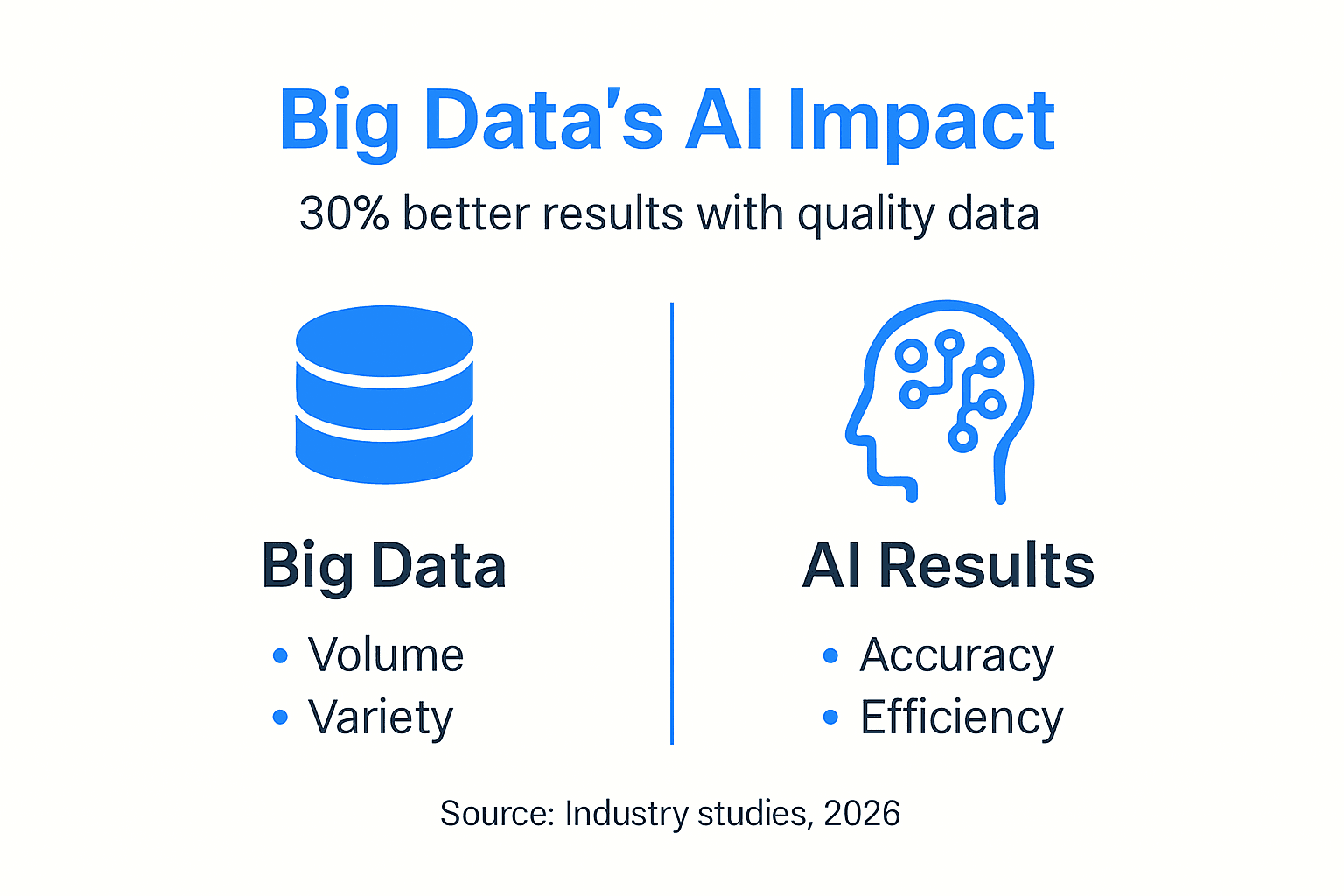
Here’s how data volume affects AI performance across common model types:
| Model Type | Data Volume Impact | Accuracy Gain |
|---|---|---|
| Image Classification | 10x more labeled images | 12-15% improvement |
| Natural Language | 10x more text samples | 10-13% improvement |
| Fraud Detection | 10x more transactions | 8-11% improvement |
| Recommendation | 10x more user interactions | 15-18% improvement |
Yet volume means nothing without quality. AI models trained without adequate big data preprocessing and cleaning suffer up to 30% worse performance in real-world scenarios. Duplicate records, missing values, inconsistent formats, and measurement errors all degrade model learning.
The preprocessing pipeline matters as much as the data itself:
- Cleaning: Remove duplicates, fix errors, handle missing values systematically
- Normalization: Standardize scales and formats across data sources
- Feature engineering: Transform raw data into representations models can learn from effectively
- Validation: Split data properly to test model performance on unseen examples
Pro Tip: Invest in automated data quality monitoring that flags issues before they poison your training pipeline. Catching problems early saves exponentially more time than debugging mysterious model failures later.
Common Misconceptions about Big Data in AI
Several persistent myths about big data in AI lead organizations astray, wasting budgets and damaging credibility.
Myth 1: More data always produces better AI. This oversimplification ignores data quality, relevance, and representativeness. Adding millions of low-quality examples to your training set doesn’t improve outcomes. Poor data quality can reduce AI performance by over 20% despite voluminous datasets. You need both quantity and quality working together.
Myth 2: Big data volume eliminates AI bias. Larger datasets actually amplify existing biases if the data isn’t representative. A facial recognition system trained on 10 million images performs worse on underrepresented groups than a smaller, balanced dataset would. Bias mitigation requires deliberate sampling strategies and diverse data sources, not just scale.
Myth 3: AI automatically extracts value from big data. Machine learning models are sophisticated pattern matchers, not magic interpreters. They need carefully engineered features, appropriate architectures, and domain expertise guiding their training. Throwing raw big data at an algorithm rarely produces useful intelligence without substantial human guidance.
Myth 4: Data governance is optional for AI projects. This misconception leads to compliance nightmares, security breaches, and unreliable models. Without governance, you can’t track data lineage, ensure privacy compliance, or maintain consistent quality standards. These failures sink AI initiatives before they deliver value.
Understanding common big data misconceptions helps you avoid these traps. The distinction between AI and data science also clarifies where each discipline adds value in the analytics pipeline.
Pro Tip: Before expanding your data collection, audit what you already have. Organizations often sit on valuable untapped data while chasing expensive new sources. Cleaning and leveraging existing assets frequently delivers faster ROI than acquisition projects.
Frameworks and Models for Big Data and AI Integration
Successful big data and AI integration requires structured methodologies that bridge analytics and machine learning workflows.
Adapted CRISP-DM for AI: The Cross-Industry Standard Process for Data Mining translates well to AI projects with modifications:
- Business understanding: Define AI objectives and success metrics clearly
- Data understanding: Assess big data sources for volume, variety, quality, and accessibility
- Data preparation: Execute the preprocessing pipeline with AI-specific feature engineering
- Modeling: Train and tune algorithms using big data infrastructure
- Evaluation: Test against real-world scenarios, not just validation sets
- Deployment: Integrate models into production with monitoring and retraining pipelines
This framework keeps teams focused on business value rather than getting lost in technical experimentation.
Data governance frameworks: Formal governance ensures big data remains reliable, compliant, and valuable for AI:
- Data quality standards: Define acceptable ranges, formats, and completeness thresholds
- Access controls: Implement role-based permissions and audit trails
- Lineage tracking: Document data origins, transformations, and destinations
- Privacy compliance: Enforce GDPR, CCPA, and industry-specific regulations
- Lifecycle management: Archive, refresh, or purge data based on relevance and requirements
Organizations with mature data governance frameworks report 40% fewer AI project failures and faster time to production.
Tool stack considerations: Your big data platform must support AI workflows efficiently:
| Capability | Big Data Tools | AI Requirements |
|---|---|---|
| Storage | Hadoop, S3, Azure Data Lake | Fast random access for training |
| Processing | Spark, Flink | GPU acceleration, distributed training |
| Orchestration | Airflow, Kubeflow | Model versioning, experiment tracking |
| Serving | Kafka, Kinesis | Low-latency inference APIs |
Choosing compatible tools prevents expensive migrations when scaling from prototype to production.
Real-World Examples of Big Data Enhancing AI Applications
Concrete examples demonstrate how big data directly enables AI-driven business outcomes across industries.
Retail personalization: Major retailers analyze billions of customer interactions, combining purchase histories, browsing behavior, demographic data, and seasonal patterns. AI models trained on this diverse big data generate personalized product recommendations and dynamic pricing. Results include 20% higher conversion rates and 15% increases in average order values. The key success factor was integrating previously siloed data sources into unified customer profiles.
Financial fraud detection: Banks process millions of transactions daily, feeding real-time data into AI models that flag suspicious patterns. By leveraging big data velocity, these systems cut fraud detection time by up to 40% compared to rule-based approaches. The models learn subtle indicators that manual rules miss, adapting as fraud tactics evolve. Financial institutions report blocking 30-35% more fraudulent transactions while reducing false positives that frustrate legitimate customers.
Healthcare diagnostics: Medical AI systems analyze multimodal big data including imaging scans, electronic health records, genomic sequences, and clinical notes. This variety enables more accurate diagnoses than any single data type provides. Radiology AI trained on millions of annotated images detects anomalies human experts miss while reducing interpretation time. Early disease detection rates improve significantly when big data diversity supports comprehensive pattern recognition.
Manufacturing optimization: Industrial AI monitors sensor data from thousands of equipment points, identifying maintenance needs before failures occur. Predictive models trained on years of operational big data reduce unplanned downtime by 25-30% and extend equipment lifespans. The volume of historical data lets models distinguish normal variation from genuine degradation signals.
Explore how retail personalization with AI continues evolving. For robust infrastructure supporting these applications, consider partnerships with reliable cloud infrastructure providers that handle big data workloads.
Ethical and Governance Considerations in Big Data for AI
The power of big data-fueled AI brings significant ethical responsibilities that organizations must address proactively.
Bias mitigation requires active intervention. Big data doesn’t automatically create fair AI. In fact, large datasets often encode historical discrimination and systemic inequities. Addressing this requires:
- Representative sampling: Deliberately include underrepresented groups in training data
- Bias testing: Evaluate model performance across demographic segments
- Fairness constraints: Implement algorithmic adjustments that prevent discriminatory outcomes
- Diverse teams: Include varied perspectives in AI development and governance
Organizations implementing comprehensive ethical AI frameworks reduce bias incidents by up to 40% while building greater stakeholder trust.
Regulatory compliance protects operations and reputation. Data privacy regulations like GDPR impose strict requirements on how you collect, process, and store personal information. Non-compliance risks massive fines and legal exposure. Your big data governance must enforce:
- Purpose limitation: Use data only for explicitly stated, legitimate purposes
- Data minimization: Collect only what you genuinely need for AI applications
- Right to explanation: Document how AI models make decisions affecting individuals
- Deletion capabilities: Purge personal data upon request while maintaining model integrity
Robust AI data security and governance practices become competitive advantages as customers increasingly value privacy.
Transparency builds trust in AI systems. When stakeholders understand how AI uses their data and makes decisions, they’re more likely to accept outcomes. This requires clear communication about:
- What data you collect and why
- How AI models process information
- What safeguards prevent misuse
- How humans oversee automated decisions
The AI ethics importance extends beyond compliance to fundamental questions about technology’s role in society.
Conclusion: Strategic Takeaways for Leveraging Big Data in AI
The relationship between big data and AI success is neither automatic nor simple, but you can master it with the right approach.
Five strategic principles guide effective implementation:
- Balance all three dimensions: Volume, variety, and velocity each contribute uniquely to AI capabilities
- Prioritize quality with scale: Data governance and preprocessing determine whether big data helps or harms model performance
- Adopt proven frameworks: Structured methodologies like adapted CRISP-DM prevent common pitfalls and accelerate delivery
- Learn from real applications: Industry examples reveal patterns of success and failure worth studying before you invest
- Embed ethics from day one: Bias mitigation and governance aren’t afterthoughts but foundational requirements
Big data’s 15% accuracy improvements and 40% efficiency gains represent real competitive advantages. Organizations that treat data as a strategic asset rather than a technical resource position themselves to lead in AI-driven markets.
Stay current with evolving best practices. As AI capabilities advance and regulations tighten, your big data strategies must adapt. The fundamentals remain constant, but implementation details shift with technology and expectations.
Explore Advanced AI Solutions with AICloudIT
Ready to turn these insights into action? AICloudIT provides the resources IT professionals need to excel at AI and big data integration. Our platform offers curated coverage of emerging AI tools, practical implementation guides, and strategic frameworks tailored for technology leaders. Whether you’re exploring artificial general intelligence resources, researching AI applications for your industry, or seeking an AI tool setup guide to boost team productivity, you’ll find expert insights that accelerate your initiatives. Join thousands of professionals leveraging AICloudIT to stay ahead in the rapidly evolving AI landscape.
Frequently Asked Questions
What makes big data essential for AI model accuracy?
Big data provides the volume and diversity of training examples AI models need to learn robust patterns rather than memorizing noise. Tenfold increases in quality data can improve model accuracy by 10-15%, while variety ensures models handle real-world complexity. Without sufficient big data, models overfit to limited examples and fail when encountering new scenarios.
How does data variety improve AI learning capabilities?
Variety exposes models to different data types and formats they’ll encounter in production, enabling multimodal applications that combine text, images, structured data, and sensor readings. Models trained on diverse data generalize better to edge cases and unusual situations. This breadth prevents the brittleness that comes from training on homogeneous datasets.
Why is data governance critical in big data for AI?
Governance ensures data quality, regulatory compliance, and ethical AI use. Without formal frameworks, organizations suffer from inconsistent data quality that degrades model performance by over 20%, compliance violations that trigger massive fines, and bias issues that damage reputation. Strong governance reduces AI project failures by 40% while accelerating time to production.
What are common pitfalls when integrating big data with AI?
Organizations frequently prioritize data volume over quality, neglect preprocessing that prevents 30% performance losses, and ignore bias in large datasets. Other failures include inadequate governance, choosing incompatible tool stacks, and expecting AI to automatically extract value without domain expertise. Learn from AI data analytics role best practices to avoid these traps.
How can businesses ensure ethical AI use with big data?
Implement comprehensive frameworks covering bias testing, representative sampling, fairness constraints, and diverse development teams. Enforce privacy regulations through purpose limitation and data minimization. Maintain transparency about data collection and AI decision-making processes. Organizations following ethical AI principles reduce bias incidents by 40% while building stakeholder trust.
Recommended
- How to Analyze AI Performance for Accurate Results
- AI vs. Data Science Archives – AICloudIT
- AI Visibility Metrics Every Website Must Track in 2026 – AICloudIT
- AI vs. Machine Learning Archives – AICloudIT
- RankPirate
