

Cybersecurity threats are growing faster and more sophisticated than ever. Traditional defenses struggle to keep pace with the volume and complexity of modern attacks. AI is changing the game by cutting incident response times by up to 85%, enabling real-time threat detection and automated mitigation. For IT professionals integrating AI solutions, understanding how to harness these capabilities while navigating limitations is critical to building resilient security postures in 2026.
Key Takeaways
| Point | Details |
|---|---|
| AI dramatically accelerates incident response | Real-time anomaly detection and automated responses cut response times by up to 85% compared to manual methods. |
| AI augments human analysts, not replaces them | Human oversight remains essential for ethical governance, adversarial attack mitigation, and contextual decision making. |
| AI and traditional tools serve complementary roles | AI excels at zero-day and pattern anomaly detection; traditional tools provide signature-based reliability. |
| Practical frameworks enable successful integration | Stepwise adoption with multidisciplinary teams, continuous learning metrics, and ethical guidelines ensures sustainable AI deployment. |
| Real-world evidence validates AI’s impact | Financial sectors and enterprises report measurable reductions in breaches, faster threat mitigation, and improved security posture. |
Introduction to AI in Cybersecurity
AI in cybersecurity refers to leveraging machine learning algorithms, neural networks, and adaptive models to detect, analyze, and respond to cyber threats automatically. Unlike signature-based tools that rely on known threat databases, AI systems learn from vast datasets to identify unusual patterns and zero-day vulnerabilities in real time. This shift from reactive to proactive defense represents a fundamental evolution in how organizations protect their digital assets.
The journey from traditional tools to AI-powered systems began decades ago. Early antivirus software depended on signature matching, requiring constant manual updates to recognize new malware. As threats grew more sophisticated, heuristic analysis emerged, but still fell short against polymorphic and zero-day attacks. Today, AI models ingest terabytes of network data, user behavior logs, and threat intelligence feeds to predict and neutralize threats before they cause damage. The role of AI in decision making extends beyond cybersecurity, reshaping how enterprises approach risk management across domains.
Several key drivers fuel AI adoption in cybersecurity:
- Exponential growth in attack volume and complexity demands automated defenses that operate at machine speed.
- Shortage of skilled cybersecurity analysts makes AI augmentation essential to handle workload at scale.
- Demand for real-time threat response necessitates systems that detect and mitigate attacks within seconds, not hours.
- Regulatory compliance requirements push organizations toward transparent, auditable AI systems with AI data security practices built in.
Successful AI adoption requires foundational prerequisites. Organizations need quality data pipelines, sufficient compute infrastructure, and multidisciplinary teams combining cybersecurity expertise with AI knowledge. Integration with existing security information and event management (SIEM) platforms ensures AI tools fit seamlessly into operational workflows. As AI and cloud in enterprises converge, scalable cloud-based AI security solutions become increasingly accessible to mid-sized IT teams. Beyond cybersecurity, AI’s expanding roles demonstrate its versatility in analyzing complex data patterns across industries.
How AI Enhances Threat Detection and Response
AI transforms threat detection through real-time anomaly detection. Machine learning models analyze millions of data points, including network traffic, user behavior, endpoint activity, and application logs, to establish baseline patterns. When deviations occur, such as unusual login times, unexpected data transfers, or abnormal system calls, AI flags these anomalies instantly. This capability is crucial for identifying zero-day exploits and advanced persistent threats that evade signature-based defenses.
Automated incident response represents AI’s second major advantage. Once a threat is detected, AI-driven systems can automatically isolate compromised endpoints, block malicious IP addresses, and initiate forensic data collection without waiting for human intervention. This automation reduces the window of exposure from hours to seconds, minimizing potential damage. Security orchestration, automation, and response (SOAR) platforms integrate AI detection with automated workflows, enabling coordinated responses across multiple security tools simultaneously.
The impact is quantifiable. Organizations implementing AI-powered security operations centers (SOCs) report up to 85% reduction in threat response times compared to manual processes. Financial institutions leveraging AI for fraud detection see similar acceleration, with AI in financial sector cybersecurity cutting false positives while catching sophisticated attacks traditional systems miss. Mean time to detect (MTTD) and mean time to respond (MTTR) drop dramatically, directly reducing breach costs and operational disruption.
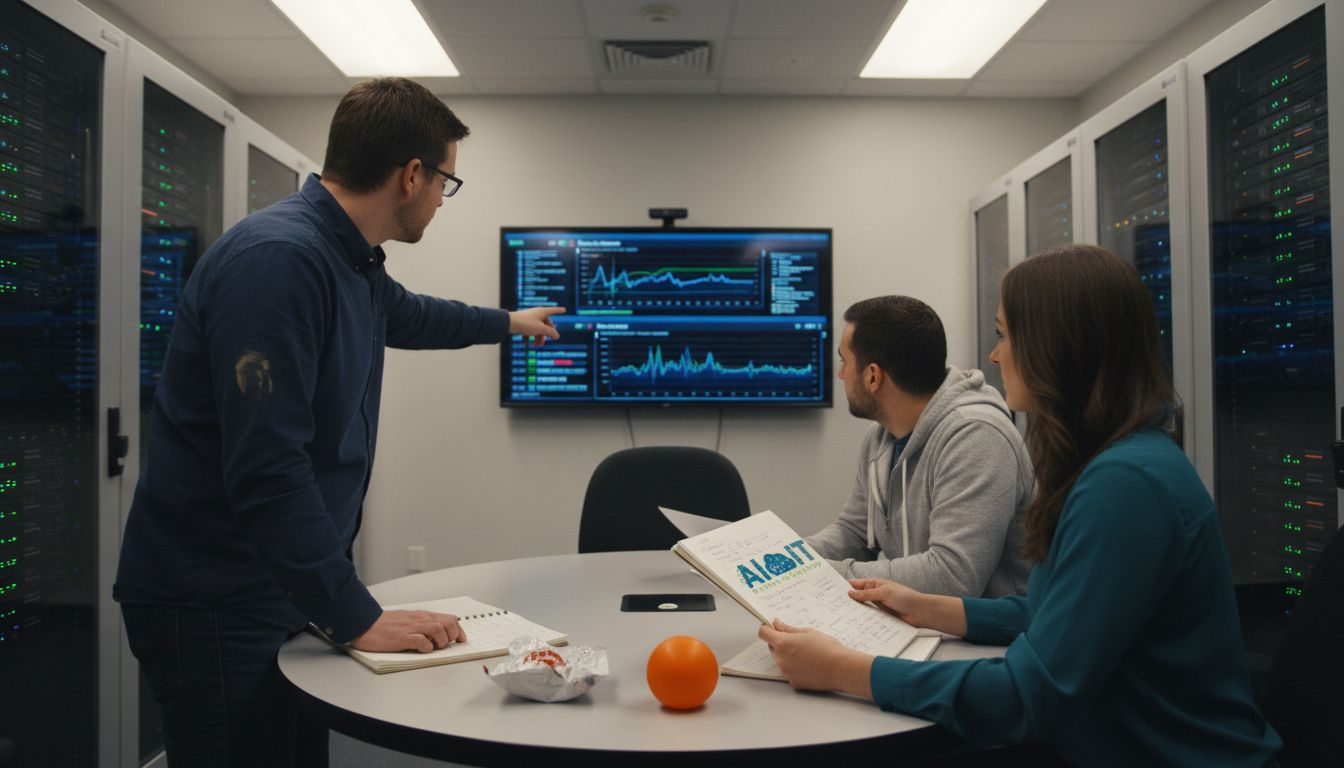
Pro Tip: Combine AI with SOAR tools for maximum efficiency. SOAR platforms orchestrate automated playbooks triggered by AI detections, ensuring consistent, rapid responses across your security infrastructure while maintaining audit trails for compliance.
Key AI capabilities enhancing detection and response include:
- Behavioral analytics identifying insider threats through user activity monitoring.
- Predictive threat intelligence correlating global attack data to anticipate emerging campaigns.
- Natural language processing analyzing threat reports and dark web chatter for early warnings.
- Adaptive learning continuously refining detection models based on new attack vectors.
Common Misconceptions and Real Limitations
A pervasive myth holds that AI will replace human cybersecurity analysts entirely. This is false. AI excels at processing vast data volumes and recognizing patterns, but lacks contextual understanding, ethical judgment, and creative problem solving humans provide. Analysts remain essential for investigating complex incidents, making risk-based decisions, and adapting strategies to novel threats. AI augments human capabilities, handling routine tasks so analysts focus on high-value activities requiring expertise and intuition.
AI systems face genuine vulnerabilities. Adversarial attacks manipulate AI inputs to evade detection or trigger false positives. Attackers can craft malware variants that exploit blind spots in training data, causing AI models to misclassify threats as benign. Over 40% of surveyed organizations reported adversarial AI attacks that bypass AI-based defenses, highlighting this growing challenge. Regular adversarial testing, diverse training datasets, and ensemble models combining multiple AI approaches help mitigate these risks.
Ethical concerns compound technical limitations. AI models trained on biased data perpetuate those biases, potentially flagging legitimate user behavior from certain demographics as suspicious. Lack of transparency in deep learning models, the “black box” problem, makes it difficult to explain why AI flagged specific events, complicating compliance and trust. Organizations must implement AI ethics and bias frameworks ensuring fairness, accountability, and transparency in AI-driven security decisions.
Common misconceptions and corrections:
-
Misconception: AI achieves 100% threat detection accuracy.
Reality: No system is perfect; AI reduces false negatives but requires continuous tuning to minimize false positives. -
Misconception: Once deployed, AI models need no maintenance.
Reality: Threat landscapes evolve constantly; models require regular retraining and validation against new attack patterns. -
Misconception: AI eliminates the need for traditional security tools.
Reality: AI complements existing defenses; layered security combining AI with firewalls, encryption, and access controls provides optimal protection. -
Misconception: All AI cybersecurity solutions deliver equal value.
Reality: Tool effectiveness depends on data quality, integration capabilities, and alignment with organizational threat profiles.
Pro Tip: Establish human-in-the-loop oversight where AI recommendations require analyst approval before executing high-impact actions like network segmentation or account suspension, balancing speed with control.
“Understanding AI limitations in cybersecurity is as important as recognizing its strengths. Transparency and continuous validation ensure AI remains a trustworthy partner in defense operations.”
Comparing AI and Traditional Cybersecurity Solutions
Understanding when AI-powered tools outperform traditional approaches, and vice versa, guides effective technology selection. The table below compares key dimensions:
| Dimension | AI-Powered Solutions | Traditional Solutions |
|---|---|---|
| Detection Speed | Real-time, milliseconds to seconds | Minutes to hours for analysis |
| Zero-Day Threats | High effectiveness through anomaly detection | Limited; relies on signatures |
| Scalability | Handles massive data volumes effortlessly | Manual scaling; resource intensive |
| False Positive Rate | Lower with tuned models | Higher with rigid rules |
| Implementation Complexity | Requires AI expertise, quality data pipelines | Simpler deployment, established processes |
| Transparency | Black box challenges in deep learning | Clear rule-based logic |
| Adaptability | Continuous learning from new threats | Manual updates required |
| Cost Structure | High initial investment, lower operational costs | Lower upfront, higher ongoing maintenance |
AI solutions shine in environments facing high threat volumes, sophisticated attacks, and resource constraints. They excel at detecting anomalies in user behavior, identifying patterns across distributed systems, and automating responses to common incidents. AI versus traditional cybersecurity integration allows organizations to leverage strengths of both approaches simultaneously.
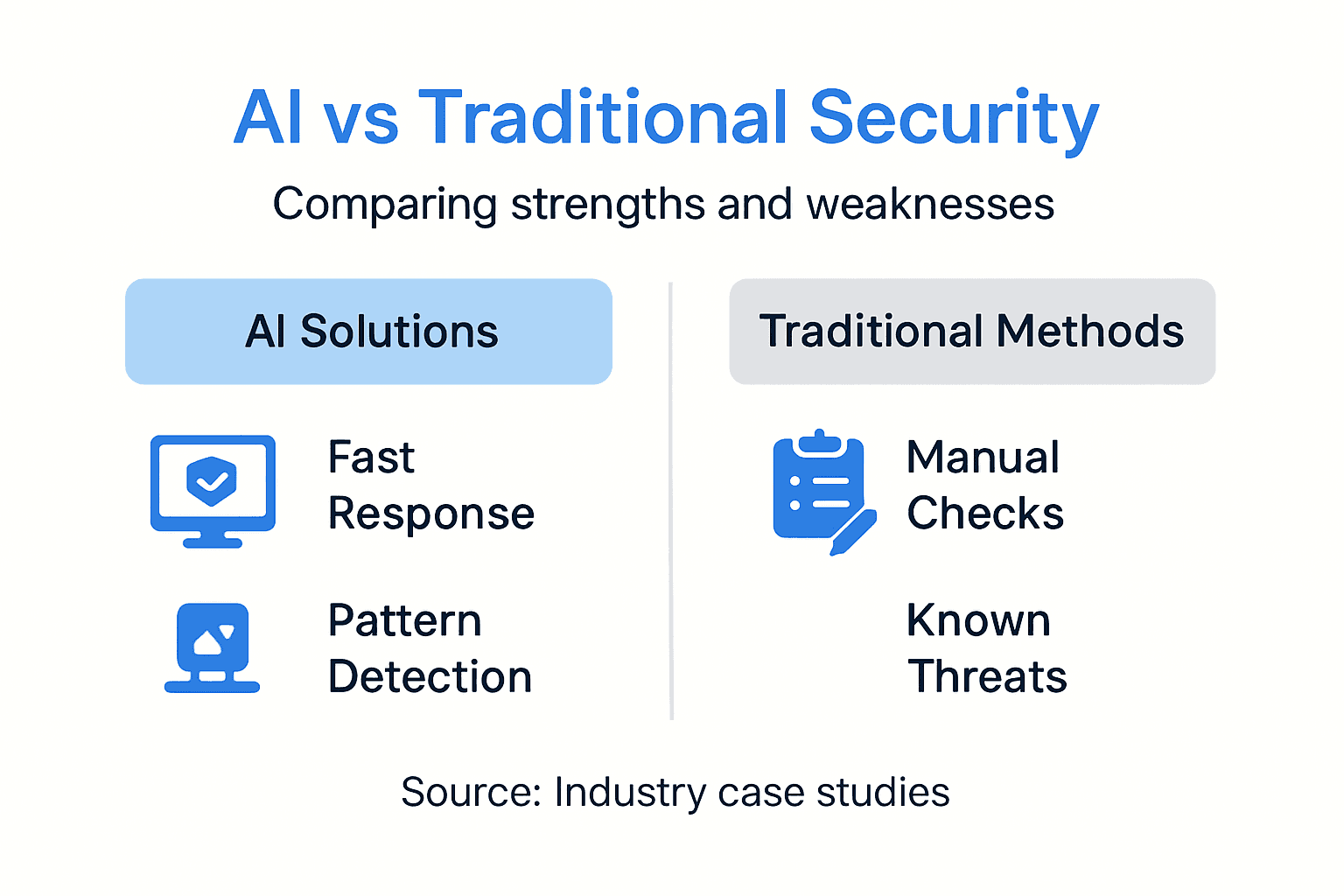
Traditional tools remain valuable for well-understood threats, compliance-driven signature matching, and scenarios requiring explainable decisions. Signature-based antivirus still catches known malware efficiently, and rule-based firewalls provide predictable network filtering. Combining approaches delivers defense in depth.
When to favor AI solutions:
- Your organization handles petabytes of data requiring real-time analysis.
- Zero-day and advanced persistent threats constitute primary concerns.
- Analyst teams are overwhelmed by alert volumes and manual triage.
- Budget allows for upfront investment in AI infrastructure and expertise.
When traditional tools suffice:
- Threat landscape is stable with well-documented attack signatures.
- Regulatory requirements demand transparent, auditable decision processes.
- IT teams lack AI expertise or resources for model maintenance.
- Budget constraints favor lower upfront costs despite higher operational overhead.
Optimal strategies blend both paradigms. Use AI for anomaly detection and rapid response while maintaining traditional signature-based defenses as a reliable baseline. This layered approach ensures coverage across known and unknown threats.
Frameworks and Best Practices for AI Integration
Successful AI adoption follows a structured framework balancing technical implementation with organizational readiness. This stepwise approach ensures sustainable integration:
-
Assess Organizational Readiness: Evaluate data infrastructure, compute resources, and team capabilities. Identify gaps in AI expertise, data quality, and integration requirements before selecting tools.
-
Define Clear Use Cases: Prioritize specific security challenges AI will address, such as insider threat detection, malware classification, or vulnerability management. Avoid vague “AI everywhere” strategies lacking measurable objectives.
-
Select Appropriate Tools: Choose AI platforms aligning with existing infrastructure, threat priorities, and budget. Evaluate vendor claims through proof-of-concept deployments measuring detection accuracy and false positive rates.
-
Build Multidisciplinary Teams: Combine cybersecurity analysts, data scientists, AI engineers, and ethics specialists. Cross-functional collaboration ensures technical effectiveness meets operational and ethical standards.
-
Establish Continuous Monitoring: Define key performance indicators (KPIs) such as detection time reduction, false positive rates, mean time to respond, and return on investment. Track metrics continuously to validate AI value and identify tuning needs.
-
Implement Ethical Guidelines: Create policies governing data usage, bias mitigation, transparency requirements, and human oversight. Regular audits ensure AI systems operate fairly and comply with regulations.
-
Maintain Feedback Loops: Capture analyst feedback on AI recommendations, false positives, and missed detections. Use this input to retrain models, refine detection thresholds, and improve accuracy over time.
Continuous learning is non-negotiable. Threat actors constantly evolve tactics, requiring AI models to adapt through regular retraining on fresh threat intelligence and attack data. AI adoption frameworks emphasize iterative improvement cycles where models are validated against real-world incidents and updated accordingly.
Human-in-the-loop control maintains accountability. Critical decisions, such as blocking legitimate business processes or isolating production systems, should require analyst confirmation. This balance preserves speed while preventing costly false positives.
Measuring success involves both quantitative and qualitative metrics. Quantitatively, track MTTD, MTTR, incident volume handled per analyst, and cost per incident resolved. Qualitatively, assess analyst satisfaction, stakeholder confidence in AI recommendations, and compliance audit outcomes. Together, these indicators provide a holistic view of AI’s security impact.
Case Studies and Evidence of AI Impact
Real-world deployments validate AI’s cybersecurity benefits across industries. Financial institutions face relentless attacks targeting customer data and transaction systems. One major bank implemented AI-driven anomaly detection across its global network, analyzing transaction patterns, user behavior, and network traffic in real time. Within six months, the system identified previously undetected fraudulent activity, reducing breach incidents by 62%. Financial sector AI cybersecurity applications demonstrate measurable ROI through reduced fraud losses and faster threat containment.
Enterprise IT departments managing complex hybrid cloud environments benefit similarly. A Fortune 500 retailer deployed AI-augmented SOAR tools integrating with existing SIEM platforms. The AI layer processed over 10 million security events daily, automatically triaging alerts and orchestrating responses for common threats. Human analysts focused on high-priority incidents requiring investigation. Results included a 78% reduction in mean time to respond, a 40% decrease in false positive alerts reaching analysts, and improved compliance posture through consistent, auditable incident handling.
Key outcome metrics from case studies:
- 85% faster threat detection and response times compared to manual processes.
- 62% reduction in successful breach incidents through proactive anomaly detection.
- 40% decrease in false positive rates, improving analyst productivity and reducing alert fatigue.
- 78% reduction in mean time to respond, minimizing attack window and limiting damage.
- Measurable cost savings from prevented breaches, reduced downtime, and operational efficiency gains.
These examples underscore AI’s tangible impact when implemented thoughtfully with proper integration, team training, and continuous optimization. Success depends not on AI alone but on combining technology with skilled personnel and robust processes.
Practical Challenges and Future Outlook
Despite proven benefits, AI cybersecurity adoption faces persistent challenges. Building effective multidisciplinary teams requires recruiting scarce talent combining cybersecurity domain knowledge with AI expertise. Organizations struggle to find professionals who understand both threat landscapes and machine learning model development. Training existing staff bridges this gap but demands time and investment.
Ethical governance remains complex. As AI systems make increasingly autonomous security decisions, ensuring fairness, transparency, and accountability becomes critical. Continuous ethical governance and multidisciplinary teams are essential for sustainable AI cybersecurity, requiring ongoing audits, bias testing, and policy refinement. Establishing clear lines of responsibility when AI-driven actions cause unintended consequences, such as blocking legitimate users or exposing sensitive data during automated responses, demands legal and operational clarity.
Evolving threat landscapes driven by AI-enabled attacks compound these challenges. Adversaries increasingly use AI to automate reconnaissance, craft convincing phishing campaigns, and develop polymorphic malware evading detection. This AI arms race requires continuous model updates, adversarial robustness testing, and collaborative threat intelligence sharing across organizations and sectors.
Common failure points and mitigation strategies:
- Insufficient training data: Leads to inaccurate models. Mitigate by aggregating diverse datasets, partnering with threat intelligence providers, and using synthetic data generation.
- Lack of integration: AI tools operating in silos miss context. Ensure deep integration with SIEM, SOAR, and existing security infrastructure.
- Neglecting model maintenance: Stale models miss new threats. Establish regular retraining schedules and automated model performance monitoring.
- Ignoring explainability: Black box decisions erode trust. Invest in explainable AI techniques and maintain human oversight for critical actions.
Looking ahead to 2026 and beyond, several trends shape AI cybersecurity’s future. Federated learning enables collaborative model training across organizations without sharing sensitive data, improving detection capabilities while preserving privacy. Quantum computing poses both threats and opportunities, potentially breaking current encryption but also enabling quantum-resistant AI algorithms. Edge AI brings real-time threat detection to IoT devices and distributed networks, reducing latency and bandwidth demands.
Regulatory frameworks governing AI in cybersecurity will mature, establishing standards for transparency, accountability, and bias mitigation. Organizations that proactively adopt ethical AI governance practices will gain competitive advantages through stakeholder trust and regulatory compliance.
“The future of cybersecurity lies not in AI replacing humans but in symbiotic partnerships where machines handle scale and speed while humans provide judgment, creativity, and ethical oversight.”
Preparing for these trends requires strategic investments in AI infrastructure, continuous team development, and adaptive security architectures. IT professionals who master AI integration today position their organizations to lead in an increasingly complex threat environment.
Explore AI-Powered Cybersecurity Solutions with AICloudIT
AICloudIT offers comprehensive resources to guide your AI cybersecurity journey. Explore our curated content on application of artificial intelligence across security domains, from threat detection to automated response orchestration. Discover advanced cybersecurity solutions integrating AI with traditional defenses for layered protection strategies. Our AI tool setup guide provides practical implementation steps, helping you accelerate deployment while avoiding common pitfalls. Partner with AICloudIT to stay ahead of emerging threats and leverage cutting-edge AI innovations that transform your security posture in 2026.
Frequently Asked Questions
How does AI improve zero-day threat detection beyond traditional methods?
AI identifies zero-day threats through behavioral anomaly detection rather than signature matching. Machine learning models establish baseline patterns for network traffic, user behavior, and system activity, then flag deviations indicating previously unknown exploits. This approach detects novel attacks traditional signature-based tools miss entirely.
What roles should human analysts play alongside AI tools in cybersecurity?
Human analysts provide contextual judgment, investigate complex incidents requiring creative problem solving, and maintain ethical oversight of AI decisions. They validate AI recommendations, tune models to reduce false positives, and adapt security strategies to evolving business needs. AI handles scale and speed; humans ensure accuracy and accountability.
How can organizations mitigate biases in AI cybersecurity models?
Mitigating bias requires diverse training datasets representing varied user behaviors, regular fairness audits testing model outputs across demographic groups, and transparency in how AI flags threats. Establish review processes where analysts examine flagged incidents for bias patterns. Implement explainable AI techniques making decision logic auditable and correctable.
What steps ensure the resilience of AI models against adversarial attacks?
Resilience comes from adversarial testing during development, using ensemble models combining multiple AI approaches, and maintaining diverse training data reflecting attack variations. Implement anomaly detection on AI inputs themselves to catch manipulation attempts. Require human validation for high-stakes security actions, preventing automated exploitation of model weaknesses. Consult best practices for securing AI systems to build robust defenses.
What future AI trends should cybersecurity teams prepare for by 2026?
Teams should prepare for federated learning enabling collaborative threat intelligence without data sharing, quantum-resistant AI algorithms protecting against quantum computing threats, and edge AI bringing real-time detection to IoT devices. Regulatory frameworks governing AI transparency and accountability will mature, requiring compliance investments. AI-enabled adversarial attacks will escalate, demanding continuous model updates and adversarial robustness testing.
Recommended
- Using Artificial Intelligence To Help Keep Your Financial Data Safe – AICloudIT
- AI Data Security Guide: Safeguard Enterprise AI Systems
- 6 Essential AI Tools for Technologists to Boost Efficiency
- AI Tool Setup Guide: Boost Developer Productivity by 50%
- f01i.ai – AI Crypto Trading Bot Builder | No Commissions | Automated Trading
