
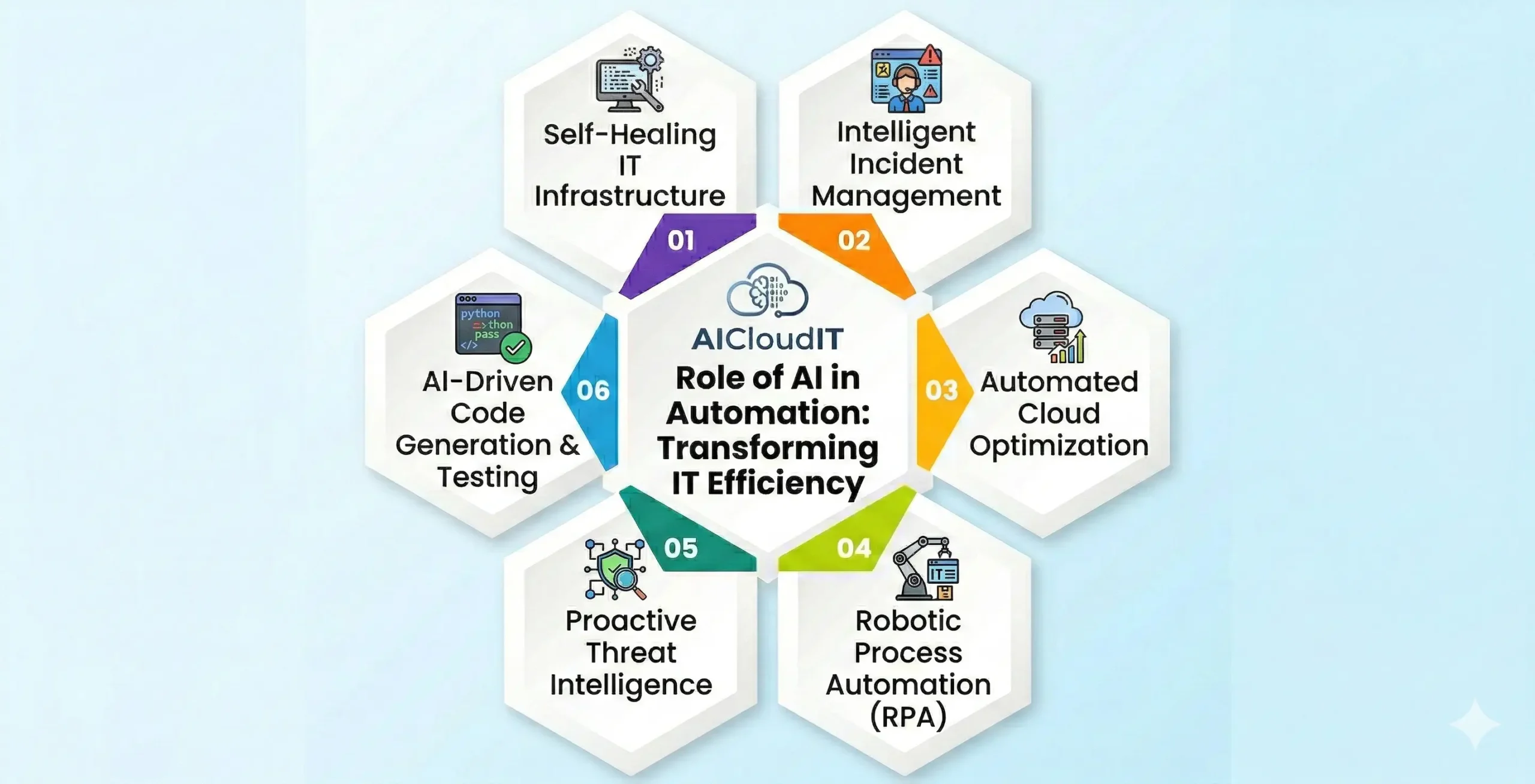
Automated systems are no longer confined to routine scripts and checklists. For IT managers across North American enterprises, the shift toward complex workflows powered by AI is changing how teams drive efficiency in cloud operations. As modern AI learns patterns, predicts failures, and manages resources with minimal intervention, your team faces new opportunities and challenges. This guide breaks down the real-world impact of AI-powered automation, showcasing what works, where strategic governance matters most, and how to match solutions with your unique operational demands.
Key Takeaways
| Point | Details |
|---|---|
| AI Enhances Operational Efficiency | Modern AI systems evolve beyond simple tasks, automating complex workflows that improve response times and reduce operational overhead. |
| Importance of Governance Frameworks | Successful AI implementation requires clear policies that define automation boundaries and human oversight. |
| Pilot Low-Risk Processes | Begin AI automation with high-volume, low-risk processes to build confidence and demonstrate quick wins. |
| Continuous Monitoring and Training | Establish robust monitoring of AI systems and invest in the training needed to adapt to evolving AI technology and methods. |
Defining AI’s Role in Modern Automation
AI no longer handles just simple, repetitive tasks. Modern AI systems tackle complex workflows that historically demanded human judgment and expertise. This shift fundamentally changes how IT teams approach operational efficiency in cloud environments.
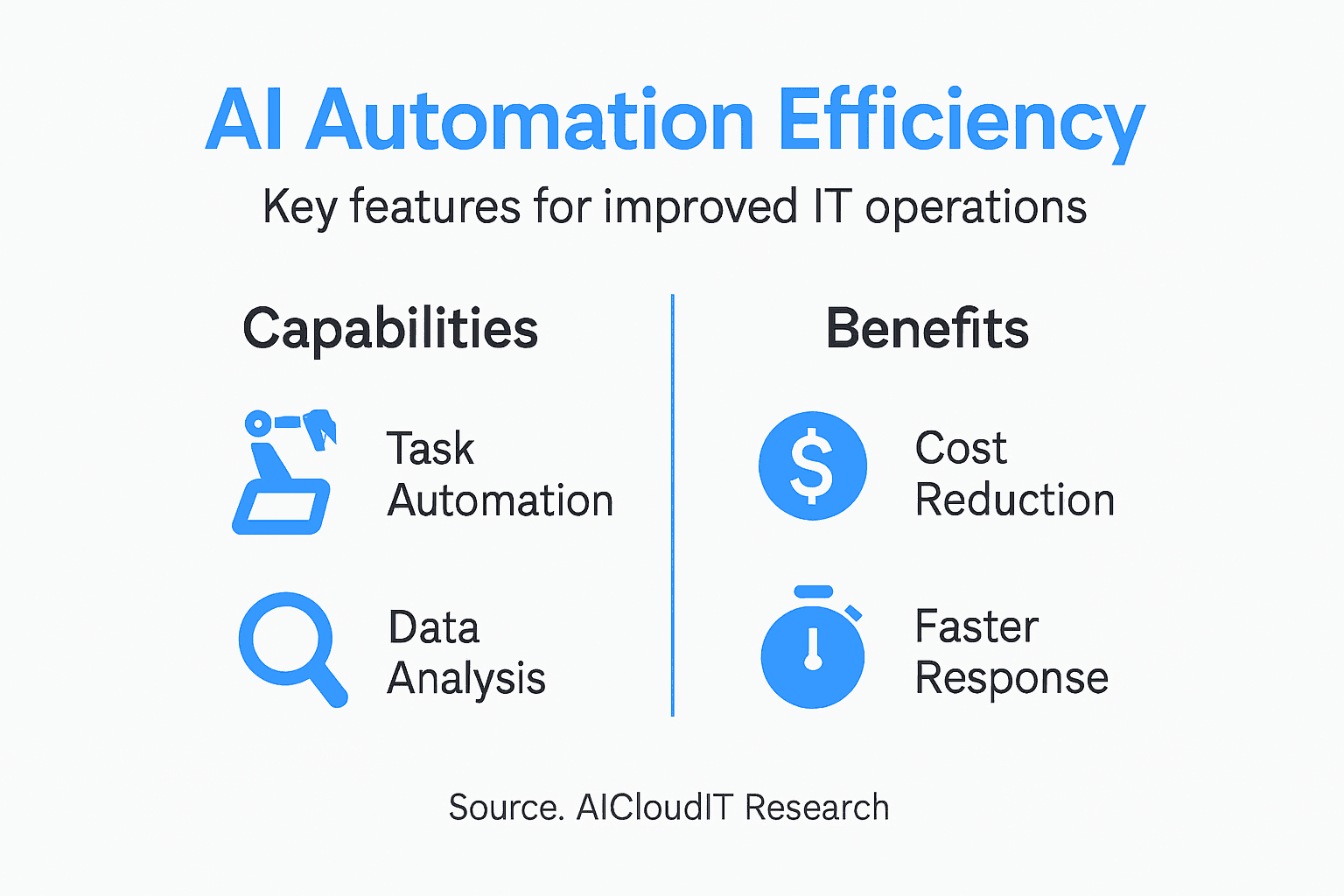
The transformation centers on three core capabilities:
- Task automation extends beyond rule-based processes to nuanced decision-making
- Data-driven insights accelerate response times across infrastructure monitoring
- Intelligent augmentation amplifies human expertise rather than replacing it
According to research on AI adoption at scale, organizations are automating operations that were previously considered too complex or contextual for machines. Your IT infrastructure now benefits from AI systems that learn patterns, predict failures, and optimize resource allocation with minimal intervention.
Consider what this means for your team. Yesterday’s automation was binary: if X happens, do Y. Today’s AI-driven automation operates more like an experienced colleague who understands your environment’s nuances and adjusts accordingly.
The practical impact breaks down into measurable outcomes:
- Incident response time drops from hours to minutes
- Infrastructure optimization occurs continuously, not on scheduled reviews
- Routine administrative tasks consume minimal human attention
- Decision-making integrates multiple data streams automatically
Modern AI automation reduces operational overhead by handling the decision layers that previously required manager approval.
Across institutional and enterprise settings, strategic governance frameworks prove essential for implementing AI effectively. This means establishing clear policies around what AI handles independently versus what requires human oversight. Your cloud operations need guardrails that match your risk tolerance and compliance requirements.
The distinction matters for IT managers: automation efficiency depends not just on AI capability, but on how well your organization aligns governance with implementation. Without proper frameworks, even powerful AI systems create bottlenecks through excessive escalations or inconsistent decisions.
What separates successful implementations from struggling ones? Organizations that define AI’s role clearly before deployment. Specify which processes AI owns completely, which require human validation, and which remain human-controlled. This clarity prevents deployment friction and maximizes the efficiency gains you’re seeking.
Pro tip: Start with your highest-volume, lowest-risk processes when piloting AI automation—this builds team confidence while generating quick wins that fund expansion into more complex automation projects.
Types of AI-Driven Automation Solutions
AI-driven automation isn’t one-size-fits-all. Different problem sets demand different approaches, and understanding the taxonomy helps you choose the right tool for your IT operations.
Three primary architectural models dominate modern implementations:
- Rule-based systems execute predefined logic when conditions are met
- Large language model-driven solutions handle unstructured text and complex reasoning
- Multi-agent cooperative systems coordinate multiple AI components working together
According to systematic taxonomies classifying AI-driven automation technologies, hybrid forms combining these approaches are increasingly common. Your infrastructure likely benefits from solutions that blend rule-based triggers with machine learning optimization.
Functionally, solutions break down into distinct categories based on what they accomplish:
- Automated decision-support systems that recommend actions but require human approval
- Robotic process automation (RPA) that mimics human workflows in legacy applications
- Intelligent document processing that extracts and categorizes unstructured information
- Fraud detection AI that identifies anomalies in real-time transaction streams
- AI-enabled forecasting that predicts capacity demands and performance bottlenecks
Each solution type operates with different human oversight levels. Some require explicit approval before taking action, while others operate autonomously within defined boundaries.
Here’s a summary of how different AI automation solutions align with operational needs and oversight requirements:
| Solution Type | Typical Use Case | Level of Human Oversight |
|---|---|---|
| Automated decision-support | Action recommendations in IT ops | Human approval required |
| Robotic process automation | Legacy workflow automation | Minimal after set-up |
| Intelligent document processing | Document extraction/classification | Periodic human review |
| Fraud detection AI | Transaction anomaly detection | Human validation of alerts |
| AI-enabled forecasting | Resource/capacity prediction | Oversight for major changes |
The right automation solution matches your operational maturity and risk tolerance, not just technical capability.
Consider your current environment. Are you managing infrastructure with extensive manual monitoring? An AI tool like those designed for technologists can reduce that burden by automating detection and initial response. Are you processing thousands of support tickets monthly? Intelligent routing and content analysis reduce classification time dramatically.

The execution mechanism matters equally. Does your solution push events to your existing systems, or pull data and take independent action? Cloud-native solutions often operate differently from on-premise systems, requiring different governance approaches.
What separates successful deployments from problematic ones? Matching solution type to your actual workflow patterns, not the vendor’s feature list. Your IT team understands your pain points better than any marketing pitch does.
Pro tip: Pilot one solution type in low-risk, high-volume processes first—this proves value while establishing governance patterns you’ll scale to more complex automation.
Key Applications in Cloud-Based IT Operations
AI transforms cloud operations from reactive firefighting into proactive optimization. Your infrastructure gains the ability to anticipate problems before they disrupt service.
The most impactful applications address your team’s immediate pain points:
- Automated threat detection identifies suspicious patterns faster than manual review
- Resource optimization adjusts compute allocation dynamically to match demand
- Predictive maintenance flags infrastructure degradation before failures occur
- Intelligent incident response automates initial triage and remediation steps
Security remains the highest-value application. Advanced threat detection systems analyze network traffic, access logs, and system behavior continuously. When anomalies emerge, AI doesn’t wait for human review—it isolates affected systems and escalates appropriately based on severity.
Consider what this means operationally. Your security team shifts from investigating every alert to validating AI assessments and handling sophisticated threats. Alert fatigue disappears when machine learning filters out noise.
Resource optimization operates similarly but with different economics. Cloud costs scale with utilization patterns you may not fully understand. AI systems discover which workloads spike predictably, which run idle during off-hours, and which could consolidate to fewer instances. Your monthly cloud bill drops without cutting corners on performance.
Predictive maintenance prevents 80% of outages by catching issues before customers notice impact.
Vulnerability management and automated incident response capabilities handle the operational continuity layer. When a new CVE drops, AI scans your environment instantly. When an incident occurs, automated response systems execute documented remediation playbooks while humans focus on investigation and prevention.
Data analytics unlock another dimension entirely. AI processes massive volumes of operational data—logs, metrics, traces—that your team couldn’t manually analyze. Patterns emerge that reveal performance optimization opportunities, cost reduction paths, and architectural improvements.
These applications compound in value. Early problem detection reduces incident severity. Optimized resources lower operational overhead. Better security posture reduces risk exposure. Each improvement amplifies the others.
Pro tip: Begin with threat detection and resource optimization—they deliver measurable cost savings and security improvements within 30 days, building organizational confidence for expanding automation to more complex operational workflows.
Risks, Challenges, and Mitigation Strategies
AI automation introduces genuine risks alongside its benefits. Understanding these challenges prevents costly mistakes and builds sustainable automation practices in your environment.
The primary risks fall into distinct categories:
- Model blindness occurs when AI systems fail on edge cases outside their training data
- Autonomous errors amplify when poorly designed AI executes bad decisions at scale
- Security vulnerabilities emerge when attackers exploit AI systems deliberately
- Data quality issues cascade through automated decision-making pipelines
- Over-automation removes human oversight from decisions requiring judgment
Model blindness represents your biggest operational risk. Your AI system performs flawlessly on 99% of scenarios, then encounters an unusual configuration and makes a catastrophic mistake. The system acted autonomously, so the damage compounds before humans detect the problem.
This is why validation matters. Before deploying any AI automation, your team must test edge cases extensively. What happens when inputs are malformed? When system load spikes unexpectedly? When unusual but valid scenarios occur? Rigorous testing catches these gaps before production deployment.
Autonomous errors affect more systems simultaneously than human mistakes, making prevention critical.
Secure your AI systems against active threats. Attackers now target AI models specifically, crafting inputs designed to trigger incorrect outputs. Understanding LLM vulnerabilities through red teaming helps your team identify weaknesses before attackers do.
Data quality requires continuous attention. Garbage input produces garbage output, regardless of AI sophistication. If your automation ingests contaminated data sources, decisions degrade progressively. Establish data validation checks upstream of your AI systems.
Human oversight remains essential. Specify which automation decisions require human approval before execution. High-impact decisions—infrastructure shutdowns, security policy changes, cost allocation—should route to humans first. Routine, low-risk decisions can operate fully autonomously.
Implementation challenges emerge quickly. Your organization needs new skills: AI operations, model monitoring, and governance expertise. Training existing staff takes time. Budget accordingly for upskilling your team alongside technology investment.
Mitigation requires systematic approaches. Implement comprehensive logging so you understand why AI made each decision. Build monitoring systems that flag unusual automation patterns. Establish rollback procedures for quickly disabling problematic automation. Create clear escalation paths when AI systems encounter situations they cannot handle confidently.
This table compares common risks in AI automation and effective mitigation strategies:
| Risk Type | Example Impact | Best Mitigation Approach |
|---|---|---|
| Model blindness | Catastrophic error from anomalies | Rigorous edge-case testing |
| Autonomous errors | Large-scale incorrect actions | Human-in-the-loop deployment |
| Security vulnerabilities | Exploited model, data breach | Model hardening, red teaming |
| Data quality issues | Poor decision quality | Continuous data validation |
| Over-automation | Missed human judgment calls | Clear escalation procedures |
Pro tip: Begin automation deployment with human-in-the-loop systems where AI recommends but humans approve—this builds organizational confidence while limiting damage from early mistakes before advancing to fully autonomous automation.
Best Practices for Successful AI Adoption
Successful AI adoption requires more than deploying technology. Your organization needs clear strategy, leadership commitment, and systematic governance to realize long-term value.
Start with organizational alignment. Define what AI adoption means for your IT operations specifically. Are you automating incident response? Optimizing resource allocation? Improving security posture? Clear objectives prevent scattered investments and wasted effort.
Leadership commitment matters immensely. When executives treat AI as a technology checkbox rather than a strategic initiative, adoption falters. Your organization needs sponsors who allocate budget, remove obstacles, and hold teams accountable for delivering results.
Build cross-functional teams. IT operations, security, data engineering, and business stakeholders must collaborate from the beginning. A solution that works technically but conflicts with governance policies fails operationally. Diverse perspectives catch these misalignments early.
Key practices for successful adoption include:
- Define clear AI strategy aligned to business objectives and public value
- Embed AI literacy across teams to build shared understanding
- Ensure system interoperability so AI integrates seamlessly with existing tools
- Institute robust monitoring to track AI performance continuously
- Establish transparent governance around how AI makes decisions
According to best practices for AI governance and strategy alignment, organizations that define clear governance frameworks early experience faster adoption and better outcomes.
Organizations treating AI as a strategic initiative rather than a technology project see 3x faster ROI.
Measure performance rigorously. Analyzing AI performance accurately reveals what works and what needs adjustment. Track metrics that matter to your business: cost reduction, incident resolution time, security threat detection rate. Don’t rely on vendor metrics alone.
Scale incrementally. Deploy pilot projects in controlled environments first. Learn from early implementations before expanding to critical systems. This approach builds organizational confidence while minimizing risk exposure.
Invest in training. Your team needs skills in AI operations, model monitoring, and governance. Budget for upskilling alongside technology investment. People drive adoption success more than tools do.
Embrace transparency. Explain how AI systems make decisions to stakeholders who need to understand and trust them. Document assumptions, limitations, and approval workflows. Trust comes from visibility.
Pro tip: Establish a cross-functional AI governance committee that meets monthly to review performance, resolve conflicts, and guide strategy—this keeps adoption aligned with organizational values while building shared ownership across teams.
Unlock the Full Potential of AI-Driven Automation for Your IT Operations
The article “Role of AI in Automation Transforming IT Efficiency” highlights the growing complexity of AI automation and the critical need to balance autonomous decision-making with human oversight. Challenges like model blindness, over-automation, and the need for strategic governance can affect your operational efficiency and security posture. If your team struggles with incident response delays, resource optimization, or integrating AI smoothly into your cloud environment, these are exactly the pain points addressed here.
At AICloudIT we provide technology professionals with the latest insights on AI automation solutions that empower your team to automate complex workflows confidently. Explore our extensive content including AI tools for technologists and detailed guides on analyzing AI performance accurately to ensure your AI deployments deliver measurable results with clear governance frameworks.
Ready to transform your IT operations with AI automation that aligns with your risk tolerance and compliance demands? Visit AICloudIT now to access cutting-edge resources that help you pilot smart automation confidently and build scalable AI workflows that reduce costs while enhancing security.
Frequently Asked Questions
What are the main capabilities of modern AI in automation?
Modern AI in automation focuses on three core capabilities: task automation that involves nuanced decision-making, data-driven insights for faster response times, and intelligent augmentation that enhances human expertise rather than replacing it.
How does AI improve incident response times in IT operations?
AI dramatically decreases incident response times, often reducing them from hours to minutes by learning patterns, predicting failures, and automatically optimizing decision-making processes.
What are the different types of AI-driven automation solutions available?
AI-driven automation solutions include automated decision-support systems, robotic process automation (RPA), intelligent document processing, fraud detection AI, and AI-enabled forecasting, each serving different operational needs and requiring varying levels of human oversight.
What risks and challenges are associated with AI automation?
Common risks include model blindness, autonomous errors, security vulnerabilities, data quality issues, and over-automation. It is crucial to implement rigorous testing and establish clear governance frameworks to mitigate these challenges.
Recommended
- 6 Essential AI Tools for Technologists to Boost Efficiency
- Role of AI in Decision Making: Enterprise Impact
- Role of AI in Business: Unlocking Efficiency and Growth
