
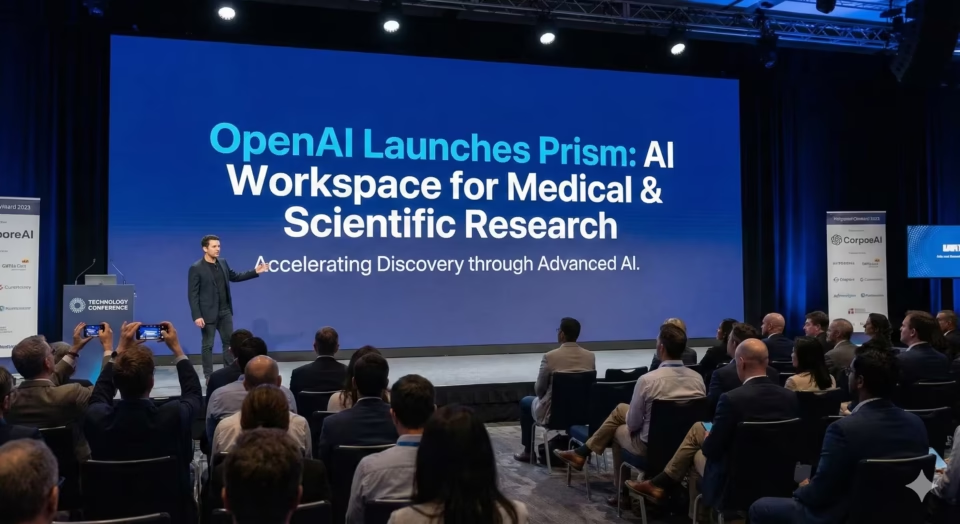
Scientific research has long been a fragmented process, juggling literature reviews in one tab, data analysis in another, and the painstaking process of LaTeX formatting in a third. On January 27, 2026, OpenAI aimed to unify this workflow with the launch of Prism, an AI-native, cloud-based workspace designed specifically for the rigorous demands of academia.
Powered by the new GPT-5.2 “Thinking” model, OpenAI’s most advanced engine for scientific and mathematical reasoning—Prism represents a fundamental shift in how knowledge is produced. Born from the acquisition of the cloud-based LaTeX platform Crixet, Prism eliminates the need for local installations and complex setups, offering a streamlined environment accessible directly through prism.openai.com for ChatGPT account holders.
Here is how this tool is poised to reshape medical and scientific academia.
Key Features and Technical Capabilities
Prism is not just a chatbot pasted into a text editor; it is a context-aware research partner.
Deep Context Awareness
Unlike standard LLMs that lose the thread after a few interactions, Prism “sees” the entire project simultaneously. It understands the full manuscript structure, the underlying LaTeX code, the raw data in tables, the figures, and the entire citation history. This allows for global edits—such as “ensure all terminology in the Discussion matches the definitions in the Introduction”—that were previously impossible for AI to handle reliably.
The “Research Window”
Literature review is integrated directly into the workspace. The “Research Window” connects to major academic databases like arXiv. Users can search for, summarize, and cite relevant literature without ever leaving the drafting environment, reducing the cognitive load of context switching.
Visual-to-Digital Conversion
One of Prism’s most practical features is its multimodal capability. Researchers can snap a photo of a whiteboard sketch, a handwritten equation, or a rough diagram, and Prism will convert it into clean, professional LaTeX code or a digital vector format instantly.
Real-Time Collaboration and Voice Editing
Addressing the perennial headache of “version_final_v3.docx,” Prism supports unlimited co-authors working in a shared cloud space. It also introduces voice-based editing, allowing researchers to dictate complex structural changes or leave extensive feedback without interrupting their manual workflow.
Impact on Medical Academics and Educators
For the medical community, where precision is paramount and time is scarce, Prism offers targeted solutions.
For Medical Educators
Prism acts as a quality assurance engine. Educators use it to verify if lecture content aligns with the latest national and international clinical guidelines. It also automates the drudgery of assessment: generating exam-aligned multiple-choice questions (MCQs), viva prompts, and revision handouts derived directly from lecture materials. Furthermore, it can reframe complex topics to suit mixed-ability audiences, tailoring explanations differently for a first-year intern versus a senior resident.
For Mentors and Supervisors
The tool allows supervisors to shift their focus from “mechanical cleanup”—correcting grammar and formatting—to high-level intellectual guidance. Prism can act as a preliminary auditor, identifying logical gaps, flagging redundant arguments, and checking if the conclusions in a thesis actually align with the results presented.
For Medical Researchers
The most immediate impact is speed. Early users report finishing manuscript drafts in weeks rather than months. Beyond speed, Prism ensures internal consistency, auditing manuscripts to confirm that the Methods section perfectly matches the Results, and that the Introduction sets up objectives that are actually met in the conclusion.
Macro-Level Impact on Scientific Production
The integration of tools like Prism is already influencing scientific output metrics.
- Productivity Gains: Data suggests that adopting advanced LLMs is associated with a 23.7% to 89.3% increase in paper production, varying by field.
- Democratization: The impact is most profound for non-native English speakers, particularly in Asian institutions. By mitigating disparities in English fluency, AI allows these researchers to compete on the merit of their ideas rather than their linguistic prowess.
- Knowledge Discovery: AI-integrated search tools are changing what gets cited. Researchers are discovering more diverse prior work, including books and younger, less-cited scholarship that traditional keyword searches often miss.
- The “Quality Signal” Reversal: Historically, complex language signaled high-quality research. Today, that signal is flipping. AI-assisted papers often use sophisticated language to disguise substantively weak contributions, forcing peer reviewers to look past the polish to find the substance.
Other Recent Updates:
The Grok AI Undressing Scandal: How One Chatbot Sparked Global Safety Laws
All ChatGPT AI Models List: A Comprehensive Guide
Ethics, Responsibility, and Guidelines
As powerful as Prism is, it introduces new ethical complexities.
- Authorship: The golden rule remains: AI cannot be an author. Humans retain full responsibility for accuracy, ethical standards, and scientific claims.
- Mandatory Declarations: Transparency is key. Most major publishers now require detailed disclosure of AI use, often within the Methods section or Acknowledgments.
- The Risk of “Slop”: There is a valid concern that the barrier to entry for producing “looks-like-science” papers is now too low. The community fears an influx of superficially polished but scientifically weak research that could saturate the literature and overwhelm the peer review system.
- Privacy: A lingering concern for many academics is data sovereignty. Researchers remain wary of uploading their unpublished “life’s work” to the cloud, fearing it may be used to train subsequent AI models without consent.
Comparison: Traditional Workflow vs. OpenAI Prism
| Feature | Traditional Workflow (Word/Overleaf) | OpenAI Prism |
| Context | Single file awareness | Full project awareness (code, figures, citations) |
| Literature | Separate browser tabs/Reference Manager | Integrated “Research Window” (arXiv/PubMed) |
| Visuals | Manual creation/TikZ coding | Photo-to-LaTeX code conversion |
| Collaboration | Version control conflicts / Seat limits | Real-time, unlimited co-authoring |
| Editing | Manual typing | Voice-command editing & Logic auditing |
Future Outlook of Openai Prism
Industry analysts are calling 2026 the “inflection year” for AI in research, mirroring the transformation software engineering underwent in 2025. While the base Prism platform is currently free, advanced capabilities are expected to migrate toward paid ChatGPT Business and Enterprise plans.
Prism is positioned as a potential “Overleaf killer.” With its native AI integration and lack of “seat limits” for collaborators, it challenges the incumbent tools that have dominated scientific writing for the last decade. As the tool matures, it will likely become the new standard for how scientific knowledge is codified, reviewed, and shared.
Disclaimer: This article describes the features and launch of OpenAI Prism based on the January 2026 launch details. Users should verify current pricing, availability, and specific feature sets via official OpenAI channels.
