
I’ve been following the AI model wars since GPT-3 launched, and every few months someone claims they’ve built “the smartest model yet.” Most of the time, it’s hype dressed up in benchmarks. But when Anthropic dropped Claude Opus 4.6 on February 5, 2026, the demos and early user reports suggested this might actually be different.
This isn’t just another incremental update. Opus 4.6 represents Anthropic’s clearest push yet toward reliable, production-grade AI that enterprises can actually trust with real work, not just experiments.
With a 1 million token context window, 128k output tokens, improved coding skills, and a new “agent teams” capability, it’s positioned as the model for businesses that are done testing and ready to deploy.
And yes, the timing matters. This launch came just days after OpenAI’s GPT-5.3 Codex announcement, making it crystal clear that the OpenAI versus Anthropic rivalry isn’t slowing down.
What Is Claude Opus 4.6?
Claude Opus 4.6 is Anthropic’s flagship model and the most capable in the Claude 4 family, which includes the mid-sized Sonnet 4.5 and the lightweight Haiku 4.5. Unlike earlier Claude models that were strong at analysis and conversation but sometimes struggled with sustained, complex tasks, Opus 4.6 is explicitly built for real-world professional and enterprise use where mistakes are expensive.
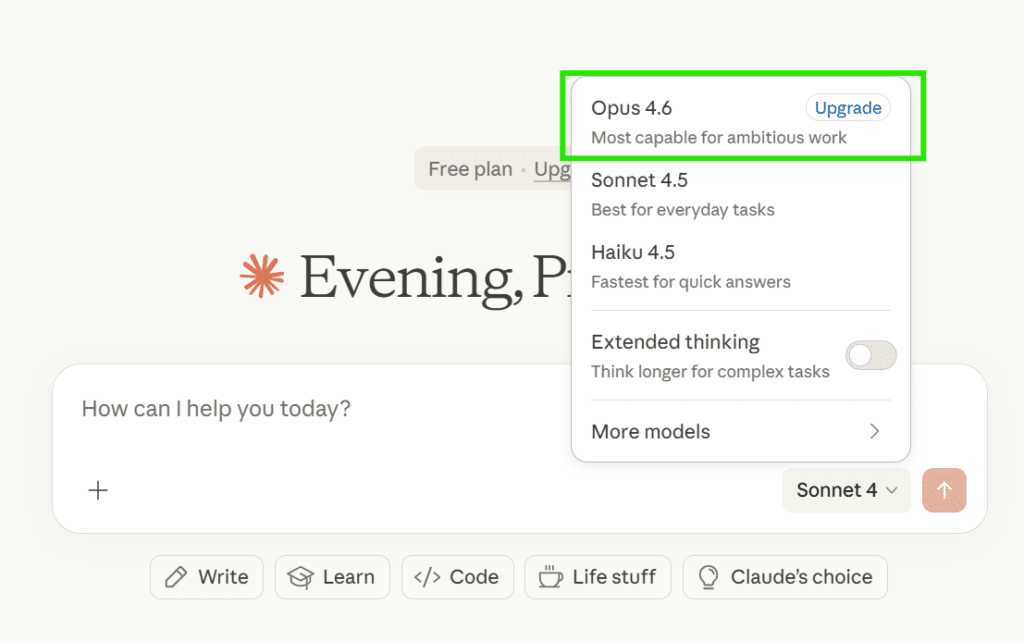
Anthropic describes it as getting “much closer to production-ready quality on the first try” than any model they’ve released before, which is a bold claim in an industry full of bold claims.
How Claude Opus 4.6 Builds on Previous Versions?
Compared to Opus 4.5, which launched just a few months earlier in November 2025, version 4.6 brings significant improvements:
- Better coding skills: The model plans more carefully, sustains agentic tasks for longer, operates reliably in larger codebases, and has stronger code review and debugging abilities to catch its own mistakes.
- Emphasis on reliability and reasoning: Anthropic focused heavily on reducing errors in multi-step workflows and improving the model’s ability to adapt its approach when conditions change.
- Performance on complex tasks: It handles longer task chains with fewer errors and less hand-holding, making it meaningfully more useful for autonomous agents.
Key Capabilities and Improvements
Advanced Coding and Debugging
Senior engineers are the target audience here. Opus 4.6 can deliver production-ready code with minimal oversight, handle complex refactoring across large codebases, and actually catch its own bugs during the coding process.
Anthropic claims the model “plans carefully, runs for longer with sustained effort, and operates reliably in larger codebases,” which addresses one of the biggest complaints developers had with earlier models: they’d start strong but lose the thread halfway through.
Stronger Reasoning and Multi-Step Problem Solving
One of the standout features is adaptive thinking. The model automatically adjusts how deeply it reasons based on task complexity. Simple queries get fast responses, while complex problems trigger deeper, more methodical reasoning. You can even control this manually with four effort levels via the API.
Handling Long and Complex Enterprise Workflows
The 1 million token context window is a game changer for enterprise use. That’s enough to fit entire codebases, multi-month email threads, or massive financial reports into a single conversation without breaking context. And with 128k output tokens, Claude can now complete larger tasks without needing to split them into multiple requests.
Anthropic also introduced context compaction, which compresses conversation history without losing critical information, solving the “context rot” problem where models gradually forget earlier parts of long conversations.
AI Coding and Developer Productivity
Opus 4.6 powers Claude Code, Anthropic’s agentic coding environment, and the improvements are substantial:
- Code generation and refactoring: Handle multi-file changes, large-scale refactors, and architectural decisions.
- DevOps and internal tooling support: Automate deployment pipelines, infrastructure management, and internal tool maintenance.
- Reduced human intervention: The model can run autonomously for hours on complex tasks, only checking in when it needs clarification or approval.
Enterprise and Professional Use Cases
Around 80% of Anthropic’s customers are enterprises, according to CEO Dario Amodei, and Opus 4.6 is explicitly designed for that audience.
AI Agents for Business Processes
The new agent teams feature allows multiple Claude Code sessions to work together on complex tasks, similar to multi-agent frameworks like AutoGPT or CrewAI. This enables sophisticated workflows where one agent handles research, another writes code, and a third reviews and tests the output.
Knowledge Work and Analysis
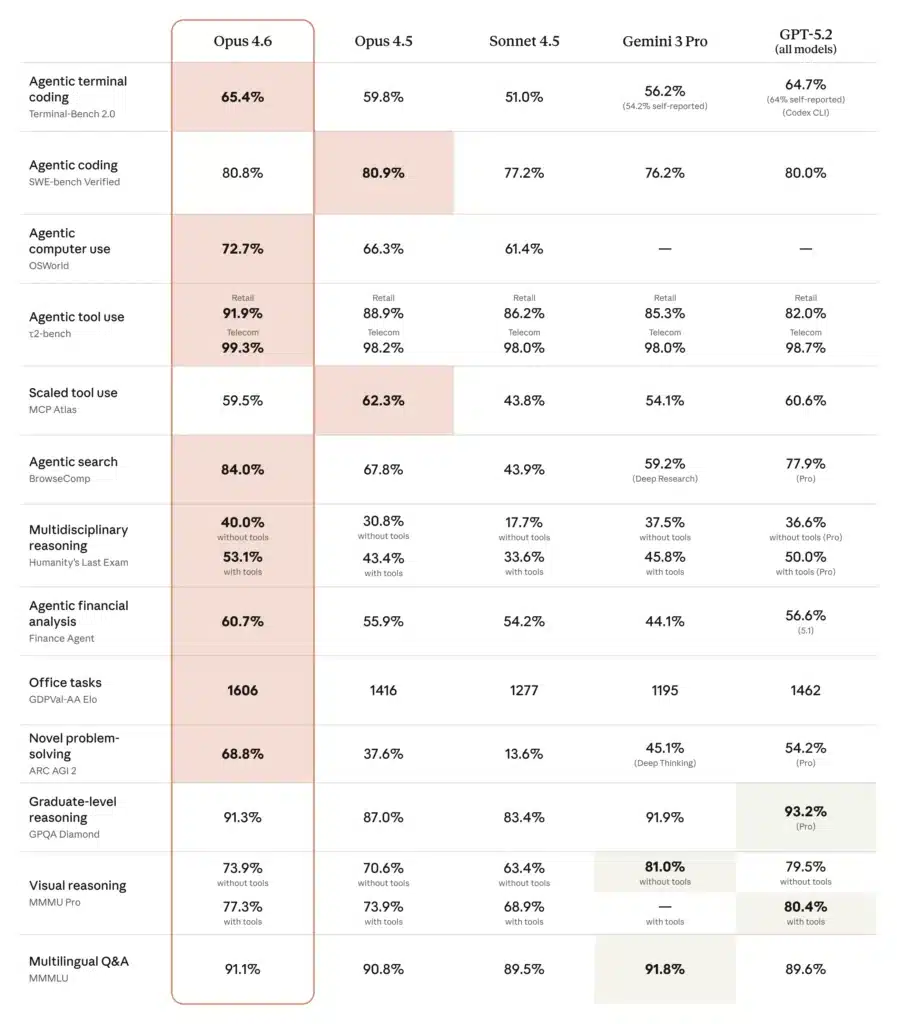
Opus 4.6 excels at extracting relevant information from massive document collections, conducting research, and performing financial analysis. It even achieved the top ranking on the Finance Agent benchmark, which tests how well agents perform essential financial analyst tasks.
Secure and Reliable Enterprise Deployments
Anthropic offers US-only inference for workloads that need to stay within the United States, available at a 1.1x token pricing premium. This addresses compliance and data sovereignty concerns that many enterprises have when adopting AI.
Why Enterprises Are Paying Attention?
- Trust, safety, and controllability: Anthropic has built its brand around AI safety and responsible deployment, which resonates with risk-averse industries like finance and healthcare.
- Scalability across teams: The model’s ability to handle complex, multi-step workflows autonomously means it can scale across large organizations without requiring constant expert oversight.
- ROI-focused AI adoption: Enterprises want tools that reduce costs and improve productivity on day one, not research toys. Opus 4.6 is positioned to deliver that.
Recent News Articles:
Why Indian IT Stocks Fell After Anthropic’s New Claude “Cowork” Legal AI Tools
Google’s Big AI Upgrade for Chrome
OpenAI Prism: AI Workspace for Medical & Scientific Research
Claude Opus 4.6 vs Competing AI Models
Positioning Against OpenAI Models
Anthropic’s launch timing, just days after OpenAI’s GPT-5.3 Codex announcement, was clearly intentional. While GPT-5.3 Codex emphasizes speed and self-improvement, Opus 4.6 emphasizes reliability, safety, and sustained performance on long-horizon tasks.
In benchmark comparisons, Opus 4.6 reportedly outperforms GPT-4o and Gemini 2.0 Pro in key areas including agentic coding, computer use, and long context retrieval.
Differentiation Through Reasoning and Safety
Where OpenAI leads with raw capability and speed, Anthropic differentiates through thoughtful reasoning and enterprise-grade safety. The adaptive thinking feature and context compaction are examples of Anthropic optimizing for reliability over pure speed.
Anthropic’s Enterprise-First Narrative
Anthropic positions itself as the “responsible AI company” that enterprises can trust with mission-critical work. That narrative, combined with strong performance, is why Claude has gained significant traction in regulated industries like finance and healthcare.
What This Launch Signals for the AI Industry?
Intensifying OpenAI–Anthropic Rivalry
The back-and-forth between OpenAI and Anthropic is accelerating. GPT-5.3 Codex on February 4, Claude Opus 4.6 the same day, this is the new normal. Each company is pushing the other to ship faster and better.
Shift Toward Enterprise-Grade AI Agents
Both companies are betting heavily on agentic AI, but with different flavors. OpenAI emphasizes autonomy and speed; Anthropic emphasizes reliability and control. The market will ultimately decide which approach wins.
Growing Expectations for Reliable, Real-World AI
The bar for “good enough” AI is rising fast. Enterprises no longer want models that are “pretty good” or “interesting.” They want tools that work reliably, at scale, on day one. Opus 4.6 is Anthropic’s attempt to meet that bar.
Feature Comparison: Claude Opus 4.6 vs Earlier Claude Versions
| Feature | Claude Opus 4.5 (Nov 2025) | Claude Opus 4.6 (Feb 2026) |
| Context Window | 200k tokens | 1 million tokens (beta) |
| Output Tokens | 16k tokens | 128k tokens |
| Coding Skills | Strong | Production-ready with better planning and debugging |
| Agentic Workflows | Good | Longer, more complex task chains with fewer errors |
| Context Compaction | Not available | Yes, solves context rot |
| Adaptive Thinking | Not available | Yes, adjustable effort levels |
| Agent Teams | Not available | Yes, multi-agent collaboration |
| US-Only Inference | Not available | Yes, at 1.1x pricing |
FAQs:
Opus 4.6 has a much larger context window (1M vs 200k tokens), better coding and debugging skills, adaptive thinking, context compaction to prevent context rot, and new agent teams capabilities.
API pricing is $5 per million input tokens and $25 per million output tokens. For prompts exceeding 200k tokens, premium pricing applies: $10 input and $37.50 output per million tokens.
Not entirely. It’s better framed as a tool that significantly boosts developer productivity by handling routine tasks, complex refactors, and sustained multi-step workflows, but it still requires human oversight for strategic decisions and final approval.
Yes, it’s available through claude.ai, the Anthropic API, and major cloud platforms including AWS, Google Cloud (Vertex AI), Microsoft Azure, and Snowflake.
Agent teams allow multiple Claude Code sessions to collaborate on complex tasks, enabling multi-agent workflows where different instances handle different parts of a project simultaneously.
Yes, Claude Opus 4.6 supports multi-modal inputs including images, PDFs, and documents. This allows it to analyze charts, diagrams, screenshots, and extract information from complex visual materials.
Disclaimer: This article is based on Anthropic’s official announcements and independent media coverage as of February 2026. Features, pricing, and availability may change. Users should verify current details through Anthropic’s official channels before making adoption decisions.
