
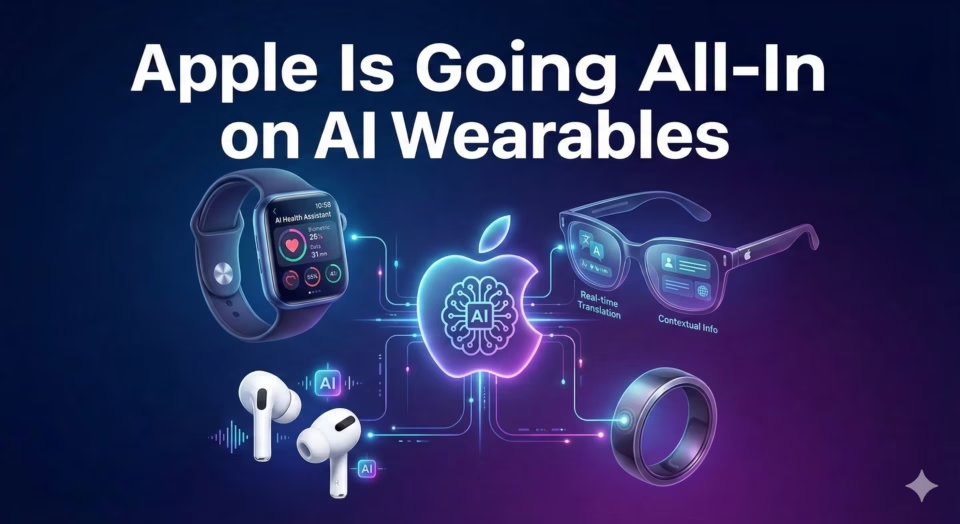
TL;DR: Apple is accelerating development of three AI-powered wearables — smart glasses, a camera-equipped pendant, and AI-enhanced AirPods — all centered around a smarter, vision-capable Siri. Smart glasses could enter production as early as late 2026, with a public launch targeting 2027. This marks Apple’s biggest strategic bet on ambient AI hardware since the Apple Watch.
Apple has spent two years watching Meta’s Ray-Ban smart glasses quietly become the sleeper hit of the AI hardware wave. Now, according to a Bloomberg report by Mark Gurman published February 17, 2026, Apple isn’t just watching anymore. The company is ramping up work on three AI wearables simultaneously: smart glasses, an AI pin or pendant, and a new generation of camera-equipped AirPods.
The common thread across all three products isn’t screens, specs, or even price.
It’s vision.
Every device will feature cameras that let Apple’s AI “see” the world around the user, enabling contextual answers, object recognition, real-time translation, and environment-aware responses through a fundamentally upgraded Siri.
This is Apple’s clearest signal yet that the future of personal computing isn’t on your desk, or even in your pocket. It’s on your face, around your neck, and in your ears.
The Three Devices Apple Is Building
Apple Smart Glasses (Codename: N50)
Apple’s answer to the Meta Ray-Bans is a screenless smart glasses device equipped with two camera systems — a high-resolution sensor for photos and video, and a second dedicated to feeding Siri live environmental context and measuring distance, similar to how LiDAR works on iPhone.
The glasses will also include speakers and microphones, allowing Siri to respond to questions about the wearer’s surroundings without requiring them to pull out a phone. Notably, there is no built-in display — Apple is betting on audio and contextual AI rather than an AR overlay, which keeps the device lighter and far more wearable than Vision Pro.
“Apple’s smart glasses are positioned as a direct rival to Meta Ray-Bans. The company has reportedly already supplied internal teams with prototypes.”
— Moneycontrol, February 18, 2026 [moneycontrol]
Timeline: Production could begin as early as December 2026, with a public launch targeting 2027.techcrunch+1
AI Pendant / Pin
The second device is a wearable pendant or pin that can be clipped to clothing or worn as a necklace. Like the glasses, it includes cameras and microphones, but its camera isn’t intended for photography. Instead, it feeds visual input to Siri, enabling hands-free AI assistance without requiring the user to look at anything at all.
Think of it as a spiritual successor to the ill-fated Humane AI Pin, but with Apple’s design sensibility, deep iPhone integration, and a user base of 1.5 billion iPhone owners to launch into.
“Apple may be developing its own AI wearable — a pin that users can wear on their clothing equipped with two cameras and three microphones.”
— TechCrunch, January 21, 2026 [techcrunch]
Timeline: The project is still in early stages and could be cancelled, but a 2027 release is possible if development continues. [forklog]
Camera AirPods
The most immediately practical of the three devices is a new generation of AirPods with built-in cameras. The cameras here won’t be for taking photos; they’ll serve as eyes for Siri, letting the AI see what you’re looking at and respond in real time.
Apple is already planning to add AI features to AirPods in 2026, starting with real-time translation and simple hand gesture controls for managing music and fitness apps. The camera-equipped version would be a more advanced follow-up that takes contextual AI even further.
“If these updates roll out by 2026, they will mark Apple’s initial step in the next generation of wearables, introducing AI capabilities and enabling simple hand gestures.”
— CNET, February 17, 2026[cnet]
Timeline: AI-enhanced AirPods are planned for 2026, with camera-equipped versions following later.
The Siri Upgrade That Makes It All Work
Every one of these devices runs on a next-generation Siri that the current version simply cannot power. Today’s Siri can set timers and play music. The Siri these devices need can understand visual context, execute multi-step tasks, recognize objects in real time, and respond intelligently to the environment around you.
Apple is reportedly integrating Google Gemini AI capabilities into the next Siri, which would give it a significant intelligence boost while Apple continues building its own foundation models. Without this upgrade, the three wearables would be expensive novelties. With it, they become genuinely useful.
“All three devices are being built around the Siri digital assistant, which will rely on visual context to carry out actions.”
— Bloomberg / Mark Gurman, February 17, 2026 [bloomberg]
Why Apple Shelved Vision Pro Upgrades to Prioritize This?
Apple’s strategic pivot to AI wearables isn’t accidental — it’s a direct response to Vision Pro’s underwhelming market adoption. The headset launched at $3,499 and attracted early adopters, but never crossed over into mainstream use. Rather than doubling down on an expensive, heavy AR headset, Apple is betting on lightweight, ambient AI that people will actually wear every day.
This is the same instinct that drove the Apple Watch. A smaller, simpler device that becomes indispensable through constant use beats a powerful but inconvenient device that lives on a shelf. Smart glasses with AI that works, at a fraction of Vision Pro’s price, have a genuine shot at mass adoption.
How Apple Stacks Up Against the Competition?
Apple is entering a market that Meta has been shaping for two years and OpenAI is actively targeting.
| Device | Company | Launch | Display | AI Features | Price (Est.) |
| Ray-Ban Meta Smart Glasses | Meta | 2023 (updated 2024) | None | Meta AI, camera | ~$299 |
| Apple Smart Glasses (N50) | Apple | 2027 (target) | None | Siri + visual AI | TBD |
| Apple AI AirPods | Apple | 2026 | None | Real-time translation, gestures | TBD |
| Apple AI Pendant | Apple | 2027 (possible) | None | Siri visual context | TBD |
| OpenAI AI Hardware | OpenAI | H2 2026 (rumored) | TBD | ChatGPT-powered | TBD |
Apple enters with massive advantages: 1.5 billion iPhone users as a built-in distribution channel, the tightest hardware-software integration in the industry, and a brand that makes people comfortable wearing technology in public.
What This Means for Developers and Enterprises?
For developers, this is a significant platform signal. Apple building AI wearables at scale means a new app ecosystem built around ambient context rather than touchscreens. Think of ARKit and CoreML, but extended to live camera feeds from glasses or a pendant. New APIs for spatial awareness, real-time object recognition, and voice-first interfaces will follow.
For enterprises, the use cases are significant: field workers getting real-time guidance, surgeons with hands-free assistance, warehouse staff with visual AI support, and sales teams with live contextual prompts during client meetings.
Challenges Apple Still Needs to Solve
- Battery life: Continuous camera use drains batteries fast. Ray-Ban Meta glasses currently last around 4 hours with active use
- Privacy: Always-on cameras raise serious questions that Apple will need to address very publicly before launch
- Siri reliability: The new Siri needs to be dramatically more capable than today’s version for these devices to deliver on their promise
- Price: Apple products command a premium, but AI glasses need to be accessible enough for broad adoption to succeed
What to Watch Next?
- WWDC 2026 (June): Likely the platform where Apple reveals the software and developer tools powering these devices
- Late 2026: Smart glasses production timeline — confirmed production start would be the clearest sign of a 2027 launch
- 2026 AirPods launch: The first real-world test of Apple’s ambient AI capabilities before glasses and pendant arrive
Other Recommended News:
Anthropic’s Powerful Claude Sonnet 4.6 Is Available Now
Introducing Claude Opus 4.6
OpenAI Launches GPT-5.3 Codex
Google’s Big AI Upgrade for Chrome
FAQs
When will Apple smart glasses launch?
Apple is targeting a 2027 launch, with production potentially starting in late 2026.
Will Apple smart glasses have a display?
No. Apple’s glasses are designed to be screenless, relying on audio and Siri for interaction rather than visual overlays.
What is the Apple AI pendant?
A wearable pin or pendant with cameras and microphones that feeds Siri visual context about the user’s surroundings. It’s still in early development and may not ship.
How are the new AirPods different from current ones?
The 2026 AirPods will add real-time translation and hand gesture support. A future camera-equipped version will let Siri see your surroundings.
How does Apple’s smart glasses compare to Meta Ray-Bans?
Both are screenless with cameras and AI assistants, but Apple’s will integrate deeply with iPhone and a next-gen Siri, likely with stronger privacy controls.
Is this Apple’s response to OpenAI’s AI hardware?
Partly. Apple is competing with both Meta and OpenAI in the AI wearables race, with the advantage of 1.5 billion iPhone users as a ready distribution network.
