
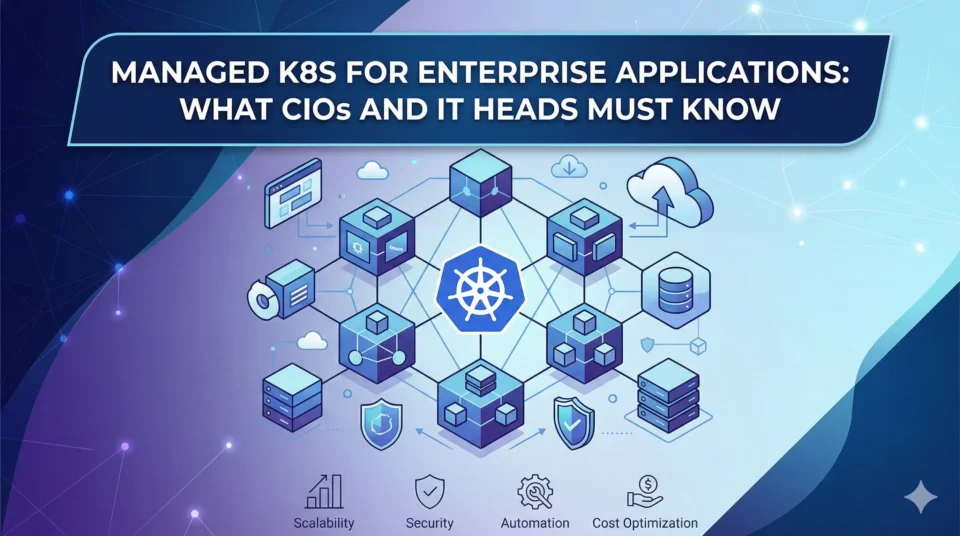
Enterprises are increasingly building cloud-native applications, distributed services, and data-driven platforms that must scale reliably across regions. Traditional infrastructure models often struggle to keep pace with these requirements.
This is where container orchestration platforms like a managed Kubernetes have become central to modern enterprise cloud strategy. They allow organizations to deploy applications faster, scale workloads dynamically, and maintain consistency across environments.
However, as adoption grows, many technology leaders are discovering a practical challenge: running Kubernetes efficiently requires deep operational expertise and continuous maintenance.
For organizations exploring reliable infrastructure options, solutions like a Kubernetes service can offer a structured foundation for high-performance clusters without the overhead of managing every infrastructure layer internally.
The shift toward managed Kubernetes is not just about convenience. It is increasingly tied to business continuity, customer experience, and operational risk management.
Why Kubernetes Matters at the Enterprise Level?
For enterprise organizations, Kubernetes is not simply a developer tool. It acts as a platform for application delivery at scale. Key enterprise benefits include:
1. Consistent deployments across environments
A standardized Kubernetes deployment pipeline allows teams to move applications from development to production with fewer inconsistencies.
2. High availability infrastructure
Kubernetes enables workloads to run across distributed nodes, reducing single-point failure risks.
3. Automated scaling
Features like auto scaling Kubernetes allow platforms to respond dynamically to traffic spikes without manual intervention.
4. Faster release cycles
Through CI/CD integrations and GitOps workflows, teams can deploy updates rapidly while maintaining control over configuration management.
For organizations running multiple digital products or high-traffic services, these capabilities translate directly into revenue protection and improve customer experience. But the operational complexity behind the scenes is significant.
Do you know: Role of AI in Data Analytics: Transforming Enterprise Insight
The Real Challenge: Kubernetes is Powerful, but Hard to Run Well
Running Kubernetes in production involves more than launching a Kubernetes cluster. Enterprises must manage several layers of infrastructure and operations:
| Operational Layer | Key Responsibilities |
| Cluster management | Node health, scaling, upgrades |
| Security | Image vulnerability scanning, supply chain security |
| Networking | Egress gateways, load balancing |
| Workload orchestration | Priority classes, preemption policies |
| Scheduling | Topology spread constraints |
| Infrastructure lifecycle | Node auto provisioning, cluster api management |
Each of these components affects system stability. Poorly managed clusters can result in:
- Application downtime
- Slow service response
- Revenue loss during peak demand
- Operational firefighting instead of innovation
Many enterprises initially attempt to build internal Kubernetes infrastructure teams. Over time, however, they discover that the operational overhead grows rapidly as environments scale.
What Managed Kubernetes Changes for Enterprise Teams?
A managed k8s platform shifts the responsibility of cluster operations from internal teams to specialized infrastructure providers.
Instead of maintaining the control plane, patching nodes, and monitoring cluster health internally, enterprises can focus on application development and service delivery.
Typical capabilities of a managed Kubernetes environment include:
Infrastructure automation
- Node auto provisioning
- Automatic cluster upgrades
- Built-in auto scaling Kubernetes
Security frameworks
- Integrated image vulnerability scanning
- Enhanced supply chain security policies
- Secure networking configurations
Reliability and uptime
- SLA-based infrastructure
- Defined service level objectives
- Automated failover mechanisms
Operational simplification
- Native integration with GitOps workflows
- Cluster lifecycle management via cluster api
This shift improves operational efficiency and reduces the burden on DevOps teams. And for enterprises running mission-critical applications, the biggest advantage is predictability.
Learn here: How AI Is Transforming Managed Helpdesk Services for Modern Enterprises
What CIOs and IT heads should evaluate before choosing a platform?
Not every Kubernetes hosting environment meets enterprise requirements. Technology leaders should evaluate several strategic criteria.
Infrastructure Reliability
Look for platforms that offer:
- Multi-zone high availability infrastructure
- SLA commitments
- Transparent uptime metrics
Reliability is not just technical performance. It directly impacts customer experience and digital revenue streams.
Scalability Architecture
Enterprise workloads often experience unpredictable spikes.
Key capabilities include:
- Node auto provisioning
- Topology spread constraints to distribute workloads
- Intelligent scheduling using priority classes
These features ensure that business-critical services always receive compute resources first.
Security and Compliance
Security is a major concern when running Kubernetes for enterprise applications.
A strong platform should include:
- Image vulnerability scanning
- Secure container registries
- Network isolation using egress gateways
- Policy-driven access controls
Hybrid and multi-cloud readiness
Many enterprises operate hybrid environments. Platforms that support hybrid cloud Kubernetes allow organizations to run workloads across private infrastructure and public cloud environments without major architectural changes.
In-house vs Managed: Where the Business Case Becomes Clear
For many organizations, the debate ultimately becomes a cost and efficiency discussion.
Below is a simplified comparison.
| Factor | In-House Kubernetes | Managed Kubernetes |
| Infrastructure maintenance | Internal teams handle upgrades and patches | Provider manages cluster lifecycle |
| Staffing requirements | High DevOps expertise needed | Smaller operational team required |
| Scalability | Both manual and automated planning required | Automated scaling capabilities |
| Reliability | Depends on internal expertise | SLA-control plane |
| Cost predictability | Infrastructure and staffing fluctuate | More predictable operational costs |
When enterprises calculate the total cost of ownership, the operational complexity of internal cluster management often becomes the deciding factor. In environments where downtime directly affects revenue or customer experience, many leaders choose managed platforms.
Also know: AI Data Security Guide: Safeguard Enterprise AI Systems
Conclusion: What leaders should take away
Kubernetes has become foundational for modern digital platforms. But operating it effectively requires significant expertise and ongoing infrastructure management.
A well-implemented managed Kubernetes strategy can deliver:
- More predictable operational costs
- Reduced infrastructure risk
- Faster innovation cycles
- Improved platform reliability
As enterprises expand their digital ecosystems, platforms that simplify Kubernetes infrastructure management while maintaining enterprise-grade reliability will play an increasingly important role in long-term cloud strategy.
FAQs
Managed Kubernetes is a cloud service where the infrastructure provider manages the Kubernetes control plane, cluster maintenance, upgrades, and operational components. Organizations can focus primarily on deploying and managing applications rather than running the underlying orchestration platform.
For many enterprises, managed k8s improves reliability and operational efficiency. It reduces the internal resources needed to manage clusters while providing built-in scaling, security, and infrastructure automation.
Managed platforms reduce infrastructure management overhead by automating cluster operations such as scaling, patching, and node provisioning. This helps organizations avoid unexpected operational costs associated with maintaining complex Kubernetes infrastructure internally.
