

Cloud computing has become the backbone of modern enterprise IT, with over 87% of enterprises operating in multi-cloud environments. This widespread adoption reflects a fundamental shift in how organizations approach infrastructure, data management, and strategic planning. IT professionals and decision-makers increasingly recognize cloud computing as essential for operational efficiency, cost optimization, and competitive advantage. This article explores the compelling benefits driving cloud adoption, from financial advantages to strategic agility, helping you understand why cloud computing has become indispensable for enterprise success in 2026.
Key takeaways
| Point | Details |
|---|---|
| Multi-cloud dominance | Enterprises leverage multiple cloud providers to optimize resilience, avoid vendor lock-in, and enhance application delivery across diverse environments. |
| Cost transformation | Cloud subscription models eliminate upfront capital expenses while reducing IT costs by up to 38% through pay-as-you-go pricing and automated resource management. |
| Strategic agility | Cloud-native platforms enable faster time to market, seamless scalability, and operational flexibility that traditional infrastructure cannot match. |
| Market growth | Cloud computing spending reached $913 billion in 2025, reflecting massive enterprise investment in cloud transformation and digital innovation. |
| Future readiness | Nearly all new digital workloads will run on cloud-native platforms by 2026, making cloud adoption critical for long-term competitiveness. |
Understanding the rise of cloud computing in enterprises
The cloud computing market reached $913 billion in 2025, representing explosive growth from approximately $156 billion in 2020. This remarkable expansion demonstrates how rapidly enterprises have embraced cloud infrastructure as their primary IT foundation. The shift from traditional data centers to cloud environments has accelerated across every industry, driven by compelling operational and financial advantages.
Multi-cloud adoption has emerged as the dominant strategy. Over 87% of enterprises already operate in multi-cloud environments, leveraging multiple providers to optimize workload placement, negotiate better pricing, and mitigate risks associated with single-vendor dependency. This approach allows organizations to select the best services from each provider while maintaining flexibility to adapt as business needs evolve.
Several factors explain this widespread adoption:
- Enterprises recognize cloud infrastructure offers superior scalability compared to traditional data centers
- Organizations seek to reduce capital expenditures and shift to operational expense models
- Business leaders demand faster deployment cycles and greater operational agility
- IT teams need flexible resources that can expand or contract based on real-time demand
- Companies prioritize disaster recovery capabilities and geographic redundancy
Cloud computing now commands a substantial portion of IT budgets and data storage worldwide. Organizations increasingly view cloud not as an alternative to traditional infrastructure but as the foundation for digital transformation. Understanding how to navigate this landscape effectively requires examining both the cloud computing setup guide fundamentals and the strategic considerations that make cloud adoption successful. The variability and elasticity inherent in cloud environments create opportunities for optimization that simply don’t exist with fixed infrastructure investments.

Cost efficiency and scalability with cloud-native solutions
Traditional IT infrastructure demands significant upfront capital investment in servers, storage, networking equipment, and data center facilities. Organizations must purchase capacity for peak demand, leaving resources underutilized during normal operations. Ongoing maintenance, power consumption, cooling systems, and hardware refresh cycles create continuous financial drains that divert budget from innovation.
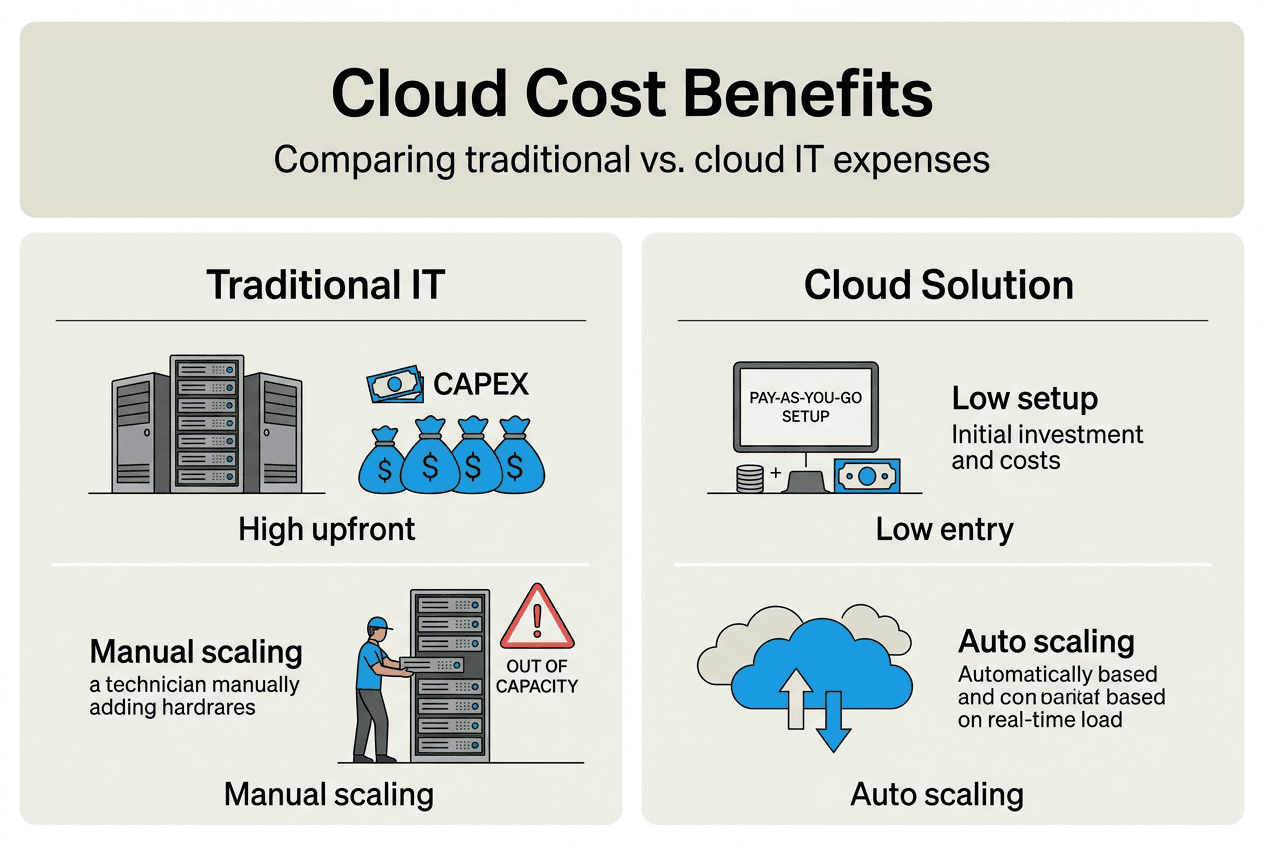
Cloud-native solutions offer cost-effectiveness through a subscription model, fundamentally transforming IT economics. You pay only for resources consumed, eliminating waste from idle capacity. This pay-as-you-go approach reduces financial risk by converting large capital expenditures into predictable operational expenses that scale with actual usage.
Automatic scalability represents one of cloud computing’s most powerful advantages. Resources expand instantly during traffic spikes or intensive processing periods, then contract when demand subsides. This elasticity ensures optimal performance without over-provisioning, allowing IT teams to focus on strategic initiatives rather than capacity planning.
| Cost Factor | Traditional Infrastructure | Cloud-Native Solutions |
|---|---|---|
| Initial Investment | High capital expenditure for hardware | Minimal upfront costs with subscription pricing |
| Scaling Costs | Purchase additional equipment, lengthy procurement | Instant resource allocation, pay for usage |
| Maintenance | Ongoing hardware, facility, and staff expenses | Provider manages infrastructure maintenance |
| Utilization Efficiency | Often 20-30% average utilization | Dynamic allocation matches actual demand |
Real-world results validate these advantages. Cloud migration resulted in a 38% reduction in IT costs for organizations moving from traditional infrastructure. These savings stem from eliminating hardware refresh cycles, reducing data center footprint, and optimizing resource allocation through intelligent automation. Budget freed from infrastructure maintenance can fund innovation initiatives, competitive differentiation, and strategic technology adoption.
The integration of AI in cloud management further amplifies cost efficiency. Machine learning algorithms analyze usage patterns, predict demand fluctuations, and automatically adjust resources to minimize waste while maintaining performance. This intelligent optimization delivers savings that manual management cannot achieve.
Pro Tip: Carefully evaluate cloud subscription models against your specific usage patterns. Reserved instances offer significant discounts for predictable workloads, while spot instances provide deep savings for flexible, interruptible tasks. Combining these pricing models strategically can reduce cloud costs by 40-60% compared to on-demand pricing alone.
Strategic advantages: agility, resilience, and future-proofing IT operations
Cloud computing empowers organizations with unprecedented business agility. Development teams deploy applications in minutes rather than weeks, accelerating time to market for new products and features. This speed advantage allows companies to respond rapidly to market opportunities, competitive threats, and changing customer demands. Traditional infrastructure simply cannot match the velocity that cloud platforms enable.
Multi-cloud architectures enhance operational resilience by distributing workloads across multiple providers and geographic regions. This approach mitigates the risk of provider-specific outages, avoids vendor lock-in, and provides flexibility to optimize performance based on regional requirements. The multi-cloud model is not a mere technical configuration, but a strategic posture designed to optimize application delivery and resilience in dynamic business environments.
| Capability | Traditional Infrastructure | Cloud-Native Platform |
|---|---|---|
| Deployment Speed | Weeks to months for new environments | Minutes to hours with automated provisioning |
| Geographic Reach | Limited by physical data center locations | Global presence through provider networks |
| Disaster Recovery | Complex, expensive secondary sites | Built-in redundancy across multiple regions |
| Vendor Flexibility | Locked into hardware investments | Switch providers or use multiple simultaneously |
The strategic shift toward cloud-native platforms continues accelerating. By 2026, nearly all new digital workloads will be built on cloud-native platforms, signaling that cloud adoption is no longer optional for competitive organizations. Companies that delay cloud transformation risk falling behind competitors who leverage cloud agility for faster innovation cycles and superior customer experiences.
Cloud computing also future-proofs IT operations by providing immediate access to emerging technologies. Artificial intelligence, machine learning, advanced analytics, and IoT platforms integrate seamlessly with cloud infrastructure, allowing organizations to adopt innovations without massive infrastructure investments. This technology access democratizes advanced capabilities that were previously available only to the largest enterprises.
The connection between cloud agility and business outcomes extends beyond IT operations. Agile business solutions enabled by cloud infrastructure allow organizations to pivot quickly in response to market changes. Companies can experiment with new business models, test market hypotheses, and scale successful initiatives without the constraints of fixed infrastructure.
Pro Tip: Implement multi-cloud strategies with clear workload placement criteria. Use AWS multi-region architecture for mission-critical applications requiring maximum uptime, while leveraging alternative providers for specific capabilities like machine learning or data analytics where they excel. This strategic distribution optimizes both performance and cost while maximizing resilience.
How to approach cloud adoption effectively in 2026
Organizations currently spend 45% of their IT budgets on cloud infrastructure, reflecting cloud’s central role in enterprise technology strategy. Effective cloud adoption requires thoughtful planning and systematic execution to maximize benefits while minimizing disruption. A structured approach ensures your organization realizes cloud’s full potential.
Follow this step-by-step process for successful cloud adoption:
- Assess current infrastructure and identify workloads suitable for cloud migration based on performance requirements, data sensitivity, and compliance needs
- Define clear business objectives for cloud adoption, including specific cost targets, performance goals, and strategic capabilities you aim to achieve
- Select appropriate cloud models (public, private, hybrid, or multi-cloud) that align with your security requirements, budget constraints, and operational preferences
- Develop a phased migration roadmap prioritizing applications with the highest business impact and lowest technical complexity for early wins
- Establish cloud governance frameworks covering security policies, access controls, cost management, and compliance monitoring before migrating production workloads
- Invest in team training and skill development to ensure your IT staff can effectively manage and optimize cloud environments
- Implement monitoring and optimization tools to track performance, control costs, and identify opportunities for continuous improvement
- Integrate AI-enabled cloud management platforms to automate routine tasks, predict resource needs, and optimize spending across your cloud portfolio
The cloud computing setup guide provides detailed technical guidance for implementing these steps. Pay particular attention to security configuration, network architecture, and identity management during initial setup, as these foundational elements are difficult to change later.
Cloud adoption succeeds when organizations view it as a business transformation, not just a technology migration. Engage stakeholders across departments early to understand their requirements and concerns. Finance teams need visibility into cloud spending patterns. Security teams require robust controls and audit capabilities. Business units want faster application delivery and improved user experiences. Addressing these diverse needs upfront prevents friction during implementation.
AI transforming cloud management represents a critical capability for organizations managing complex multi-cloud environments. Machine learning algorithms can optimize resource allocation, predict capacity requirements, and identify security threats faster than manual processes. Incorporating AI-driven management tools from the beginning establishes a foundation for efficient, scalable operations.
Pro Tip: Partner with experienced cloud consultants for your initial migration, especially for complex enterprise applications. Their expertise accelerates deployment, avoids common pitfalls, and establishes best practices your team can build upon. The investment in expert guidance typically pays for itself through faster time to value and fewer costly mistakes.
Explore AICloudIT’s cloud computing solutions
AICloudIT specializes in helping enterprises navigate cloud adoption successfully. Our expert consulting services guide you through every phase of cloud transformation, from initial assessment and strategy development to migration execution and ongoing optimization. We understand the complexities IT professionals face when modernizing infrastructure while maintaining business continuity.
Our managed services support multi-cloud deployments, ensuring you leverage the best capabilities from each provider while maintaining consistent security and governance. We help you implement cloud-native architectures that maximize agility, resilience, and cost efficiency. Whether you’re beginning your cloud journey or optimizing existing environments, AICloudIT provides the expertise and support you need.
Explore our comprehensive cloud computing services and access detailed resources tailored for IT professionals. Our cloud computing setup guide offers practical implementation advice you can apply immediately. Contact AICloudIT today to discuss how we can accelerate your cloud adoption and help you realize the strategic advantages cloud computing delivers.
Frequently asked questions
Why is cloud computing becoming essential for enterprises?
Cloud computing provides the scalability, agility, and cost efficiency that modern businesses require to compete effectively. Traditional infrastructure cannot match cloud’s ability to deploy resources instantly, scale dynamically, or provide global reach. Organizations that delay cloud adoption risk falling behind competitors who leverage cloud advantages for faster innovation and superior customer experiences.
What are the main cost benefits of migrating to the cloud?
Cloud migration eliminates upfront capital expenditures for hardware and reduces IT costs by up to 38% through subscription pricing. You pay only for resources consumed, avoiding waste from idle capacity. Cloud providers handle maintenance, upgrades, and facility costs, freeing your budget for strategic initiatives rather than infrastructure management.
How does a multi-cloud strategy improve IT resilience?
Multi-cloud architectures distribute workloads across multiple providers, eliminating single points of failure and avoiding vendor lock-in. If one provider experiences an outage, your applications continue running on alternative platforms. This approach also optimizes performance by placing workloads in regions closest to users while leveraging each provider’s unique strengths.
What challenges should organizations anticipate when adopting cloud computing?
Integration complexity requires careful planning to connect cloud services with existing systems and data sources. Data security demands robust access controls, encryption, and compliance monitoring across distributed environments. Your team needs new skills in cloud architecture, automation, and cost optimization. Change management becomes critical as cloud adoption transforms workflows and responsibilities across IT and business units.
What role does AI play in cloud computing management?
AI automates resource optimization by analyzing usage patterns and adjusting capacity to match demand, reducing waste and costs. Machine learning enhances security monitoring by detecting anomalies and potential threats faster than manual processes. AI in cloud management improves operational efficiency by predicting failures, optimizing workload placement, and automating routine tasks that previously required manual intervention.
Recommended
- Cloud computing setup guide for IT professionals 2026
- The role of AI in cloud management efficiency 2026
- Why Use Cloud AI: Real Impact for Businesses
- 3 Ways AI is Transforming the Future of Cloud Management – AICloudIT
- Security Benefits of Cloud Computing for Brisbane SMEs – IT Start
