

Choosing the right datasets and metrics for AI evaluation sets the stage for whether your findings mirror real-world performance or fall short. For AI analysts and data scientists working across global enterprise projects, every decision about data and measurement influences model success. This guide shows how relevant benchmark datasets and rigorous metrics drive reliable evaluations, supporting practical improvements in accuracy, speed, robustness, and real business impact.
Quick Summary
| Main Insight | Explanation |
|---|---|
| 1. Establish Clear Evaluation Goals | Define what success means for your AI model, focusing on metrics like accuracy or efficiency based on use case. |
| 2. Use Representative Datasets | Ensure your datasets truly reflect real-world scenarios to avoid biases that could misrepresent your model’s performance. |
| 3. Include Multiple Performance Metrics | Relying on a single metric is risky; evaluate accuracy, latency, and robustness to gain a comprehensive understanding of your model. |
| 4. Benchmark in Realistic Conditions | Execute tests in environments that simulate production to capture authentic performance data and avoid discrepancies. |
| 5. Connect Metrics to Business Outcomes | Map performance metrics to business goals to determine their true impact, ensuring that improvements translate to real value. |
Step 1: Prepare relevant datasets and performance metrics
You’re starting the foundation of your AI evaluation. The quality of your datasets and metrics determines whether your results reflect real-world performance or create misleading conclusions. Getting this right requires intentional choices about what data you use and how you measure success.
Start by identifying your evaluation goals. What does success look like for your specific AI model? Are you prioritizing accuracy, speed, robustness, or resource efficiency? Your answer shapes everything downstream. A language model serving customer support has different priorities than one processing financial transactions. Write down what matters most for your use case.
Next, select representative datasets that match your actual deployment environment. This is where many teams stumble. Using benchmark datasets that don’t reflect your real data introduces bias into your analysis. If your model will process customer feedback with regional slang and informal language, your test dataset should include exactly that. Relevant benchmark datasets require careful consideration of task-specific requirements and real-world distributions.
Define multiple performance metrics that capture different aspects of model behavior:
- Accuracy metrics for correctness
- Latency measurements for speed
- Resource consumption for efficiency
- Robustness indicators for edge cases
- Task-specific metrics for domain requirements
Avoid relying on a single metric. A model can score well on accuracy while failing catastrophically on latency or robustness. You need a comprehensive view.
Here’s how various performance metrics influence AI evaluation strategies:
| Metric Type | What It Measures | Real-World Importance |
|---|---|---|
| Accuracy | Model correctness | Ensures reliable predictions |
| Latency | Response speed | Supports timely user interaction |
| Resource Efficiency | Computational cost | Cuts operational expenses |
| Robustness | Handling unusual cases | Maintains reliability under stress |
| Task-Specific | Domain-relevant outcomes | Aligns results with business needs |
Select metrics that directly answer your evaluation goals, not metrics that are simply easy to compute.
Combine your dataset and metric choices into a documented framework. Record why you selected each dataset and metric. This documentation becomes invaluable when reviewing results later and explaining your methodology to stakeholders.
Pro tip: Create a dataset versioning system with clear documentation of your data sources, preprocessing steps, and date ranges so your evaluations remain reproducible across different models and time periods.
Step 2: Execute targeted benchmarks and real-world tests
Now you move from planning to action. Running benchmarks transforms your prepared datasets and metrics into actual performance data. This step separates theoretical evaluation from practical results that reveal how your model truly performs.

Start by executing your first benchmark using your prepared dataset and metrics. Run your model against the dataset systematically, recording results for each metric. This initial benchmark establishes a baseline. You’ll compare all future improvements against this starting point. Don’t rush this phase. Careful execution prevents errors that compound through analysis.
Design benchmarks that simulate real-world conditions. Your test environment should match production as closely as possible. If your model runs on standard CPUs in deployment, benchmark on those same CPUs. If it processes data with variable input sizes, include that variability in testing. Real-world performance assessment requires authenticity in testing conditions, not just dataset selection.
Execute multiple benchmark rounds across different scenarios:
- Standard conditions with expected input distributions
- Edge cases with extreme or unusual inputs
- Resource-constrained environments if relevant
- Different data conditions or seasonal variations
- Stress testing with high volume or concurrent requests
Document everything during execution. Record timestamps, system configurations, input characteristics, and any anomalies. This documentation becomes critical when troubleshooting unexpected results or replicating tests later.
Benchmark replicability matters more than benchmark perfection. You need to run tests the same way every time to track meaningful changes.
After completing benchmarks, compare results against your baseline. Did performance meet expectations? Are there surprising failures in specific scenarios? These observations guide your next optimization cycles.
Pro tip: Set up automated benchmark runs on a consistent schedule so you capture performance trends over time and catch degradation before models reach production.
Step 3: Evaluate results against business objectives
Your benchmark numbers mean nothing without business context. This step transforms raw performance data into strategic insights that drive decisions. You’re answering the question that matters: Does this model actually serve your organization’s goals?
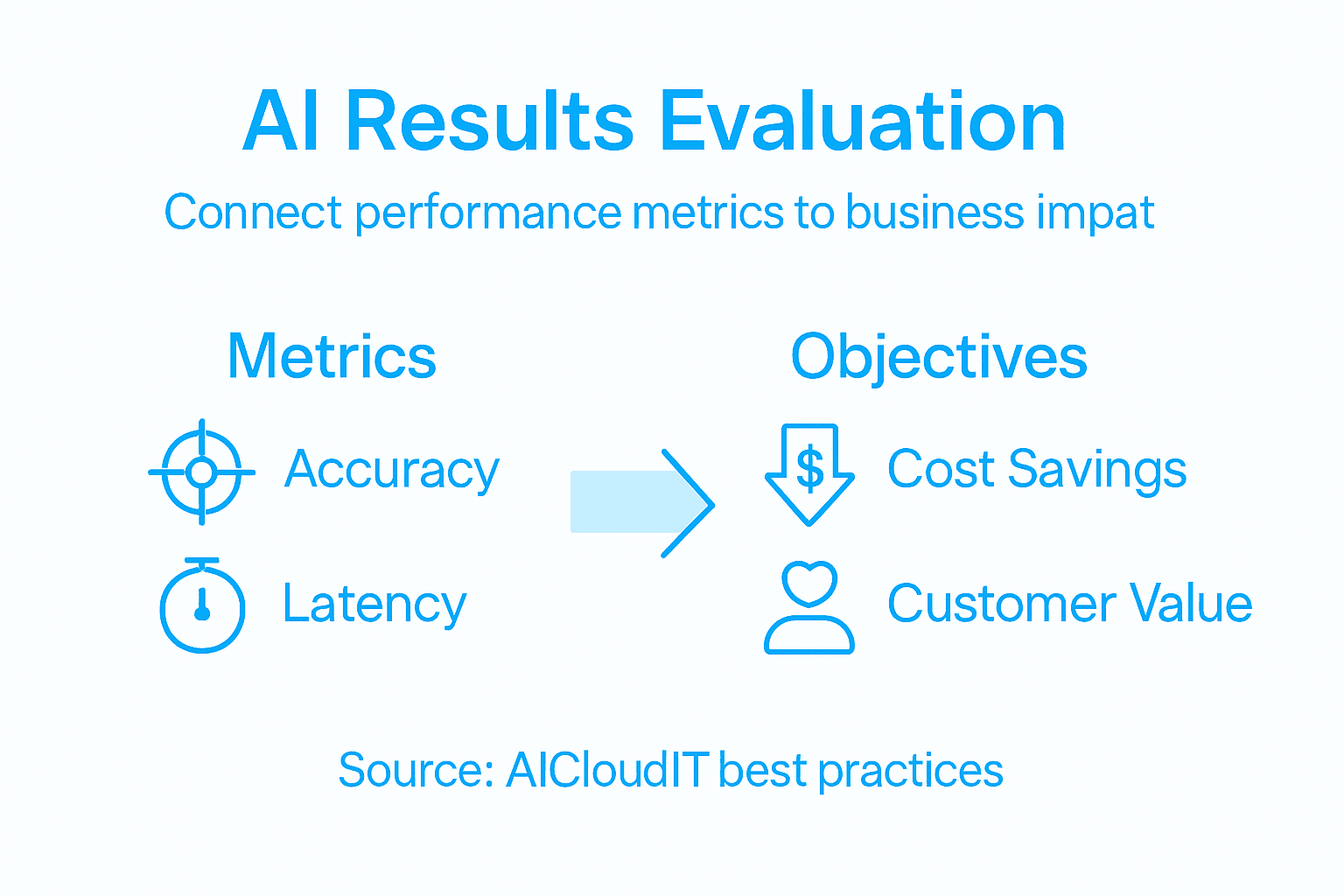
Start by connecting metrics to business outcomes. A 2% accuracy improvement sounds positive, but what does it mean for your bottom line? Does it reduce customer churn, lower processing costs, or accelerate time-to-market? Map each performance metric directly to a business impact. This connection separates meaningless improvements from ones that genuinely matter.
Review your benchmark results through three business lenses. First, operational efficiency: Does the model reduce costs, speed up processes, or lower resource consumption compared to current methods? Second, customer experience: Does it improve response quality, personalization, or satisfaction metrics? Third, innovation value: Does it enable new capabilities or competitive advantages? AI contribution towards business objectives requires assessment across multiple performance dimensions aligned with organizational priorities.
Compare your model’s actual performance against predefined business thresholds:
- Accuracy targets that justify replacing existing systems
- Cost savings that offset implementation and maintenance
- Speed improvements that create measurable user value
- Reliability levels acceptable for your risk tolerance
- Scalability that supports projected growth
Honestly assess gaps. Where does your model fall short of expectations? Is the shortfall acceptable given time and budget constraints? Can you improve it through retraining, or does it require architectural changes?
A technically impressive model that doesn’t advance business goals is just an expensive experiment.
Document your evaluation findings clearly. Include what the model does well, where it struggles, and recommended next steps. This clarity helps stakeholders understand the true value proposition and make informed deployment decisions.
AI evaluation decisions can impact business success in different ways:
| Decision Area | Example Impact | Business Outcome |
|---|---|---|
| Operational Choices | Streamlining data pipelines | Reduced processing costs |
| Customer Experience | Improving response quality | Higher satisfaction scores |
| Innovation Value | Enabling new capabilities | Competitive market advantages |
| Statistical Validation | Confirming result significance | Increases stakeholder confidence |
Pro tip: Establish clear business success criteria before running benchmarks so you evaluate results against predetermined standards rather than deciding what matters after seeing the numbers.
Step 4: Verify findings with statistical quality checks
Your benchmark results need validation. Raw numbers can hide uncertainty, bias, or statistical artifacts. This step adds rigor by applying statistical methods that confirm your findings are real and reproducible, not random variation.
Start by calculating confidence intervals around your performance metrics. A model showing 87% accuracy is incomplete information. Does that represent 85-89% or 75-99%? Confidence intervals quantify uncertainty. Wider intervals suggest your results may not generalize well. Narrow intervals indicate more reliable findings. Statistical rigor distinguishes solid conclusions from lucky results.
Assess statistical significance to determine if observed improvements actually matter. Small performance gains sometimes occur by chance, especially with limited test data. Statistical tests reveal whether improvements exceeded random variation. This prevents celebrating improvements that disappear when testing different data.
Statistical models quantifying AI performance uncertainty help distinguish benchmark accuracy from generalized accuracy and improve interpretation reliability. Tools like generalized linear mixed models reveal true system capabilities and guide sound selection decisions.
Verify your findings through these quality checks:
- Calculate confidence intervals for each performance metric
- Run statistical significance tests on claimed improvements
- Check for data leakage between training and test sets
- Validate that results remain consistent across multiple test runs
- Examine whether findings hold across different data subgroups
Document any limitations discovered. Did results vary significantly across demographic groups? Did certain input types show unexpected failures? Were confidence intervals unexpectedly wide? Transparency about limitations builds credibility and informs deployment decisions.
Statistics transform guesses into evidence. Take time to verify your numbers properly.
Communicate statistical findings clearly to non-technical stakeholders. Avoid jargon. Instead say “We’re 95% confident accuracy falls between 85% and 89%” rather than discussing confidence intervals.
Pro tip: Set a minimum acceptable confidence interval width before analysis begins so you know when results are statistically robust enough for decision-making rather than debating standards after seeing numbers.
Unlock Precise AI Insights to Drive Real Business Value
Struggling to analyze AI performance with clear, actionable results? This article highlights the challenges of selecting the right datasets, metrics, and statistical checks to avoid misleading conclusions. If your goal is to ensure your AI models deliver on accuracy, robustness, and business impact, you need a trusted resource that breaks down complex evaluation strategies into practical insights.
At AICloudIT, we specialize in connecting IT professionals and business leaders with the latest advancements and best practices in artificial intelligence and cloud technology. Explore our content on AI model developments and comprehensive AI news to stay ahead of the curve. Don’t let incomplete evaluation hold back your AI initiatives. Visit our website now to refine your AI strategy and turn performance data into a competitive advantage.
Frequently Asked Questions
What datasets should I use for analyzing AI performance?
To analyze AI performance accurately, use datasets that reflect your actual deployment environment. For example, if your model processes customer feedback with specific language styles, include similar examples in your dataset.
How do I establish evaluation goals for my AI model?
Start by determining what success looks like for your model. Identify whether you prioritize accuracy, speed, robustness, or resource efficiency, then document these goals to guide your analysis.
What performance metrics should I consider when evaluating AI?
Consider multiple performance metrics, such as accuracy for correctness, latency for speed, and robustness for handling edge cases. Select metrics that align directly with your evaluation goals to get a comprehensive view of your model’s capabilities.
How do I simulate real-world conditions in benchmarks?
To simulate real-world conditions, run your benchmarks in an environment that closely matches your production setup. For example, if your model operates on standard CPUs, ensure that your benchmarking also uses the same hardware.
How can I communicate statistical findings to non-technical stakeholders?
When communicating statistical findings, avoid technical jargon and simplify the language. For example, say “We are 95% confident that accuracy falls between 85% and 89%” to make your results clear and accessible.
What should I document during the evaluation process?
Document key elements such as dataset sources, preprocessing steps, benchmark configurations, and any observed anomalies. This thorough documentation helps ensure your evaluations are reproducible and aids in explaining methodology to stakeholders.
Recommended
- AI Data Security Guide: Safeguard Enterprise AI Systems
- 6 Essential AI Tools for Technologists to Boost Efficiency
- What are the best programming languages for AI? – AICloudIT
- AI vs Machine Learning vs Data Science
- Dot Data Labs — High-Quality Data for Training AI Models — Providing datasets for AI training
