

Every global enterprise faces mounting pressure to make faster, more accurate decisions as business complexity grows. Artificial Intelligence is now a central tool for IT leaders and data analysts, enabling organizations to process massive datasets, recognize patterns, and extract actionable insights with unmatched speed and precision. This article outlines how AI empowers strategic business decisions, highlights diverse model types, and explores practical integration steps for optimizing workflows across industries.
Key Takeaways
| Point | Details |
|---|---|
| AI Enhances Decision-Making | AI provides organizations with tools for predictive analytics, natural language processing, and real-time data processing to improve decision accuracy and efficiency. |
| Model Selection is Crucial | Choosing the right AI decision-making model depends on specific business needs, requiring careful assessment of data and desired outcomes to ensure effective implementation. |
| Integration is Key | Successful AI integration into enterprise workflows demands alignment with existing systems and continuous optimization to support human decision-making. |
| Governance is Essential | Establishing strong governance frameworks is necessary to address ethical challenges, such as algorithmic bias and data privacy, ensuring responsible AI usage. |
Defining AI’s Role in Business Decisions
Artificial Intelligence (AI) has emerged as a transformative force in enterprise decision-making, fundamentally reshaping how businesses analyze data, predict outcomes, and develop strategic initiatives. By leveraging advanced computational techniques, AI enables organizations to extract meaningful insights from complex datasets far more rapidly and accurately than traditional methods.
Businesses are increasingly adopting AI to enhance decision-making across multiple domains through several key capabilities:
- Predictive Analytics: Forecasting future trends and potential risks
- Natural Language Processing: Understanding and interpreting human communication
- Machine Learning Algorithms: Identifying patterns and generating actionable recommendations
- Real-Time Data Processing: Making instantaneous strategic decisions
The strategic application of AI in business decisions is supported by empirical research demonstrating its profound impact. AI’s transformative business insights highlight how advanced algorithms can dramatically improve decision accuracy and efficiency across finance, marketing, and operational domains.
Modern enterprises recognize that AI is not about replacing human judgment, but augmenting and accelerating decision-making processes. By providing data-driven recommendations, AI helps business leaders mitigate risks, identify opportunities, and develop more nuanced strategies that balance quantitative analysis with strategic vision.
Pro tip: Start small by implementing AI in one specific business function to understand its potential and build organizational confidence in AI-driven decision-making.
Types of AI Decision-Making Models
Artificial Intelligence has evolved sophisticated decision-making models that fundamentally transform how enterprises approach complex strategic challenges. AI decision-making techniques reveal multiple paradigms that enable organizations to process massive datasets and generate actionable insights with unprecedented precision.
The primary types of AI decision-making models can be categorized into several distinct approaches:
- Supervised Learning Models: Utilize pre-labeled training data to make predictions
- Unsupervised Learning Models: Identify hidden patterns without predefined labels
- Reinforcement Learning Models: Learn through trial-and-error interactions
- Hybrid Collaborative Models: Combine human expertise with AI computational power
These models differ significantly in their operational mechanisms and strategic applications. Supervised learning models excel in scenarios with clear historical data, while unsupervised models are particularly effective in discovering unexpected relationships within complex datasets. Reinforcement learning represents a dynamic approach where AI systems continuously improve decision quality through iterative feedback mechanisms.
Modern enterprises are increasingly adopting AI decision-making strategies that integrate multiple model types to create more robust and adaptable decision support systems. The goal is not to replace human judgment but to augment it with data-driven insights that enhance strategic thinking and operational efficiency.
Pro tip: Evaluate your organization’s specific decision-making challenges before selecting an AI model to ensure the most appropriate and effective implementation strategy.
Here’s a summary comparing different AI decision-making models and their ideal business uses:
| AI Model Type | Typical Data Used | Best for Business Needs | Limitation |
|---|---|---|---|
| Supervised Learning | Labeled historical data | Forecasting, classification tasks | Needs extensive labeled data |
| Unsupervised Learning | Unlabeled, raw data | Discovering hidden trends | Harder to interpret results |
| Reinforcement Learning | Real-time feedback data | Adaptive control, process optimization | Requires trial-and-error cycles |
| Hybrid Collaborative | Both quantitative data and expert input | Complex decisions, strategy alignment | Needs close human-AI teamwork |
How AI Integrates with Enterprise Workflows
Artificial Intelligence is revolutionizing enterprise workflows by seamlessly embedding intelligent capabilities across organizational systems and processes. Strategic AI integration approaches demonstrate how advanced technologies can transform traditional business operations through sophisticated data processing and intelligent automation.
Enterprises can implement AI integration through multiple strategic approaches:
- Data Pipeline Integration: Connecting AI models directly with existing data management systems
- API-Based Workflow Embedding: Leveraging application programming interfaces for seamless AI functionality
- Microservice Architecture: Modular AI components that can be independently deployed
- Real-Time Performance Monitoring: Continuous tracking and optimization of AI system performance
The integration process typically involves comprehensive assessment of current technological infrastructure, identifying potential AI application points, and designing tailored implementation strategies. Practical AI use cases reveal that successful integration requires careful alignment between technological capabilities and specific business objectives.

Modern enterprises are moving beyond simple automation towards intelligent workflow augmentation. This approach focuses on creating adaptive systems where AI complements human decision-making, providing enhanced analytical capabilities, predictive insights, and operational efficiency across multiple business domains.
Pro tip: Conduct a comprehensive workflow audit before AI implementation to identify the most impactful integration opportunities and potential system compatibility challenges.
Real-World Use Cases and Industry Examples
Artificial Intelligence is transforming decision-making across diverse industries, delivering unprecedented insights and operational capabilities. AI-driven enterprise solutions demonstrate remarkable potential for enhancing efficiency, accuracy, and strategic performance across multiple business domains.
Industry-specific AI applications reveal significant transformative potential:
- Retail: Personalized customer recommendations and dynamic pricing strategies
- Finance: Real-time fraud detection and risk assessment algorithms
- Healthcare: Advanced diagnostic support and predictive patient care modeling
- Transportation: Intelligent route optimization and supply chain management
- Manufacturing: Predictive maintenance and quality control systems
In the retail sector, companies like Amazon leverage AI to create hyper-personalized shopping experiences, analyzing customer behavior patterns to generate precise product recommendations. Artificial intelligence applications enable retailers to dynamically adjust pricing, manage inventory, and predict consumer trends with remarkable accuracy.
Financial institutions are using AI to revolutionize risk management and customer service. Advanced machine learning models can detect fraudulent transactions within milliseconds, assess credit risks more comprehensively, and provide personalized financial advice tailored to individual customer profiles.
Pro tip: Prioritize pilot programs in specific organizational departments to validate AI implementation strategies before enterprise-wide rollout.
Risks, Challenges, and Governance Issues
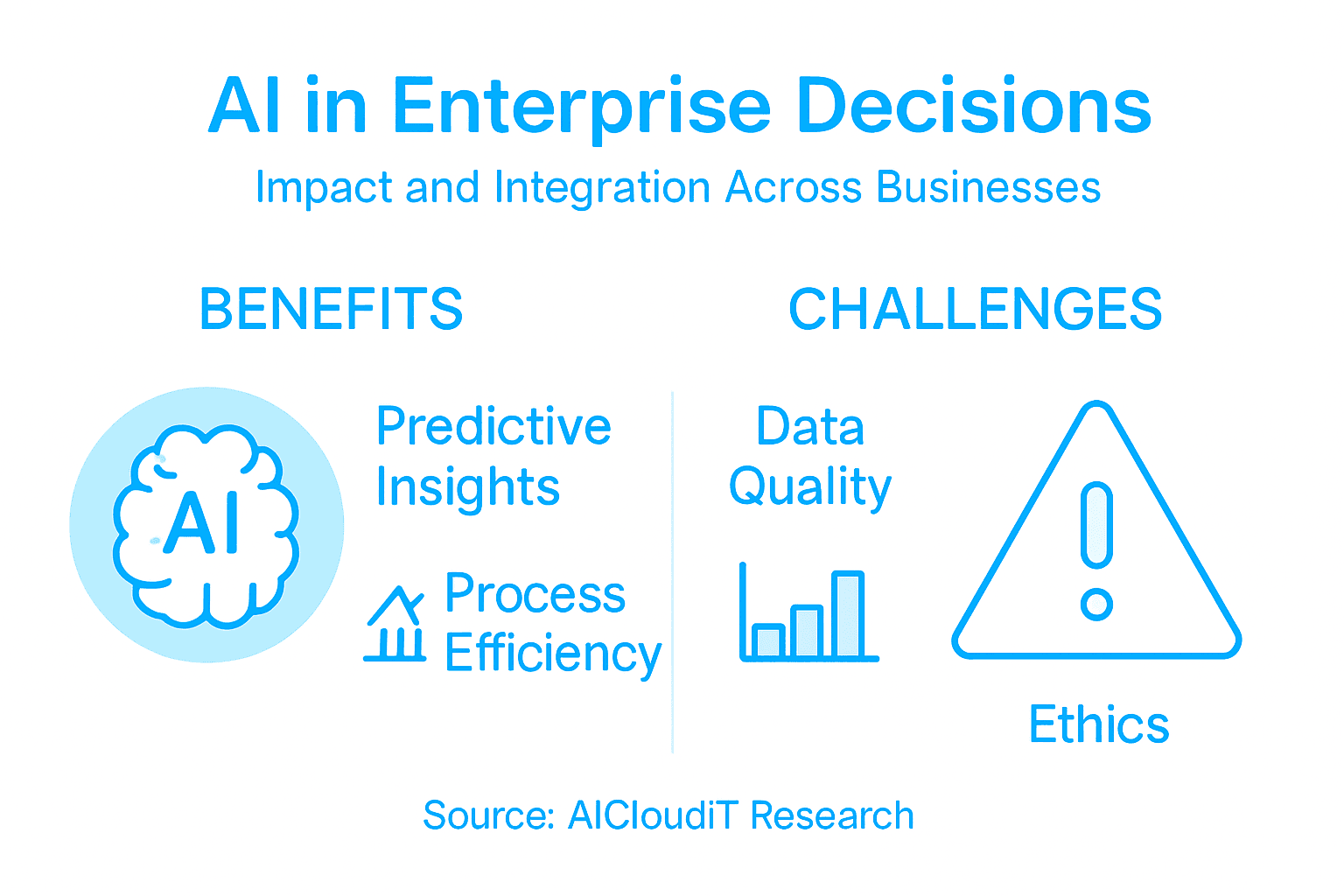
Artificial Intelligence implementation introduces complex ethical and operational challenges that demand sophisticated governance frameworks. Responsible AI governance has become critical for enterprises seeking to mitigate potential risks and maintain organizational integrity.
Key governance challenges include:
- Algorithmic Bias: Preventing discriminatory decision-making patterns
- Data Privacy: Protecting sensitive organizational and customer information
- Transparency: Ensuring explainable AI decision processes
- Accountability: Establishing clear responsibility frameworks
- Ethical Compliance: Aligning AI systems with legal and moral standards
Organizations face significant hurdles in developing comprehensive AI oversight mechanisms. Organizational AI compliance requires robust monitoring systems that can detect potential ethical breaches and systematically address emerging technological risks.
Effective AI governance demands a multifaceted approach that combines internal policy development, continuous monitoring, and proactive risk management. Companies must invest in training, develop clear ethical guidelines, and create mechanisms for ongoing assessment of AI system performance and potential unintended consequences.
Pro tip: Establish a cross-functional AI ethics committee with representatives from technology, legal, and compliance departments to provide comprehensive oversight and strategic guidance.
The following table outlines common AI governance challenges and practical solutions:
| Challenge | Business Impact | Example Solution |
|---|---|---|
| Algorithmic Bias | Legal risks, reputation damage | Regular bias audits |
| Data Privacy | Regulatory penalties | Strong data encryption |
| Transparency | Reduced stakeholder trust | Explainable AI models |
| Accountability | Unclear responsibility | Defined oversight roles |
| Ethical Compliance | Misalignment with values | Ethics training programs |
Strategic Best Practices for IT Leaders
Successful AI integration requires a strategic approach that balances technological innovation with organizational readiness. AI decision-making frameworks demonstrate the critical importance of aligning technological capabilities with broader business objectives.
Key strategic best practices for IT leaders include:
- Modular Architecture Design: Creating flexible AI infrastructure
- Continuous Model Retraining: Ensuring ongoing performance optimization
- Cross-Functional Collaboration: Breaking down organizational silos
- Rigorous Data Governance: Maintaining high-quality, ethical data standards
- Comprehensive Risk Management: Proactively identifying and mitigating potential challenges
AI-powered leadership strategies emphasize the importance of balancing technological capabilities with human judgment. Effective implementation requires a nuanced approach that goes beyond simple technological deployment, focusing on creating adaptive systems that enhance rather than replace human decision-making.
IT leaders must develop comprehensive upskilling programs that enable teams to effectively leverage AI technologies. This involves creating a culture of continuous learning, promoting technological literacy, and developing robust frameworks for AI integration that prioritize both technological efficiency and ethical considerations.
Pro tip: Develop a phased AI adoption strategy that starts with pilot projects in low-risk domains, allowing for iterative learning and organizational adaptation.
Unlock the Full Potential of AI in Your Enterprise Decision Making
The journey from understanding AI’s role in enterprise decision making to successfully integrating it into your workflows can be complex and challenging. Many organizations struggle with selecting the right AI decision-making models, managing algorithmic risks, and aligning AI strategies with business goals. Whether it is navigating supervised or reinforcement learning models or addressing critical governance issues like algorithmic bias and transparency, the stakes are high and the pressure to perform is real.
At AICloudIT, we deliver expert insights and the latest developments in AI technologies and cloud computing that empower IT leaders and business professionals to confidently adopt AI-driven solutions. Discover practical guidance on overcoming integration challenges through our comprehensive resources on AI decision-making strategies and explore how intelligent workflow augmentations can transform your organization’s performance. Your next step to mastering AI starts here. Visit AICloudIT today to stay ahead in the fast-evolving world of AI and make smarter, faster business decisions.
Frequently Asked Questions
What are the key benefits of AI in enterprise decision-making?
AI enhances decision-making by providing predictive analytics, real-time data processing, and machine learning algorithms that help businesses forecast trends, understand customer behavior, and develop successful strategies.
How do AI decision-making models differ from each other?
AI decision-making models include supervised learning, which uses labeled data; unsupervised learning, which finds hidden patterns; reinforcement learning, which learns from trial and error; and hybrid models that combine both AI and human expertise to optimize decisions.
What are some real-world applications of AI in different industries?
AI is applied in various sectors, including retail for personalized recommendations, finance for fraud detection and risk assessment, healthcare for diagnostic support, and manufacturing for predictive maintenance and quality control.
What are the challenges associated with implementing AI in organizations?
Challenges include algorithmic bias, data privacy concerns, lack of transparency, accountability issues, and ensuring ethical compliance, all of which necessitate robust governance and oversight frameworks.
Recommended articles:
- Are AI and Cloud Reshaping Enterprise Communications?
- AI Driven ERP Systems: Future of Nusaker
- Top AI Cloud Business Management Platform Tools (2026 Guide)
