

Threats to AI data security can appear faster than most teams expect, especially when sensitive datasets cross international boundaries and touch machine learning models. For cybersecurity managers, protecting these assets is more than a technical challenge—it impacts compliance, trust, and business resilience. This article delivers practical insights based on the latest guidance from RAND and OWASP, equipping you to assess vulnerabilities, design robust policies, and implement advanced controls for AI-specific data protection.
Quick Summary
| Key Message | Explanation |
|---|---|
| 1. Conduct a Comprehensive Security Assessment | Inventory all AI systems and identify vulnerabilities to create a solid security foundation. |
| 2. Develop AI-Specific Data Protection Policies | Establish clear policies addressing data handling to ensure both security and compliance. |
| 3. Implement Advanced Security Controls | Utilize multilayered security measures tailored for AI to prevent unauthorized access and data breaches. |
| 4. Integrate Continuous Monitoring and Threat Detection | Establish real-time monitoring to identify and respond to anomalies before they lead to security incidents. |
| 5. Verify Compliance and Remediate Vulnerabilities | Regular audits and a proactive approach to vulnerabilities ensure compliance and strengthen defenses. |
Step 1: Assess Current AI Data Security Landscape
Assessing your enterprise’s AI data security landscape requires a comprehensive and strategic approach to understanding potential vulnerabilities and risks. Your goal is to create a detailed inventory and analysis of existing AI systems, their data flows, and potential security gaps.
Begin by conducting a thorough risk-based AI security assessment that examines your entire AI ecosystem. This involves mapping out all current AI systems, understanding their data sources, identifying potential threat vectors, and evaluating existing security controls. Key steps in this assessment include:
- Inventory all AI models and machine learning systems
- Document data ingestion and processing pathways
- Identify sensitive data elements within AI training and operational datasets
- Evaluate current access control and authentication mechanisms
- Analyze potential external and internal threat scenarios
Your assessment should consider the entire AI lifecycle – from initial design and development through deployment and ongoing operations. Pay special attention to areas where sensitive data intersects with machine learning models, as these represent potential points of vulnerability.
Here’s a summary of common AI security vulnerabilities and their potential business impact:
| Vulnerability Type | Example Scenario | Potential Business Impact |
|---|---|---|
| Data Leakage | Sensitive data exposed by model | Loss of customer trust, legal penalties |
| Model Poisoning | Corrupted training data | Damaged predictions, strategic losses |
| Adversarial Manipulation | Malicious input crafted | Undermined AI decisions, fraud risks |
| Insider Threats | Unauthorized internal access | Intellectual property theft |
| Insufficient Access Control | Weak authentication mechanisms | System breaches, unauthorized changes |
A comprehensive security assessment is not a one-time event but a continuous process of monitoring, evaluation, and adaptation.
Detailed documentation is crucial during this process. Create a structured report that not only identifies current security postures but also provides actionable recommendations for mitigating identified risks.
Pro tip: Engage cross-functional teams including cybersecurity, data science, and compliance professionals to ensure a holistic and nuanced security assessment.
Step 2: Design AI-Specific Data Protection Policies
Designing comprehensive AI-specific data protection policies is crucial for safeguarding your enterprise’s sensitive information and maintaining regulatory compliance. Your objective is to create a robust framework that addresses the unique challenges of AI data management and privacy protection.
Begin by developing comprehensive AI governance controls that establish clear guidelines for data handling, access, and usage throughout the AI system lifecycle. This involves creating policies that address key areas of data protection:
- Define strict data minimization principles
- Establish clear consent and usage limitations
- Create transparent data tracking mechanisms
- Implement robust authentication and access controls
- Design protocols for secure data storage and transmission
Your policy framework should provide detailed guidance on managing sensitive information, with specific attention to how machine learning models interact with and process data. Pay particular focus to areas such as data anonymization, restricted access protocols, and methods for preventing unauthorized data exposure.
Effective AI data protection policies are not just about prevention but about creating a culture of responsible data stewardship.
The policy should be comprehensive yet flexible, allowing for adaptation as AI technologies and regulatory landscapes evolve. Collaborate with legal, cybersecurity, and data science teams to ensure a holistic approach that balances technical requirements with organizational risk management.
Pro tip: Conduct regular policy audits and update your AI data protection framework at least quarterly to stay ahead of emerging security threats and regulatory changes.
Step 3: Implement Advanced Security Controls for AI Data
Implementing advanced security controls for AI data requires a strategic and multilayered approach to protect your enterprise’s most sensitive computational assets. Your primary goal is to establish robust defenses that prevent unauthorized access, manipulation, and potential compromise of AI systems and their underlying data.
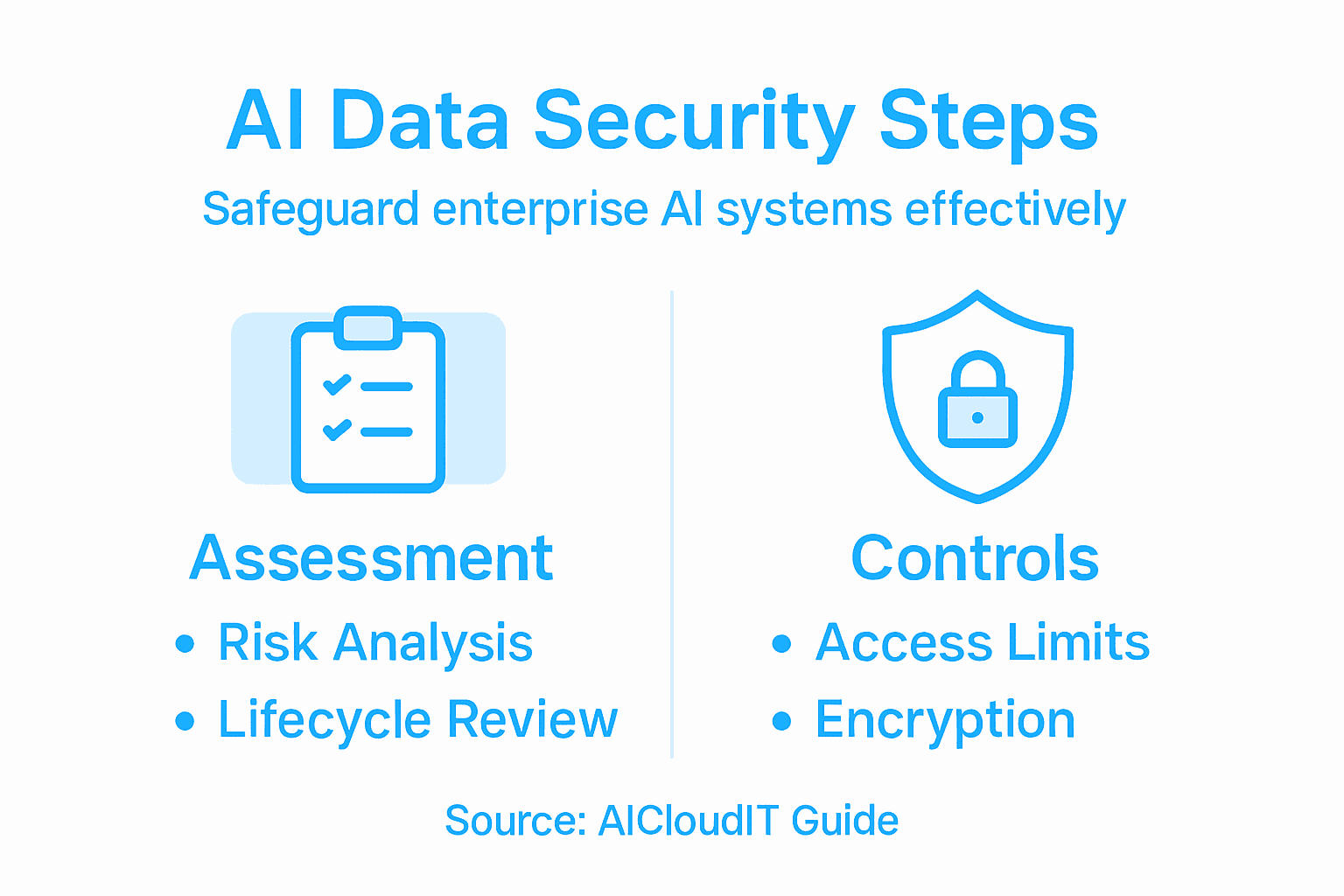
Begin by implementing comprehensive security controls that address the entire AI system lifecycle. These controls should focus on protecting critical components such as model weights, training datasets, and runtime environments. Key implementation strategies include:
- Deploy advanced encryption for data at rest and in transit
- Implement granular access control mechanisms
- Create robust model authentication protocols
- Develop comprehensive input validation techniques
- Establish continuous monitoring and anomaly detection systems
Your security approach must go beyond traditional IT security paradigms, recognizing the unique vulnerabilities inherent in machine learning systems. Threat modeling becomes crucial, requiring you to anticipate potential attack vectors specific to AI architectures, such as model poisoning, data exfiltration, and adversarial input manipulation.

The table below outlines key differences between traditional IT security and AI security needs:
| Aspect | Traditional IT Security | AI Security Requirements |
|---|---|---|
| Attack Surface | Applications and networks | Models, training data, inputs |
| Threat Complexity | Known software vulnerabilities | Evolving, adversarial AI attacks |
| Data Sensitivity | General user and system data | Proprietary and personal datasets |
| Defense Techniques | Firewalls, access controls | Input validation, anomaly detection |
Advanced AI security is not about creating impenetrable walls, but about developing adaptive and intelligent defense mechanisms.
Consider integrating multiple layers of security controls, including runtime protection, development-time safeguards, and input validation techniques. This holistic approach ensures comprehensive protection across different stages of AI system operation.
Pro tip: Conduct regular red team exercises specifically designed to test AI system security, simulating advanced persistent threats and emerging attack methodologies.
Step 4: Integrate Continuous Monitoring and Threat Detection
Implementing continuous monitoring and threat detection is essential for maintaining the security integrity of your AI systems. Your objective is to create a proactive detection mechanism that can identify potential security risks and anomalies in real time, preventing potential breaches before they escalate.
Begin by implementing comprehensive AI monitoring strategies that provide granular visibility into your AI system’s behavior and performance. These strategies should encompass multiple layers of monitoring across different operational domains. Key monitoring components include:
- Track model performance deviations
- Monitor data input and output patterns
- Analyze user interaction logs
- Detect unauthorized access attempts
- Establish baseline behavioral benchmarks
- Create automated alerting mechanisms
Anomaly detection becomes critical in this process, requiring sophisticated algorithms that can distinguish between normal operational variations and genuine security threats. Your monitoring system should leverage machine learning techniques to develop adaptive detection capabilities that evolve with your AI infrastructure.
Effective monitoring transforms your AI security from a reactive defense to a predictive shield.
Consider integrating advanced threat intelligence platforms that can correlate internal system metrics with external threat databases. This approach provides contextual awareness and helps you anticipate potential security risks before they manifest.
Pro tip: Implement machine learning-powered anomaly detection algorithms that can dynamically adjust detection thresholds based on evolving system behaviors and emerging threat patterns.
Step 5: Verify Compliance and Remediate Vulnerabilities
Verifying compliance and remediating vulnerabilities is a critical process that ensures your AI systems meet regulatory standards and maintain robust security postures. Your objective is to systematically identify, assess, and address potential weaknesses in your AI infrastructure before they can be exploited.
Begin by conducting comprehensive security compliance audits that provide a structured approach to evaluating your AI systems against established security frameworks. These audits should encompass multiple dimensions of vulnerability assessment:
- Review data handling and privacy protocols
- Validate authentication and access control mechanisms
- Assess model training and deployment security practices
- Analyze potential data leakage risks
- Check regulatory alignment with industry standards
- Evaluate incident response readiness
Vulnerability management requires a proactive and iterative approach. Your remediation strategy should prioritize risks based on potential impact, developing targeted interventions that address underlying systemic weaknesses rather than applying superficial fixes.
Effective compliance is not about passing a checklist, but creating a sustainable security culture.
Implement a structured vulnerability tracking system that enables continuous monitoring and rapid response. This system should integrate automated scanning tools with manual expert review to ensure comprehensive coverage and nuanced threat assessment.
Pro tip: Create a cross-functional vulnerability response team that includes cybersecurity experts, data scientists, and compliance professionals to develop holistic and adaptive remediation strategies.
Strengthen Your AI Data Security with Expert Insights and Tools
Protecting enterprise AI systems is a complex challenge that demands continuous vigilance against evolving threats like data leakage, adversarial manipulation, and insider risks. This article highlights crucial steps such as conducting thorough AI security assessments, designing tailored data protection policies, and implementing advanced security controls to safeguard sensitive AI data throughout its lifecycle.
At AICloudIT, we understand that building a resilient AI security framework requires more than theoretical knowledge — it needs actionable intelligence and up-to-date resources. Explore our collection of expert analyses, emerging AI tools, and cloud management solutions designed to help IT professionals and business leaders stay ahead in securing their AI ecosystems. Visit our main site to access the latest trends and practical guidance tailored for your enterprise security needs.
Are you ready to transform your AI security strategy and defend your enterprise against sophisticated threats? Start by diving deeper into our comprehensive content on AI data protection policies and continuous monitoring and threat detection. Take control of your AI system’s safety today and ensure your business stays protected tomorrow.
Frequently Asked Questions
What are the key steps to assess my organization’s AI data security landscape?
Begin by conducting a comprehensive risk-based AI security assessment. This involves mapping out all current AI systems, identifying sensitive data elements, and evaluating existing security controls within 30 days.
How can I design AI-specific data protection policies effectively?
Create a robust framework by defining strict data handling practices, implementing access controls, and ensuring compliance with privacy regulations. Focus on collaborative efforts with legal and cybersecurity teams to finalize policies within the next quarter.
What advanced security controls should I implement for my AI systems?
Deploy comprehensive security measures that include encryption, access control, and anomaly detection systems. Start by prioritizing critical components such as model weights and training datasets, aiming for implementation within 60 days.
How do I establish continuous monitoring for my AI systems?
Implement real-time monitoring strategies that track data input and model performance deviations. Ensure you set up automated alert mechanisms to respond to security threats, ideally within the first month of deployment.
What steps should I take to verify compliance and remediate vulnerabilities in my AI systems?
Conduct thorough security compliance audits to evaluate your AI systems against established frameworks. Create a structured vulnerability tracking system to prioritize and address any weaknesses within 30 days after the audit.
Recommended
- Using Artificial Intelligence To Help Keep Your Financial Data Safe – AICloudIT
- AI vs. Data Science Archives – AICloudIT
- 7 Key Benefits of GDPR Compliance for Your Business – AICloudIT
- AI vs. Machine Learning Archives – AICloudIT
Article generated by BabyLoveGrowth
