
I’ve been tracking the cloud space since before “The Cloud” was even a buzzword, back when moving your data to someone else’s server felt like a risky gamble. Fast forward to 2026, and the conversation has shifted entirely. It’s no longer about whether you’re in the cloud, it’s about how much of your business is being run by the AI living inside it.
Today, the most successful companies aren’t just using the cloud for storage; they’re using AI cloud platforms to automate messy workflows, predict customer churn before it happens, and manage global operations without breaking a sweat. Honestly, if you aren’t integrating these AI‑driven systems into your management strategy, you’re basically running a race in 2026 with 2016 sneakers.
In this guide, I’ll walk you through the top AI cloud business management tools that actually move the needle, how they stack up against each other, and what you need to look for to make sure you aren’t overpaying for hype.
What Are AI Cloud Business Management Platforms?
At its core, an AI cloud business management platform is a unified software ecosystem that lives in the cloud and uses artificial intelligence to oversee, automate, and optimize your entire operation. Think of it as the central nervous system of a company: it connects your CRM, ERP, finance, and HR data, then applies machine learning to make everything run smoother.
These platforms don’t just store your data; they understand it. They can spot a bottleneck in your supply chain, flag an unusual financial transaction, or even suggest when you should hire more staff based on predicted growth, all in real‑time and accessible from anywhere.
You must know the: 3 Ways AI is Transforming the Future of Cloud Management
How AI and cloud computing work together in business operations?
Cloud computing provides the “brawn”, the massive storage and raw processing power needed to handle gigabytes of enterprise data. AI provides the “brains,” using that power to run complex algorithms that would be impossible on a local server.
Together, they create a loop: the cloud gathers data from every corner of your business, the AI analyzes it to find efficiencies, and the cloud then pushes those optimizations back out to your teams instantly.
Why businesses are adopting AI cloud platforms?
The shift isn’t just about following a trend; it’s about survival in a market where margins are razor‑thin and speed is everything.
- Automation and efficiency: By 2026, routine tasks like data entry, basic reporting, and inventory tracking are almost entirely handled by AI agents, freeing up your team for actual strategic work.
- Data-driven decision-making: Instead of guessing what customers want next quarter, businesses use predictive models that analyze thousands of variables to provide high‑confidence forecasts.
- Scalability and flexibility: Whether you’re a startup or a global giant, cloud‑native AI lets you add or remove resources as fast as you can click a button, meaning you only pay for the power you actually use.
Key Benefits of AI Cloud Business Management Tools
Using these tools isn’t just a minor upgrade; it’s a fundamental shift in how you see your own business data.
- Process automation: Imagine a world where your financial reports are drafted automatically and your supply chain adjusts itself to a sudden spike in demand. That’s the reality for companies using advanced AI cloud management.
- Predictive analytics and insights: These platforms can spot trends long before a human analyst would, identifying new market opportunities or internal risks before they become expensive problems.
- Cost optimization: AI monitors your cloud usage and automatically shuts down idle resources or suggests cheaper configurations, preventing those “cloud bill shocks” that everyone fears.
- Improved collaboration and visibility: With a single AI‑powered source of truth, your sales, finance, and ops teams aren’t arguing over different numbers, they’re looking at the same real‑time dashboard.
Core Features to Look for in AI Cloud Business Platforms
Not all platforms are created equal, and in 2026, the gap between “legacy” cloud and “AI‑native” cloud is wider than ever.
AI-powered automation
Look for a platform that goes beyond simple “if‑this‑then‑that” rules. You want intelligent workflow automation that can learn from your team’s behavior and suggest ways to streamline tasks. This includes smart task management that prioritizes your most important work based on deadlines and project impact.
Data analytics and reporting
Static charts are out; interactive, predictive dashboards are in. Your platform should offer real‑time visibility into every department and prescriptive analytics that don’t just tell you what happened, but tell you what to do about it.
Cloud infrastructure and scalability
In 2026, almost 80% of organizations use more than one cloud provider. You need a platform with multi‑cloud or hybrid support that works across AWS, Azure, and Google Cloud seamlessly. Security is also non‑negotiable: look for a secure cloud architecture that handles encryption, identity management, and compliance automatically.
Integration capabilities
A management tool is useless if it doesn’t talk to your other software. Make sure the platform has deep integrations for your CRM, ERP, and HR systems, plus robust APIs for connecting custom third‑party tools.
Top AI Cloud Business Management Platform Tools in 2026
The market is dominated by a few giants, but they each have a very distinct “personality” and ideal user.
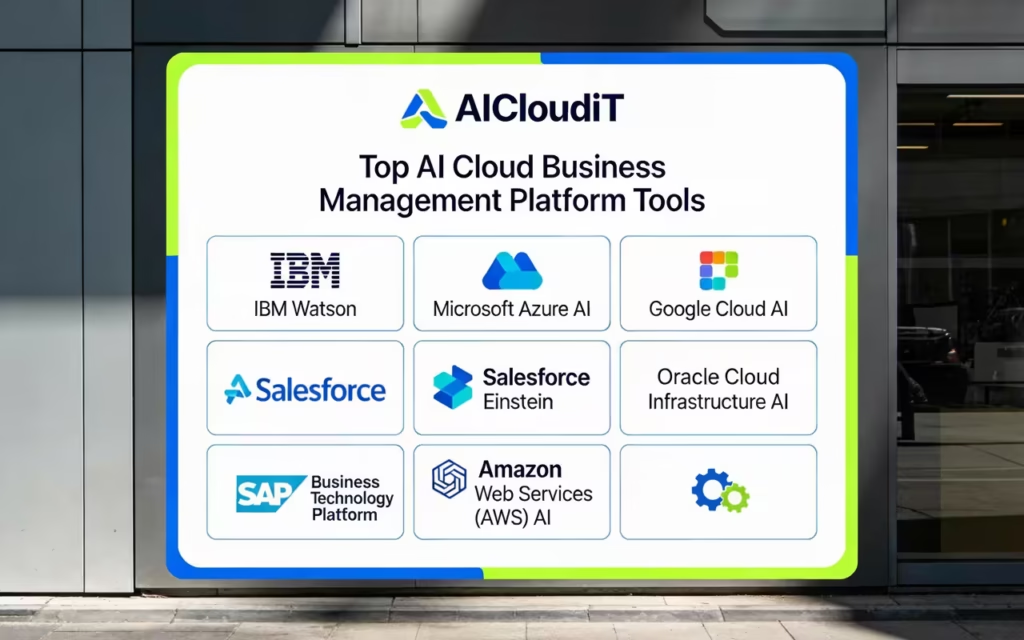
IBM Watson
IBM Watson is the elder statesman of the AI world, but it’s still one of the most powerful options for large enterprises that need to manage massive datasets and strict regulatory requirements.
- Overview: A cloud‑based suite focused on enterprise governance, risk management, and decision automation.
- Key features: Advanced natural language processing (NLP), cognitive computing, and high‑security data silos.
- Business use cases: Risk assessment, automated customer service at scale, and complex financial modeling.
- Ideal audience: Global corporations, financial institutions, and highly regulated industries like healthcare.
- Pricing: Enterprise contracts typically start around $1,500 to $3,000 per month, scaling with usage and compliance needs.
Microsoft Azure AI
Azure AI has seen massive growth lately, largely thanks to Microsoft’s deep partnership with OpenAI, which has put GPT‑powered “Copilots” into almost every corner of the platform.
- Overview: A comprehensive cloud ecosystem that integrates AI directly into the tools your team already uses, like Teams, Excel, and Dynamics 365.
- Key features: Azure OpenAI services, integrated ML pipelines, and seamless connectivity with the Power Platform for low‑code automation.
- Business use cases: End‑to‑end business process automation, generative AI for content and reporting, and predictive sales forecasting.
- Ideal audience: Mid‑to‑large enterprises already committed to the Microsoft software stack.
- Pricing: Pay-as-you-go model. Small teams often spend $100 to $500 per month, while enterprise usage can exceed $2,000 per month.
Google Cloud AI
If your business is built on data and you need the absolute best machine learning performance, Google Cloud AI (and its Vertex AI platform) is often the top choice.
- Overview: An AI‑first cloud infrastructure optimized for massive data analysis and custom ML model development.
- Key features: Vertex AI for low‑code development, BigQuery ML for data analysis, and Anthos for multi‑cloud management.
- Business use cases: High‑performance data processing, custom computer vision applications, and complex multi‑cloud operations.
- Ideal audience: Data‑heavy tech companies, retail giants, and organizations with advanced internal data science teams.
- Pricing: Usage-based. Typical costs range from $300 to $2,500 per month, depending on compute usage.
Salesforce Einstein
Salesforce Einstein is the go‑to for companies that believe their CRM should be the center of their business management universe.
- Overview: An AI layer built directly into the world’s most popular CRM, focused on making sales, service, and marketing smarter.
- Key features: Opportunity scoring, automated lead prioritization, and AI‑powered customer sentiment analysis.
- Business use cases: Predicting which deals will close, automating customer support tickets, and personalized marketing at scale.
- Ideal audience: Sales‑driven organizations and customer service hubs of all sizes.
- Pricing: Einstein features generally add $50 to $75 per user per month.
Oracle Cloud Infrastructure AI
Oracle is built for the enterprise, and its cloud platform is designed to handle the heavy lifting of ERP and database management with AI embedded in every layer.
- Overview: A powerhouse for integrated business applications with built‑in AI for strategic decision‑making.
- Key features: Predictive HR analytics, AI‑enhanced financial forecasting, and real‑time supply chain optimization.
- Business use cases: Global supply chain management, automated financial auditing, and talent scoring for HR.
- Ideal audience: Large enterprises with complex operational needs and existing Oracle database investments.
- Pricing: Contract-based pricing typically starts at $1,000 to $5,000 per month.
SAP Business Technology Platform
SAP is the backbone of global commerce, and its Business Technology Platform (BTP) is how modern companies bring AI into their existing SAP environments.
- Overview: An intelligent enterprise platform focused on unifying data and automating core business processes.
- Key features: Intelligent process optimization, integrated data analytics, and pre‑built AI models for industry‑specific tasks.
- Business use cases: Optimizing manufacturing floor operations, streamlining procurement, and automating complex financial consolidations.
- Ideal audience: Existing SAP customers and large‑scale manufacturing or logistics companies.
- Pricing: Consumption-based pricing usually begins around $200 to $500 per month.
Amazon Web Services (AWS) AI
AWS is the largest cloud provider on the planet, and its AI suite is as broad as it is deep, offering everything from basic APIs to high‑end generative AI tools.
- Overview: A massive library of cloud‑based AI and ML services designed to scale as fast as your business does.
- Key features: Amazon SageMaker for building custom models, Bedrock for accessing generative AI, and a huge range of pre‑trained AI services for vision, speech, and text.
- Business use cases: Building custom AI apps, scaling global web services, and running intensive data analytics.
- Ideal audience: Everyone from small startups to global giants who need maximum flexibility and the widest range of tools.
- Pricing: Pay-as-you-go. Real-world usage typically ranges from $100 to $1,500 per month, with higher costs at scale.
Other tools worth watching
While the giants dominate, several specialized platforms are making major waves in 2026:
- Zoho AI (Zia): Perfect for small and mid‑sized businesses that want an affordable, all‑in‑one suite with AI built in.
- Workday AI: The gold standard for AI‑driven human resources and financial management.
- ServiceNow AI: The leader in automating IT and internal business service workflows.
- H2O.ai: A powerful, open platform for businesses that want to build their own custom AI applications without being locked into one cloud provider.
AI Cloud Business Management Tools by Use Case
Choosing a platform isn’t about finding the “best” one—it’s about finding the one that solves your specific problems.
For enterprise operations management
If you’re managing global logistics, thousands of employees, and complex finance, you need a heavy hitter like Oracle Cloud, SAP BTP, or IBM Watson. These tools excel at ERP and large‑scale workflow optimization, ensuring that every piece of your massive organization is moving in sync.
For small and mid-sized businesses
SMBs don’t need a million‑dollar enterprise contract; they need cost‑efficient tools that deliver immediate value. Zoho AI and Microsoft Azure AI (especially when paired with Dynamics 365) offer powerful automation‑first tools that can scale as you grow without requiring an army of data scientists.
For data-driven decision making
If your competitive advantage is your data, look toward Google Cloud AI or AWS AI. Their platforms offer the most advanced predictive analytics and business intelligence capabilities, giving you the power to find insights that your competitors are missing.
How to Choose the Right AI Cloud Business Platform?
Picking the wrong platform is an expensive mistake that can haunt you for years. Here’s a quick mental checklist for 2026:
- Assess your business needs: Don’t buy features you won’t use. Do you need a better CRM (Salesforce), better data science (Google), or better workflow automation (Microsoft)?
- Budget and scalability: Start small, but make sure the tool can grow with you. Look for transparent, pay‑as‑you‑go pricing to avoid surprise bills as your usage scales.
- Integration with existing systems: If your team already lives in Microsoft Teams, jumping into a non‑Microsoft cloud might cause a huge dip in productivity. Stick to the ecosystem your team already knows unless there’s a massive reason to switch.
AI Cloud Platform Comparison (2026)
| Platform | Best for | Business size | Pricing model | Typical monthly cost |
|---|---|---|---|---|
| Microsoft Azure AI | Microsoft ecosystem users | Mid to Large | Pay-as-you-go | $100–$3,000+ |
| AWS AI | Builders and scale | Small to Enterprise | Pay-as-you-go | $100–$5,000+ |
| Google Cloud AI | Data-driven teams | Mid to Large | Usage-based | $300–$2,500+ |
| Salesforce Einstein | CRM optimization | Small to Large | Per user | $50–$75 per user |
| Oracle Cloud AI | ERP and finance | Large Enterprise | Contract | $1,000–$10,000+ |
| IBM Watson | Compliance and risk | Enterprise | Contract | $1,500–$10,000+ |
| SAP BTP | Manufacturing and ops | Enterprise | Consumption | $200–$5,000+ |
Challenges and Limitations of AI Cloud Business Platforms
It’s not all sunshine and automated profits; there are real hurdles to clear.
- Implementation complexity: These aren’t just “plug‑and‑play” apps. Setting up a full AI cloud management system often requires expert help to ensure your data is clean and your workflows are actually useful.
- Data privacy and security concerns: With more data in the cloud, the target on your back gets bigger. You must be hyper‑vigilant about encryption, access controls, and ever‑changing global data laws.
- Skill gaps and training requirements: Your team needs to know how to use these tools. In 2026, the biggest bottleneck isn’t the technology, it’s the human talent required to manage and maintain it.
Future Trends in AI Cloud Business Management
The race is only accelerating.
- Increased AI automation: We’re moving from “tools you use” to “AI agents that do the work for you.” Expect to see even less manual intervention as AI agents take over entire business processes.
- Industry-specific AI platforms: General tools are being replaced by platforms purpose‑built for your specific niche, whether that’s manufacturing, retail, or legal services.
- Ethical AI and governance: As AI makes more critical decisions, regulators are stepping in. Expect to see much more focus on AI sovereignty, fairness, and transparent decision‑making in the next year.
FAQs
Not necessarily. Many modern platforms offer “low‑code” or “no‑code” tools that let regular managers set up powerful automations and dashboards without writing a single line of code.
In most cases, yes. Major cloud providers invest billions in security that is far more robust than what most individual companies could afford for their own on‑premises servers.
Look for tools with built‑in AI cost management that automatically alerts you to spikes in usage or suggests ways to optimize your resources.
Absolutely. Platforms like Zoho, Microsoft, and AWS offer pay‑as‑you‑go models that allow small businesses to access elite technology for a fraction of what an enterprise would pay.
My Recommended Articles to Read:
What Is Cloud Architecture, Types, Diagrams, And More
How Is Cloud Computing Transforming the Defense Sector
What is cloud computing, types, pros, cons, and more
Top 10 Cloud Based ERP Softwares
How An AWS Multi-Region Architecture Can Strengthen DR
