
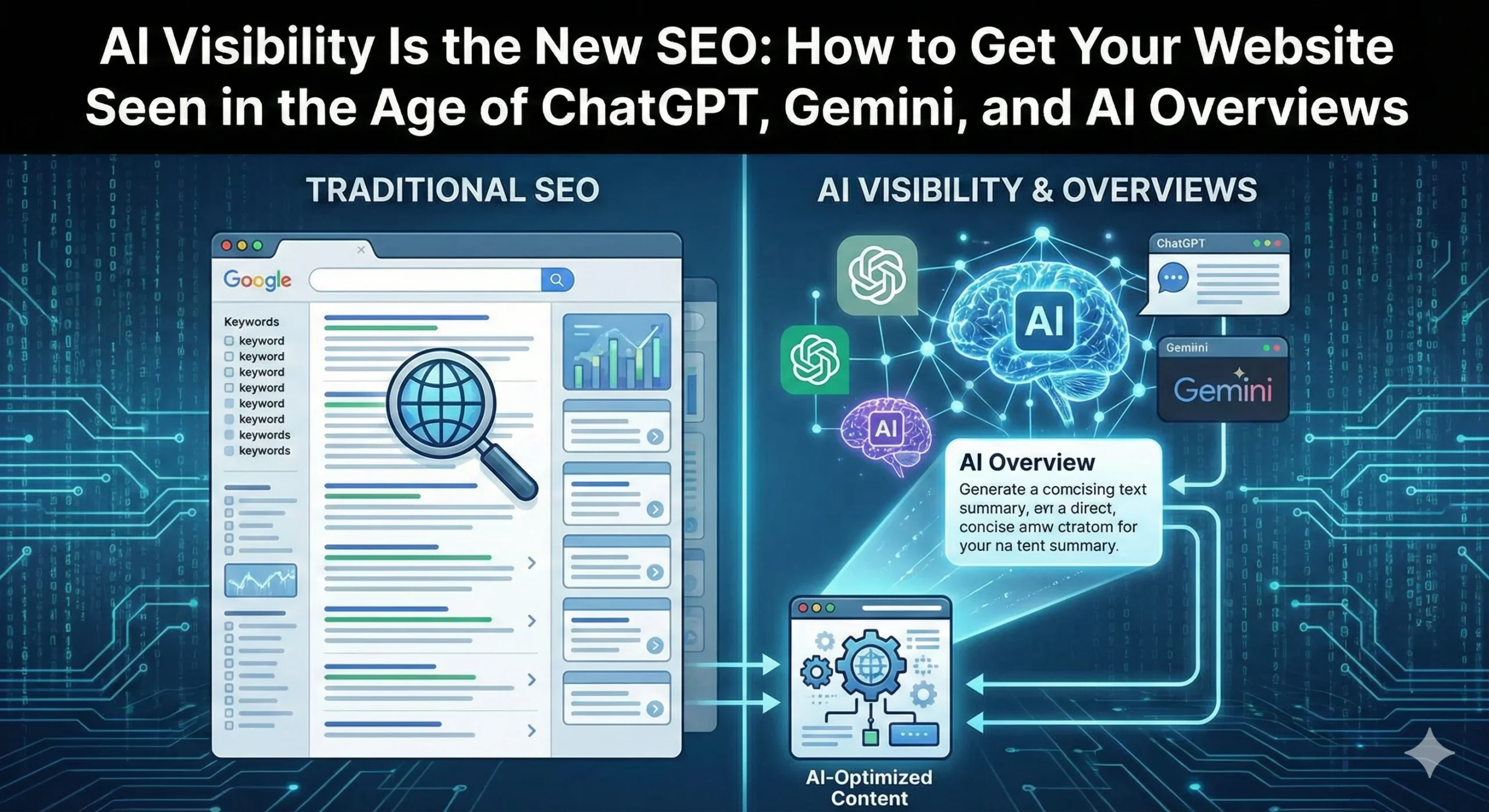
TL;DR: Google rankings alone no longer define your brand’s discoverability. In 2026, if your website isn’t showing up inside ChatGPT responses, Perplexity citations, Google AI Overviews, or Microsoft Copilot answers, you’re effectively invisible to a fast-growing segment of your audience. This guide breaks down the exact GEO/AEO KPIs you need to track, the brand-new Bing Webmaster Tools AI Performance dashboard, the best tools to measure it all — and the concrete steps to actually improve your AI visibility.
Let’s be honest for a second.
Most of us spent the last decade obsessing over page-one rankings, DA scores, and bounce rates. And those still matter — nobody’s throwing out Google Search Console just yet. But something has genuinely shifted underneath our feet, and if you haven’t felt it in your traffic data yet, you probably will by Q3 this year.
AI assistants are now answering questions your potential customers used to search for. Directly. Without a click. Without a blue link. And without your website getting a single impression credit for it.
That’s the game we’re now playing. And the rules are entirely different.
Why Traditional SEO Metrics Are Only Half the Picture Now?
Traditional SEO metrics like rankings and organic clicks measure performance in Google’s blue-link results. AI visibility metrics — also called GEO (Generative Engine Optimization) and AEO (Answer Engine Optimization) KPIs — measure how often, where, and how accurately your brand appears inside AI-generated answers on platforms like ChatGPT, Perplexity, Gemini, Google AI Overviews, and Microsoft Copilot.
Here’s the stark reality check:
| Dimension | Traditional SEO | GEO / AEO |
|---|---|---|
| Primary goal | Rank in top search positions | Be referenced or cited in AI answers |
| Success metric | Rankings, clicks, CTR | Citations, brand mentions, share of voice |
| How users find you | Click through to your site | AI includes you in generated responses |
| Content format | Pages optimized for crawlers | Answer-ready chunks optimized for LLMs |
| Authority signals | Backlinks, DA, PageRank | E-E-A-T, entity recognition, structured data |
The good news?
Conductor’s 2026 AEO/GEO Benchmarks Report — which analyzed 3.3 billion sessions across 13,770 enterprise domains — confirms that foundational SEO and AI visibility are not opposites. They’re additive. You don’t abandon one for the other. You build on what works and layer the new signals on top.
Do you know: How to Analyze AI Performance for Accurate Results
The Foundational Metrics That Still Don’t Change
Before chasing AI citations, make sure your house is in order. These three pillars are your north star — and they feed directly into how well AI systems can find, index, and trust your content.
Search Visibility
- Impressions by query and page (Google Search Console)
- Average ranking position across target keywords
- Top 10 and top 3 keyword coverage percentage
- SERP feature presence: featured snippets, PAA boxes, rich results
Traffic Engagement
- Organic sessions and engaged sessions
- Engagement rate (replaces old bounce rate in GA4)
- Pages per session and unique page views
- Return visitors from organic search
Indexing Health
- Indexing rate — what percentage of your pages are actually indexed
- Crawl and rendering issues flagged in Search Console
- Core Web Vitals scores (LCP, CLS, INP)
- Content decay — pages losing ranking and traffic over time
- Server response time (TTFB)
These metrics represent proven, durable indicators of search performance and user behavior. Don’t abandon them — augment them with what comes next.
Breaking Update: Bing Webmaster Tools Launches AI Performance Reporting
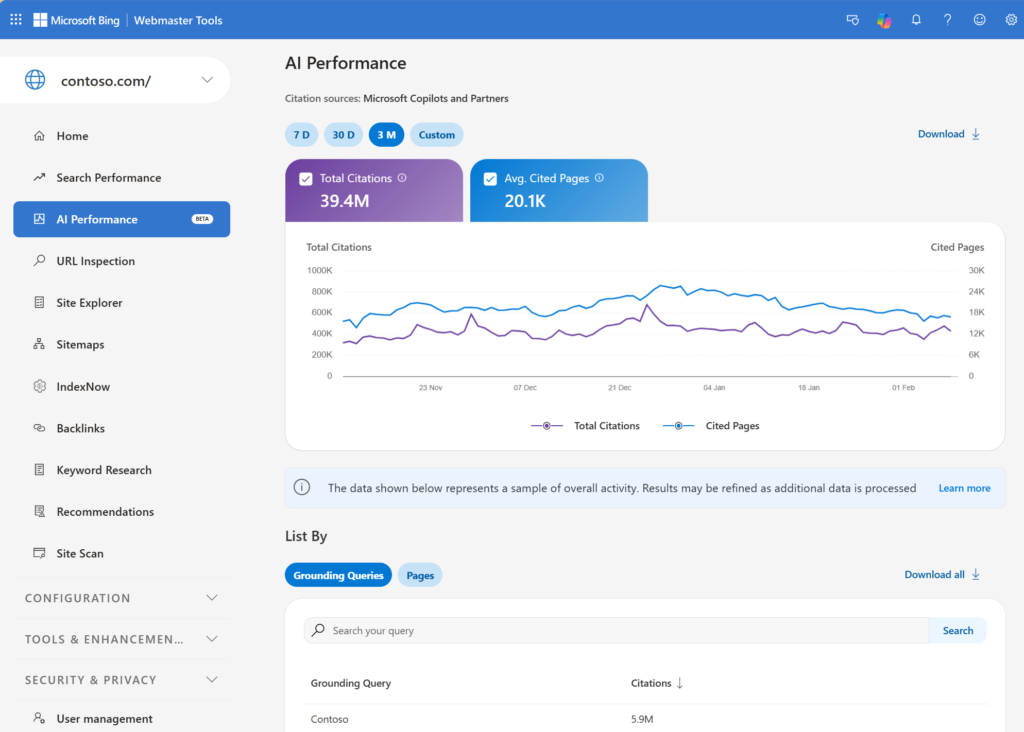
On February 10, 2026, Microsoft officially launched AI Performance — a new dedicated dashboard inside Bing Webmaster Tools (currently in public preview). It is the first native GEO-style reporting feature from a major search platform, showing publishers exactly when and how often their content is cited in AI-generated answers across Microsoft Copilot, Bing AI summaries, and select partner integrations.
This is a big deal. For years, SEO teams were flying completely blind on AI citations — publishing content, hoping AI systems would reference it, and having zero way to verify whether that was actually happening. [keytomic]
“AI Performance in Bing Webmaster Tools is the first time a major search platform has given publishers native GEO-style reporting. Citations ≠ clicks — influence can happen even when nobody visits your site. That’s a fundamentally new way to think about search visibility.”
— Search Engine Land, February 2026 [searchengineland]
Microsoft just changed that. For free.
What the AI Performance Dashboard Shows?
- Total Citations — How many times your content was referenced across Copilot and Bing AI-generated answers within a selected time period
- Average Cited Pages — The average number of your unique pages being cited per AI response, indicating content breadth
- Grounding Queries — The “fan-out” queries behind AI answers where your pages were used to ground responses (note: these are derived queries, not the user’s exact original prompt)
- Page-Level Citation Activity — Which specific URLs on your site are being cited most frequently, and how that changes over time
- Visibility Trends — How your citation activity changes week-over-week and month-over-month
What It Currently Does NOT Show?
- ❌ Click-through data from AI citations (citations ≠ clicks)
- ❌ The user’s actual original search prompt — only the derived grounding queries
- ❌ ChatGPT, Google AI Overviews, or Perplexity data — Copilot and Bing integrations only
- ❌ Sentiment analysis of how your brand is represented in responses
How to Use It Right Now?
- Log into Bing Webmaster Tools → look for “AI Performance” in the left navigation (currently labeled Public Preview)
- Check which URLs are being cited most — these are your highest-value pages for AI optimization priority
- Export the data monthly into a spreadsheet to track grounding query growth over time
- Cross-reference with GA4 by filtering sessions where the source includes “copilot” to see what traffic actually converts
- Assume you’re seeing roughly 50% of actual Copilot-driven visits — many AI users visit directly without referrer data being passed
“This is the first time a major search platform is giving publishers a native GEO-style reporting layer. Instead of rankings and clicks, Bing now shows how often your content is cited inside AI-generated answers — and that changes everything about how we measure influence.”
— Search Engine Land, February 2026 [searchengineland]
AI Surface Presence Metrics: Your New Baseline
AI Surface Presence Metrics measure how often and how accurately your brand or content appears inside AI-generated answers. The three core metrics are: AI Citation Frequency (how often you’re referenced), Prompt Coverage (what percentage of relevant queries include your content), and Answer Inclusion Rate (whether your content appears verbatim, summarized, or paraphrased in AI responses).
Think of these as your AI visibility baseline — the equivalent of “are we even on page one?” but for the LLM era.
The Three Core AI Surface Metrics [H3]
- AI Citation Frequency — How often your brand or content is referenced in AI-generated answers across different assistants (ChatGPT, Perplexity, Gemini, Copilot). This is your single most important baseline metric. Track it per platform, not just in aggregate.
- Prompt Coverage — The percentage of relevant user prompts where your content actually influences AI responses. This reveals the breadth of your AI visibility — are you showing up for 3 topics or 30?
- Answer Inclusion Rate — Whether your content appears verbatim, summarized, or paraphrased. Quality of representation matters as much as frequency — being misrepresented is sometimes worse than not appearing at all.
Real numbers worth knowing: ChatGPT’s traffic to websites grew 85% in 2025. AI visitors from ChatGPT convert at rates 23x higher than traditional search visitors. That’s not a rounding error. That’s an audience worth optimizing for.[Source: alpharanker]
Brand Attribution Signals in AI Answers
This is the layer most SEOs haven’t started measuring yet — and it’s arguably where the real brand equity gets built or lost.
Three Types of AI Brand Attribution
- Brand Mentions Without Links — AI assistants frequently reference brands and sources without providing clickable links. These unlinked mentions still build awareness and authority, even when they don’t drive direct traffic. Don’t dismiss them as worthless.
- Explicit Brand Referencing — Watch for phrases like “according to [your brand]…” or “experts at [your company] note…” inside AI responses. These explicit attributions are enormously valuable for brand credibility and signal you’re recognized as a primary source.
- Topic Association Strength — Measure how consistently AI systems associate your brand with specific subject areas. Strong, consistent associations position you as the go-to expert in your domain — the digital equivalent of being the first name people hear when a topic comes up.
How to Estimate AI Impressions (Without Official Dashboards)?
Here’s the uncomfortable truth: outside of Bing’s new AI Performance dashboard, there’s still no equivalent of Google Search Console for AI impressions on other platforms. No official tool tells you “Perplexity showed your content to 14,000 people this week.” So we estimate — intelligently.
A 3-Step Framework for AI Impression Estimation
- Identify Prompt Types — Catalog the specific types of queries where you appear in AI responses. Are they broad informational, niche technical, or branded lookups? This establishes your coverage baseline and tells you which content is already AI-visible.
- Gauge Search Interest — Use Google Trends to measure search volume for those same queries. Higher interest means more users are likely seeing AI-generated answers for that topic — and more potential impressions for whoever gets cited.
- Track Response Consistency — Manually test the same prompts across ChatGPT, Gemini, Perplexity, and Copilot. Appearing consistently across multiple assistants for similar prompts signals strong topical relevance that AI systems trust.
Building a Clearer Picture of AI-Driven Traffic
So you’re getting AI citations — great. But how do you actually prove it in your analytics? This is where most teams get stuck.
Four Tactical Steps to Track AI-Driven Actions
- Set Up Dedicated AI Traffic Tracking — Create a custom GA4 exploration or channel group using regex filters to isolate all AI referral sources. Use a pattern capturing ChatGPT, Perplexity, Copilot, Gemini, and Claude in one clean view.
- Add UTM Parameters — When you control link placement in shared content or public URLs, add identifiable UTM parameters. Even a simple
?utm_source=chatgptreveals which AI platforms are actually sending traffic. - Track AI Landing Pages — Add “Landing page + query string” as a GA4 dimension in your AI traffic exploration to see which specific pages assistants cite most. These high-citation pages deserve priority treatment for freshness and E-E-A-T updates.
- Monitor Direct Traffic Patterns — Watch for unexplained spikes in direct traffic to pages that assistants commonly cite. This may indicate free-tier AI users clicking through without referrer data — a known and persistent measurement gap.
Authority Metrics: The Trust Signals That Feed Both SEO and AI
Authority metrics for AI visibility combine Trust & Expertise Signals (E-E-A-T alignment, recognized authors, high-quality backlinks, consistent topic coverage) and Structural Authority Signals (strong internal linking, well-structured headings, clear information hierarchy, schema markup). Both categories influence whether AI systems surface your content as a trusted, citable source.
Authority metrics matter equally for traditional search engines and AI assistants. The systems that determine what to surface or cite rely heavily on trust indicators. Building authority isn’t a separate initiative — it’s foundational to visibility across every surface.
Trust & Expertise Signals
- E-E-A-T alignment — Experience, Expertise, Authority, and Trust signals embedded throughout your content and site structure
- Recognized authors and subject matter experts — Named bylines with verifiable credentials, author pages, and real-world attribution
- High-quality backlinks and editorial citations — Links from authoritative sources validating your content as a primary reference
- Consistency of topic coverage over time — Sustained, deep coverage of a subject signals genuine expertise to both Google and LLMs
Structural Authority Signals
- Strong internal linking and topic cluster architecture
- Scannable summaries and well-structured heading hierarchies (H1 → H2 → H3)
- Clear information hierarchy — answers first, context second
- Schema markup and structured data (FAQ, Article, HowTo, Organization schemas)
Brand Strength Indicators: Connecting AI Visibility to Business Outcomes
These two metrics bridge AI optimization and actual business results — answering the executive question: “So our AI visibility improved… but did it actually do anything?”
Branded Search Growth
Track year-over-year growth in branded searches and branded prompts. Strong brands see consistent increases in branded search volume as AI visibility builds awareness — AI citations introduce your brand to people who then search for you by name.
- Monitor in Google Search Console: filter by branded queries
- Track in Google Trends: branded keyword trajectory over a 12-month rolling window
- Watch for branded query growth following any notable AI citation spike
Share of Voice in AI Responses
Measure how often your brand appears in AI responses relative to competitors for your core topics. Higher share of voice indicates stronger topical authority — and gives you a competitive benchmark that raw citation counts alone can’t provide.
- Test a consistent set of 20–50 target prompts monthly across major AI platforms
- Record which brands appear, how prominently, and in what context
- Calculate your percentage of total brand mentions across those prompts vs. competitors
The Best Tools to Track and Improve AI Visibility in 2026
The best AI visibility tracking tools in 2026 include Profound, Brandlight, AthenaHQ, Otterly AI, Promptwatch, Peec AI, SE Visible, Knowatoa, Superlines, Scrunch AI, Airefs, and ZipTie.dev. Free options include Bing Webmaster Tools AI Performance dashboard and HubSpot’s AEO Grader. Tools vary by platform coverage, pricing (from $24/mo to enterprise custom), and whether they focus on citations, share of voice, or source-level intelligence.
The tool landscape has exploded in the past 12 months. Over $31 million has flowed into this segment of the market — and the quality difference between platforms is significant.
Do you know: How to Compare AI Search Optimization Tools Before You Buy
Here’s what actually matters?
Free Tools to Start With
| Tool | What It Tracks | Best For |
|---|---|---|
| Bing Webmaster Tools AI Performance | Copilot + Bing AI citations, grounding queries, cited pages | First free native GEO dashboard — start here |
| HubSpot AEO Grader | Brand AI visibility, sentiment, competitive positioning | Quick free audit across leading AI platforms |
| Google Search Console | AI Overview impressions (via “Search type: AI Overviews” filter) | Tracking Google’s own AI search visibility |
Paid Tools for Serious GEO/AEO Programs
| Tool | Platforms Tracked | Best For | Starting Price |
|---|---|---|---|
| Profound | ChatGPT, Perplexity, Claude, Gemini, Grok, Copilot, Meta AI, DeepSeek, AI Overviews (10+) | Enterprise AEO with prompt volume data | $99/mo |
| Brandlight | ChatGPT, Perplexity, Gemini, Claude, Grok, Copilot, DeepSeek, Llama, AI Overviews, AI Mode (11+) | Enterprise + agentic commerce visibility | Custom |
| AthenaHQ | ChatGPT, Perplexity, AI Overviews, AI Mode, Gemini, Claude, Copilot, Grok (8) | YC-backed; strong case studies | $95/mo |
| Otterly AI | ChatGPT, AI Overviews, AI Mode, Perplexity, Gemini, Copilot (6) | Most affordable full-featured option; Gartner Cool Vendor | $29/mo |
| Promptwatch | ChatGPT, Gemini, Claude, Perplexity, Grok, Copilot, DeepSeek, AI Overviews, Mistral, Meta (10) | Scale — 6,900+ brands, 1.11B data points tracked | $99/mo |
| Peec AI | ChatGPT, Perplexity, Claude, Google AI Overviews (+ more add-ons) | Accuracy-focused; strong regional benchmarking | €89/mo |
| SE Visible | ChatGPT, Perplexity, Gemini, AI Overviews, AI Mode (5) | Agencies; unlimited seats; 7 countries | $189/mo |
| Knowatoa | ChatGPT, Claude, Perplexity, Gemini, AI Overviews, AI Mode, Meta AI (7) | Daily refreshes; BISCUIT Framework | $59/mo |
| Superlines | ChatGPT, Perplexity, Copilot, AI Overviews, Gemini, DeepSeek, Claude, Mistral, Grok (10+) | Broadest platform coverage; MCP server | €89/mo |
| Airefs | ChatGPT (default), others on request | Source-level citation + Reddit monitoring; lowest entry price | $24/mo |
| Scrunch AI | ChatGPT, Perplexity, Google AIO, Copilot (Core); 9+ Enterprise | AXP platform; optimizing AI agent experience | $250/mo |
| Conductor | Enterprise suite with AEO/GEO modules | Large enterprise teams embedding AI signals into existing SEO workflows | Custom |
How to Choose the Right Tool?
- Just starting out? Begin with Bing Webmaster Tools AI Performance (free) + Otterly AI ($29/mo) for the widest coverage at lowest cost
- Agency or mid-market team? SE Visible ($189/mo) offers unlimited seats and multi-country tracking
- Enterprise brand? Profound or Brandlight for the deepest platform coverage and competitive intelligence
- Source-level intelligence needed? Airefs uniquely shows which specific URLs AI models pull from — not just whether you appear
The Advanced GEO KPIs Most Teams Haven’t Started Tracking Yet
If you’ve nailed the fundamentals above, these are the next-level metrics that separate mature AI visibility programs from everyone else:
- Chunk Retrieval Frequency — How often your specific content blocks are retrieved in LLM responses, not just your domain overall
- Embedding Relevance Score — How closely your content matches query intent at the vector/semantic level — the mathematical similarity LLMs use during retrieval
- Retrieval Confidence Score — How confidently an AI model selects your content when multiple sources compete for the same answer space
- Vector Index Presence Rate — Percentage of your content successfully embedded and indexed in AI vector databases
- Passage Recall Rate — Proportion of your key answer units actually retrieved by AI crawlers (GPTBot, Googlebot, ClaudeBot)
- Freshness Delta — Days since critical claims were last updated; AI systems increasingly favor recently verified information
- Non-Click Impressions — Estimated exposure from AI surfaces even when users don’t click through to your site
Your 30-Day AI Visibility Quick-Start Plan
You don’t need to overhaul everything at once. Start here:
- Week 1 — Audit & Baseline: Set up Bing Webmaster Tools AI Performance. Manually test 20 core topic queries across ChatGPT, Perplexity, Gemini, and Copilot. Record who gets cited and set your benchmark.
- Week 2 — Technical Fixes: Verify GPTBot, ClaudeBot, and PerplexityBot aren’t blocked in your
robots.txt. Implement or fix FAQ, Article, and Organization schema markup. - Week 3 — Content Optimization: Identify your top 10 highest-traffic pages. Add direct-answer summaries at the top of each. Strengthen author bios with verifiable credentials.
- Week 4 — Tracking Setup: Build your GA4 AI traffic channel group with regex filters. Choose a paid AI visibility tool based on your budget and platform priorities. Begin tracking branded search volume as a baseline.
“Only 6.82% of ChatGPT’s citations overlap with Google’s top 10 results, with 83% coming from non-Google-dominant sources. Niche depth and topical authority matter far more to LLMs than raw domain authority.”
— Conductor 2026 AEO/GEO Benchmarks Report
Frequently Asked Questions
What is AI visibility for websites?
AI visibility means how often and how accurately your website is cited or referenced inside AI-generated answers on platforms like ChatGPT, Perplexity, Google AI Overviews, and Microsoft Copilot — rather than traditional search rankings.
What is the difference between GEO and AEO?
GEO (Generative Engine Optimization) targets full AI-generated responses on ChatGPT, Gemini, and Perplexity. AEO (Answer Engine Optimization) targets direct answers in Google AI Overviews and voice assistants. Both complement traditional SEO.
Which AI platforms should I prioritize first?
Start with Google AI Overviews (largest reach), ChatGPT (fastest-growing traffic source), Perplexity (highest citation density), and Microsoft Copilot (free tracking via Bing Webmaster Tools).
Can small websites rank in AI citations?
Yes. Only 6.82% of ChatGPT citations overlap with Google’s top 10 results. Niche depth and topical authority matter far more than domain authority in AI search — a focused small site can outperform large generic brands.
What is the best free tool to track AI visibility?
Bing Webmaster Tools AI Performance is the best free starting point — it tracks Copilot citations natively. HubSpot’s free AEO Grader also provides a quick audit of brand visibility across major AI platforms.
Does AI visibility hurt traditional SEO?
No — it strengthens it. Better content structure, E-E-A-T signals, schema markup, and direct answers improve both AI citation rates and traditional Google rankings simultaneously.
What schema markup is most important for AI visibility?
Prioritize FAQPage, Article (with author and datePublished), Organization (with sameAs social links), and HowTo schema. These help AI systems identify what your content covers and who stands behind it.
What is AI Citation Frequency?
It measures how often your brand or content is referenced in AI-generated answers across platforms. It’s your single most important AI visibility baseline metric — the GEO equivalent of “how many impressions am I getting?”
Recommended Articles to Read:
Agentic AI vs Generative AI vs Traditional AI: Key Differences
Essential AI Tools for Technologists to Boost Efficiency
Working With AI: Measuring the Occupational Implications of Generative AI
5 Practical Ways to Use AI to Improve Business Performance
Disclaimer:
This article reflects publicly available information as of February 26, 2026. Tool pricing, platform features, and AI citation behaviors change frequently — verify details directly with each provider before making decisions. This content is for informational purposes only and does not constitute technical, legal, or investment advice.
Sources: Microsoft Bing Webmaster Tools, Search Engine Land, Conductor 2026 AEO/GEO Benchmarks, Lumar AI Visibility Metrics, GetAIRefs, AllAboutAI, Wellows GEO KPIs, EngageCoders, AlphaRanker, HubSpot AEO Grader, Otterly AI, AI Rank Lab..etc.
