

Automating tough workflows or making sense of mountains of business data no longer belongs to distant science fiction. For IT managers seeking strategic growth, artificial intelligence is becoming the extra set of hands and eyes your teams need, uncovering insights and solving challenges across operations, marketing, and finance. Discover how understanding the core concepts of AI can help your organization transform daily processes and decision-making without making resource-draining mistakes.
Key Takeaways
| Point | Details |
|---|---|
| Understanding AI’s Role | AI enhances business operations by automating tasks and providing data-driven insights for strategic decision-making. |
| Importance for Mid-Sized Enterprises | Mid-sized enterprises can leverage AI to compete with larger organizations by streamlining processes and increasing efficiency. |
| Choosing the Right AI Type | Different AI types serve unique purposes; selecting the appropriate one is crucial for addressing specific business challenges. |
| Focus on Governance and Responsibility | Successful AI deployment requires clear governance frameworks, ethical considerations, and continuous monitoring to mitigate risks. |
AI in Business: Core Concepts Explained
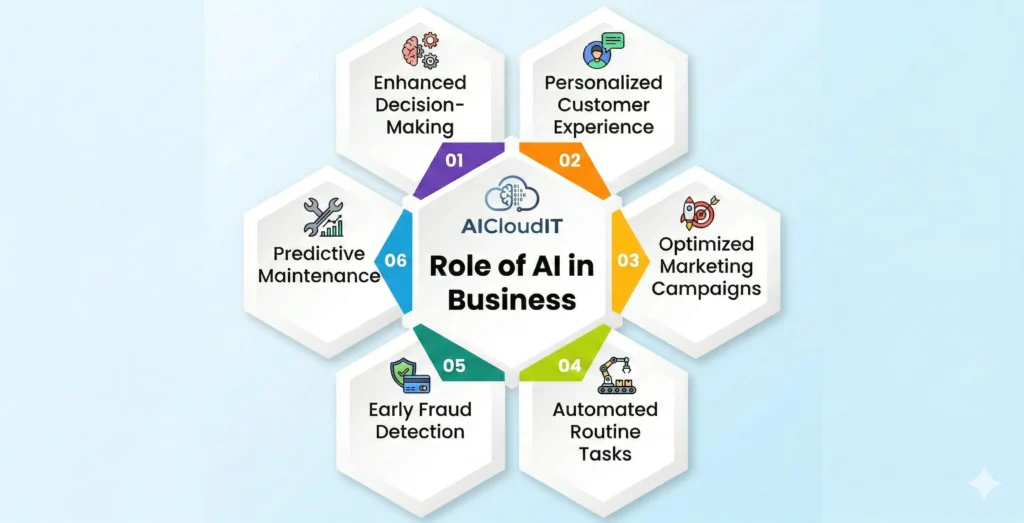
Artificial Intelligence isn’t a distant future technology. It’s reshaping how your business operates right now, from automating routine tasks to uncovering hidden patterns in your data that drive strategic decisions.
What Is AI in a Business Context?
AI refers to computational systems capable of performing tasks that traditionally required human judgment. Unlike simple automation, AI learns from patterns and adapts its behavior based on new information.
These systems process vast amounts of data and identify relationships you’d never spot manually. How AI assists businesses across operational and strategic dimensions reveals the scope of this transformation.
Think of it as adding a layer of intelligence to your existing processes, not replacing them entirely.
Three Core Dimensions of Business AI
AI impacts your organization in distinct but interconnected ways:
- Operational Efficiency: Automating repetitive tasks, reducing errors, and freeing your team to focus on higher-value work.
- Strategic Decision-Making: Using data-driven insights to make faster, more informed choices about resource allocation and growth opportunities.
- Customer Experience: Personalizing interactions at scale, anticipating needs, and improving retention through smarter engagement.
Most IT managers underestimate how quickly AI can reshape their operational baseline—expecting months when weeks are realistic.
Why This Matters for Mid-Sized Enterprises?
You operate in a unique space. You’re too large to ignore AI, but too lean to waste resources on failed implementations.

AI allows mid-sized enterprises to compete with larger organizations by automating work that would otherwise require significant headcount. Your competitors are already testing these systems. Waiting increases your risk of falling behind.
The real advantage comes from understanding where AI creates the most immediate ROI in your specific operations.
Common AI Capabilities You’ll Encounter
When evaluating AI solutions for your organization:
- Machine Learning: Systems that improve performance without explicit reprogramming as they process more data.
- Natural Language Processing: Extracting meaning from text and speech to automate customer service or document analysis.
- Predictive Analytics: Forecasting trends and outcomes based on historical patterns in your data.
- Computer Vision: Analyzing images and video to detect issues, verify quality, or extract information.
The Organizational Reality
Successful AI implementation requires more than technology selection. Your organization needs clear governance frameworks, defined roles and responsibilities, and a commitment to continuous learning.
This is systemic change. It touches how your teams work, what skills you need, and how you measure success. The technology itself is almost the easy part.
Start by identifying one high-impact process where AI can deliver clear value. Prove the concept internally. Then scale methodically.
Pro tip: Begin your AI journey by auditing your top three operational bottlenecks—process inefficiencies, data quality issues, or customer service gaps—then prioritize the one where AI can deliver measurable results within 90 days.
Types of AI Used Across Enterprise Functions
Your organization likely uses multiple types of AI already, even if you’re not calling them by those names. Each type solves different business problems and requires distinct implementation approaches.
Understanding these distinctions helps you make smarter decisions about where to invest and what results to expect.
Traditional Machine Learning
Machine Learning (ML) remains the workhorse of enterprise AI. These systems identify patterns in historical data and make predictions based on those patterns without being explicitly programmed for each scenario.
ML powers:
- Fraud detection in financial transactions
- Customer churn prediction
- Demand forecasting for inventory management
- Equipment failure prediction in manufacturing
The advantage is proven reliability. ML models perform well on structured, historical data and integrate into existing business processes seamlessly.
Generative AI and Large Language Models
Generative AI creates new content—text, images, code, or entire documents—based on patterns it learned during training. This is the technology behind chatbots, content creation tools, and code generation assistants.
For mid-sized enterprises, generative AI typically handles:
- Customer service automation and support ticket routing
- Drafting reports, emails, and documentation
- Code generation for developers
- Content personalization at scale
Generative AI delivers value fastest when applied to tasks involving language or creative work, not when you need guaranteed accuracy in regulated domains.
Data Analytics and Decision Intelligence
AI in decision making combines machine learning with business logic to recommend specific actions rather than just presenting data. These systems analyze patterns and suggest decisions, accelerating strategic choices.
You’ll see this in:
- Resource allocation optimization
- Pricing recommendations
- Supplier selection
- Market entry decisions
Physical AI and Autonomous Systems
Physical AI includes robotics, autonomous vehicles, and IoT-driven systems that take action in the real world. This type requires more infrastructure but delivers dramatic efficiency gains in manufacturing, logistics, and warehousing.
Examples include warehouse robots picking items, autonomous guided vehicles transporting materials, and predictive maintenance sensors.
Agentic AI
The newest category, agentic AI performs extended tasks autonomously with minimal human oversight. These systems break down complex workflows, make decisions independently, and adjust their approach based on outcomes.
Currently in early adoption:
- Autonomous data processing pipelines
- Automated workflow management
- Multi-step customer support resolution
Choosing the Right Type
Your selection depends on your specific challenge. Traditional ML excels at prediction. Generative AI handles creative and language tasks. Decision intelligence guides strategy. Physical AI transforms operations. Agentic AI tackles multi-step workflows.
Most enterprises deploy combinations. You might use ML for demand forecasting, generative AI for customer communications, and decision intelligence for pricing strategy in a single initiative.
Pro tip: Map your top three operational pain points to AI types first—don’t search for AI solutions to random problems—then evaluate vendors and tools that specialize in those specific AI categories.
Here’s a comparison of AI types and their ideal enterprise applications:
| AI Type | Best Use Case Area | Data Needed | Unique Value Add |
|---|---|---|---|
| Machine Learning | Operational processes | Structured, historical | Accurate predictions |
| Generative AI | Marketing, content | Text, user interactions | Scalable content creation |
| Decision Intelligence | Strategy, finance | Business data, rules | Actionable recommendations |
| Physical AI | Logistics, manufacturing | Sensor, video, IoT | Real-world automation |
| Agentic AI | Workflow automation | Process, outcome logs | Autonomous task handling |
AI Applications in Operations, Marketing, and Finance
AI delivers the most immediate ROI when applied to these three core business functions. Your operations team, marketing department, and finance group are already generating the data these systems need to perform.
AI in Operations and Supply Chain
Operational efficiency is where AI shows fastest results. Organizations use machine learning to optimize logistics, predict equipment failures, and automate routine processes.
Practical applications include:
- Demand forecasting that adjusts inventory automatically
- Predictive maintenance that schedules repairs before equipment fails
- Route optimization reducing delivery times and fuel costs
- Quality control automation catching defects in production
One mid-sized manufacturing firm reduced unplanned downtime by 40% in six months using AI predictive maintenance. Another logistics company cut delivery times by 23% through route optimization algorithms.
The advantage: operational AI delivers measurable cost savings quickly.
AI-Powered Marketing and Personalization
Marketing AI transforms how you understand and reach customers. Machine learning analyzes customer behavior patterns to deliver personalized experiences at scale.
Key uses:
- Customer segmentation based on behavioral patterns, not just demographics
- Campaign targeting that identifies high-value prospects automatically
- Content personalization showing each visitor relevant products or articles
- Churn prediction identifying at-risk customers before they leave
Marketing AI works best when your data is clean and you’ve defined what “success” means for each campaign before deploying the system.
Financial Operations and Risk Management
AI in financial services handles prediction, classification, and risk evaluation at scales humans cannot match. Organizations deploy AI for fraud detection, credit risk assessment, and portfolio optimization.
Common implementations:
- Real-time fraud detection flagging suspicious transactions instantly
- Predictive analytics forecasting cash flow and revenue trends
- Credit risk modeling assessing loan default probability
- Portfolio optimization balancing risk and return automatically
Financial AI reduces fraud losses, accelerates decision-making, and improves forecasting accuracy by 15-25% in most implementations.
Cross-Function Integration
The most effective deployments combine AI across functions. Use operational AI to reduce costs, marketing AI to increase revenue, and financial AI to manage risk on both.
Your finance team can monitor AI spending in operations and marketing, ensuring ROI targets are met and resource allocation adjusts based on performance.
Getting Started
Begin with the function where you have the clearest problem and the best data. Operations typically offers the fastest wins. Marketing builds customer relationships. Finance controls risk.
Pick one. Prove the concept. Then expand horizontally to other functions and vertically into new use cases within that function.
Pro tip: Start with your finance function’s highest-impact manual process—whether that’s monthly forecasting, credit reviews, or invoice processing—and measure the time saved before expanding to other departments.
Here’s how major business functions benefit uniquely from AI:
| Function | Fastest AI Benefit | Main Business Impact | Key Success Factor |
|---|---|---|---|
| Operations | Downtime reduction | Lower costs, higher productivity | Quality data integration |
| Marketing | Targeted personalization | Increased conversions | Accurate success metrics |
| Finance | Fraud and risk detection | Savings, better forecasting | Regulatory compliance steps |
Risks, Challenges, and Responsible AI Adoption
AI systems are powerful because they learn patterns from your data and make decisions at scale. That same power creates real risks if you’re not deliberate about how you deploy them.
Your responsibility as an IT manager extends beyond technical performance to ethical and legal accountability. Understanding these challenges upfront prevents costly mistakes later.
Algorithmic Bias and Fairness
AI systems learn patterns from historical data. If that data reflects past discrimination or imbalance, the AI amplifies those patterns at scale.
Common bias scenarios:
- Hiring algorithms favoring candidates from certain demographics
- Lending systems denying credit to specific groups at higher rates
- Marketing systems showing high-value opportunities to some customers but not others
- Customer service routing assigning difficult cases based on caller characteristics
The risk isn’t just ethical—it’s legal. Regulators increasingly scrutinize AI for discriminatory outcomes, and lawsuits follow when bias causes harm.
You need audit mechanisms that test AI systems against demographic groups and flagging unexpected disparities before deployment.
Privacy and Data Security
AI data security requires protecting both the data your AI uses and the insights it generates. More data typically means better AI performance, but it also means higher risk.
Key concerns:
- Personal data exposure through model outputs
- Reverse engineering models to extract training data
- Unauthorized access to sensitive datasets
- Compliance violations with regulations like GDPR or HIPAA
Your data governance framework must control who accesses training data, how long it’s retained, and what security standards apply.
Transparency and Explainability
Many AI systems operate as “black boxes.” They make decisions you can’t easily explain. This creates problems when those decisions affect people.
Imagine your AI denies a customer’s loan application. The customer asks why. Your system learned patterns from thousands of data points. You honestly cannot tell them.
Unexplainable AI decisions erode trust faster than transparent, understandable ones—even if the understandable system makes occasional mistakes.
Accountability and Governance
Responsible AI adoption requires clear ownership and defined processes. Who decides what values your AI should prioritize? Who tests for harmful outcomes? Who responds when something goes wrong?
Without clear accountability, responsibility disappears. Build governance structures that answer these questions:
- Who owns AI system performance and outcomes?
- How do you measure fairness, not just accuracy?
- What escalation path exists for concerning results?
- How often do you audit systems for drift or degradation?
Building Responsible AI Practices
Responsible AI isn’t a compliance checkbox. It’s an operational requirement that affects every stage of your AI lifecycle.
Start with these foundations:
- Document your AI system’s purpose and intended use clearly
- Assess data quality, bias sources, and privacy risks before deployment
- Test systems across demographic groups and edge cases
- Monitor performance continuously after deployment
- Establish a clear escalation process when issues emerge
Your teams need training on these practices. Technical staff should understand bias and fairness testing. Business teams should understand regulatory risks.
Pro tip: Require every AI project to document three things before deployment: the specific fairness metrics you’ll monitor, the audit frequency, and the decision-maker accountable for escalating concerning results.
Maximizing ROI and Avoiding Common Pitfalls
AI projects fail more often than they succeed. Not because the technology is broken, but because organizations underestimate the work required to make AI valuable in practice.
The difference between AI projects that deliver ROI and those that drain resources comes down to planning, realistic expectations, and disciplined execution.
Define ROI Before You Start
Measurable ROI means articulating what success looks like before deployment. Too many projects launch with vague objectives like “improve efficiency” or “better insights.”
Instead, define ROI precisely:
- Time savings in hours per week for specific processes
- Cost reduction as percentage of current spending
- Revenue increases from specific customer outcomes
- Error reduction measurable against current baselines
- Risk mitigation quantified in dollar terms
Profit margin analysis helps you understand which functions have the highest financial impact. Focus AI deployment on those areas first.
Without baseline metrics, you cannot prove ROI even when the system works.
Start Small and Prove the Concept
The biggest pitfall is betting your credibility on a large-scale AI rollout. Pilots deliver value faster and build internal support.
Pilot projects work when they:
- Target one specific, well-defined business problem
- Use existing data sources without major system changes
- Deliver results within 90 days
- Engage 5-20 users, not your entire organization
- Generate clear, measurable outcomes
Successful pilots become evangelists. They convince skeptics. They show tangible value. Failures in pilots are contained and cheap.
The projects that fail spectacularly are the ones that skip pilots entirely and attempt enterprise-wide deployments on faith.
Avoid These Common Mistakes
Years of failed AI projects reveal patterns. Watch for these red flags:
- Underestimating data preparation work. Most AI projects spend 60-70% of time on data, not model building.
- Treating AI as a technology problem instead of an organizational change.
- Hiring data scientists without involving business analysts who understand your operations.
- Deploying models without monitoring. Performance degrades over time as data patterns shift.
- Assuming one model serves all use cases. Different problems need different approaches.
Building Sustainable Implementation
AI systems require ongoing maintenance. The moment you deploy is not the moment your work ends.
Monitoring and support needs:
- Performance tracking showing accuracy degradation over time
- User feedback mechanisms catching problems users notice
- Data quality checks ensuring training data stays clean
- Regular model retraining as business conditions change
- Documentation systems so teams can troubleshoot issues
Budget for this sustainment. Too many organizations treat AI as a one-time project when it requires continuous care.
Securing Stakeholder Buy-In
AI only delivers value when people actually use it. Resistance from your teams kills projects.
Build support by showing early wins, involving teams in problem identification, addressing workflow disruptions, and providing training before deployment.
Pro tip: Set your ROI targets 30% below what vendors promise—if vendors claim 40% cost reduction, target 28%—then celebrate when you hit the conservative number instead of explaining missed expectations.
Unlock the Full Potential of AI for Your Business Growth
The article highlights the urgent need for mid-sized enterprises to overcome operational inefficiencies and harness AI-driven solutions to boost strategic decision-making, enhance customer experience, and drive measurable ROI. If you recognize challenges like data quality issues, scaling AI adoption across operations or marketing, or managing AI risks responsibly you are not alone. Understanding concepts such as machine learning, generative AI, and decision intelligence is vital as you embark on transforming your workflows and achieving sustainable competitive advantage.
At AICloudIT, we provide the latest insights and deep analysis on AI advancements tailored for IT managers and business leaders ready to accelerate growth. Discover practical strategies and emerging AI tools that align with your needs to reduce downtime, automate workflows, and personalize customer engagement. Visit our AI news section now to stay informed about cutting-edge technologies and start turning your AI vision into reality today.
Frequently Asked Questions
What is the role of AI in improving operational efficiency for businesses?
AI enhances operational efficiency by automating repetitive tasks, reducing human errors, and allowing teams to focus on higher-value work. This leads to faster processes and a more productive workforce.
How does AI help in strategic decision-making?
AI utilizes data-driven insights to enable faster and more informed decision-making regarding resource allocation, market opportunities, and operational strategies, ultimately leading to better business outcomes.
What are some common types of AI used in businesses today?
Common types of AI in business include Machine Learning for predictive analytics, Natural Language Processing for customer interactions, Predictive Analytics for trend forecasting, and Computer Vision for image and video analysis.
How can mid-sized enterprises leverage AI to compete with larger organizations?
Mid-sized enterprises can leverage AI by automating tasks that require significant labor, enhancing their operational efficiency, and implementing AI solutions to generate insights that drive growth and competitiveness against larger firms.
Recommended
- Role of AI in Decision Making: Enterprise Impact
- How the Application of Artificial Intelligence Assists Businesses? – AICloudIT
- The Comprehensive Guide to AI Tools and Their Applications – AICloudIT
- Using AI To Enhance B2B Customer Support – AICloudIT
