

Confusion over what Artificial Intelligence can and cannot do often leads even experienced teams to miss out on valuable insights or fall into costly traps. As companies worldwide integrate AI-driven analytics, understanding the real differences between machine learning, deep learning, and traditional statistics becomes crucial for success. This article clarifies core AI concepts, corrects common misconceptions, and highlights how precise knowledge keeps Canadian, American, and European tech teams competitive in high-stakes data analysis.
Key Takeaways
| Point | Details |
|---|---|
| Understanding AI and ML Distinction | Recognizing that AI encompasses broader systems while machine learning focuses on pattern recognition is essential for proper application. |
| Data Quality is Crucial | Ensuring high-quality input data is necessary; AI cannot compensate for poor data. |
| Human Oversight is Vital | AI tools should complement human judgment, with analysts validating AI outputs to prevent blind trust. |
| Choose the Right Techniques | Selecting AI techniques that match your data type and objective is key to unlocking valuable insights. |
AI in Data Analytics: Core Concepts and Misconceptions
AI in data analytics means using machine learning, deep learning, and natural language processing to extract meaning from data faster than traditional methods. But confusion surrounds what AI actually does versus what people believe it does.
Your team likely uses AI tools daily without fully grasping the core distinctions. Understanding these differences prevents costly mistakes and unrealistic expectations.
What AI Really Is (and Isn’t)
Artificial Intelligence encompasses broader problem-solving systems, while machine learning specifically learns patterns from data. This distinction matters because they have different capabilities and limitations.
Many organizations treat AI as a magic solution that automatically solves any data problem. The reality is far more nuanced.
Key misconceptions in data analytics include:
AI works without quality input data (false; garbage in, garbage out still applies)
Machine learning and AI are identical terms (incorrect; ML is a subset of AI)
AI replaces human judgment entirely (unrealistic; humans interpret AI outputs)
Statistical analysis and AI are completely different (they overlap significantly)
Complex AI always outperforms simpler methods (often the opposite is true)
The field of artificial intelligence has evolved over 65 years, often surrounded by misconceptions about what AI truly entails and its actual goals. Understanding these distinctions is critical for correctly applying AI tools.
How AI Transforms Your Data Analysis?
AI excels at pattern recognition across massive datasets. Where traditional analysis might take weeks, AI identifies complex trends in hours.

Pattern detection works differently than statistical hypothesis testing. AI doesn’t need predefined questions; it surfaces unexpected relationships you weren’t looking for.
Consider your organization’s customer data. AI can simultaneously analyze:
Purchase timing patterns across seasons
Product affinity relationships
Churn prediction signals
Micro-segment behaviors
Python automation has accelerated how teams deploy these analyses at scale. When selecting tools for your team, focus on those that handle data annotation and labeling requirements properly, since training data quality directly impacts model performance.
Common Misconception: AI Needs Perfection
Your data doesn’t need to be flawless for AI to work. Imperfect data produces useful insights; perfect data isn’t realistic anyway.
What matters is understanding what your data quality issues mean for your results. A model trained on biased data will amplify that bias—but that’s a data governance problem, not an AI problem.
This distinction prevents teams from waiting endlessly for perfect data that never arrives.
The Intelligence Question
What counts as “intelligence” in AI differs from human intelligence. AI systems recognize patterns and make predictions; they don’t understand context the way humans do.
Your data analysts bring intuition and domain expertise. AI brings scale and speed. The combination outperforms either approach alone.
Think of AI as exceptionally fast pattern matching, not actual comprehension. This reframing prevents disappointment when AI models can’t explain why they made decisions the same way humans can.
Why This Matters for Your Team
Clear concepts prevent three expensive mistakes:
Overselling results: Promising stakeholders what AI cannot deliver
Underutilizing capabilities: Treating AI as a reporting tool instead of an exploratory one
Misaligned expectations: Expecting AI to solve problems that require data quality fixes first
Your analytics strategy succeeds when everyone understands that complex pattern identification happens through machine learning models, but human validation ensures those patterns mean something in your business context.
Pro tip: Before implementing any AI analytics solution, conduct a “misconception audit” with stakeholders to align expectations around what the tool will and won’t do—this prevents project friction and unrealistic timelines.
Major Types of AI Techniques in Analytics
Three main categories of AI techniques power modern data analytics: supervised learning, unsupervised learning, and reinforcement learning. Each solves different problems and works best with specific data types.
Your choice of technique directly impacts what insights you can extract and how quickly you extract them. Understanding these categories prevents using a sledgehammer when a screwdriver works better.
Supervised Learning: When You Know What You’re Looking For
Supervised learning trains models on labeled data—examples where the correct answer is already known. Your model learns patterns from these examples, then predicts outcomes for new data.
This approach dominates analytics because it delivers measurable results. You have input data and desired outputs; the algorithm finds the relationship between them.
Common supervised techniques include:
Neural networks: Process data through interconnected layers, excellent for image recognition and complex patterns
Decision trees: Create rule-based pathways, highly interpretable for stakeholders
Support vector machines: Find optimal boundaries between data categories, powerful for classification
Linear/logistic regression: Simple, fast, and reliable when relationships aren’t too complex
Your fraud detection system likely uses supervised learning. You feed it historical transactions labeled as fraudulent or legitimate, and it learns to flag suspicious patterns.
Supervised learning methods dominate AI applications, followed by unsupervised and reinforcement learning approaches, with techniques including neural networks, decision trees, and support vector machines widely used across industries.
Unsupervised Learning: Finding Hidden Patterns
Unsupervised learning works with unlabeled data, discovering structure and relationships without predefined answers. No one tells the algorithm what to find—it explores the data independently.
This technique excels when you don’t know what patterns exist. You’re exploring, not confirming hypotheses.
Key unsupervised methods include:
Clustering: Groups similar data points together (customer segmentation, product categorization)
Dimensionality reduction: Simplifies complex datasets while preserving important information
Anomaly detection: Identifies unusual observations that don’t fit normal patterns
Customer data analysis often starts with unsupervised learning. You cluster users by behavior without predetermined segments, discovering micro-segments that supervised models later predict for new customers.
Reinforcement Learning: Learning Through Feedback
Reinforcement learning trains models through trial and error, rewarding correct decisions and penalizing mistakes. The algorithm optimizes decisions over time by maximizing rewards.
This technique powers recommendation engines and optimization systems. It’s slower to train but adapts to changing environments continuously.
Reinforcement learning applies when:
Outcomes depend on sequential decisions
You have dynamic, changing data patterns
Long-term rewards matter more than immediate gains
Your pricing optimization system might use this approach, adjusting prices based on demand response and learning which strategies maximize revenue.
Choosing Your Technique
The right technique depends on three factors: your data type, your objective, and your computational resources.
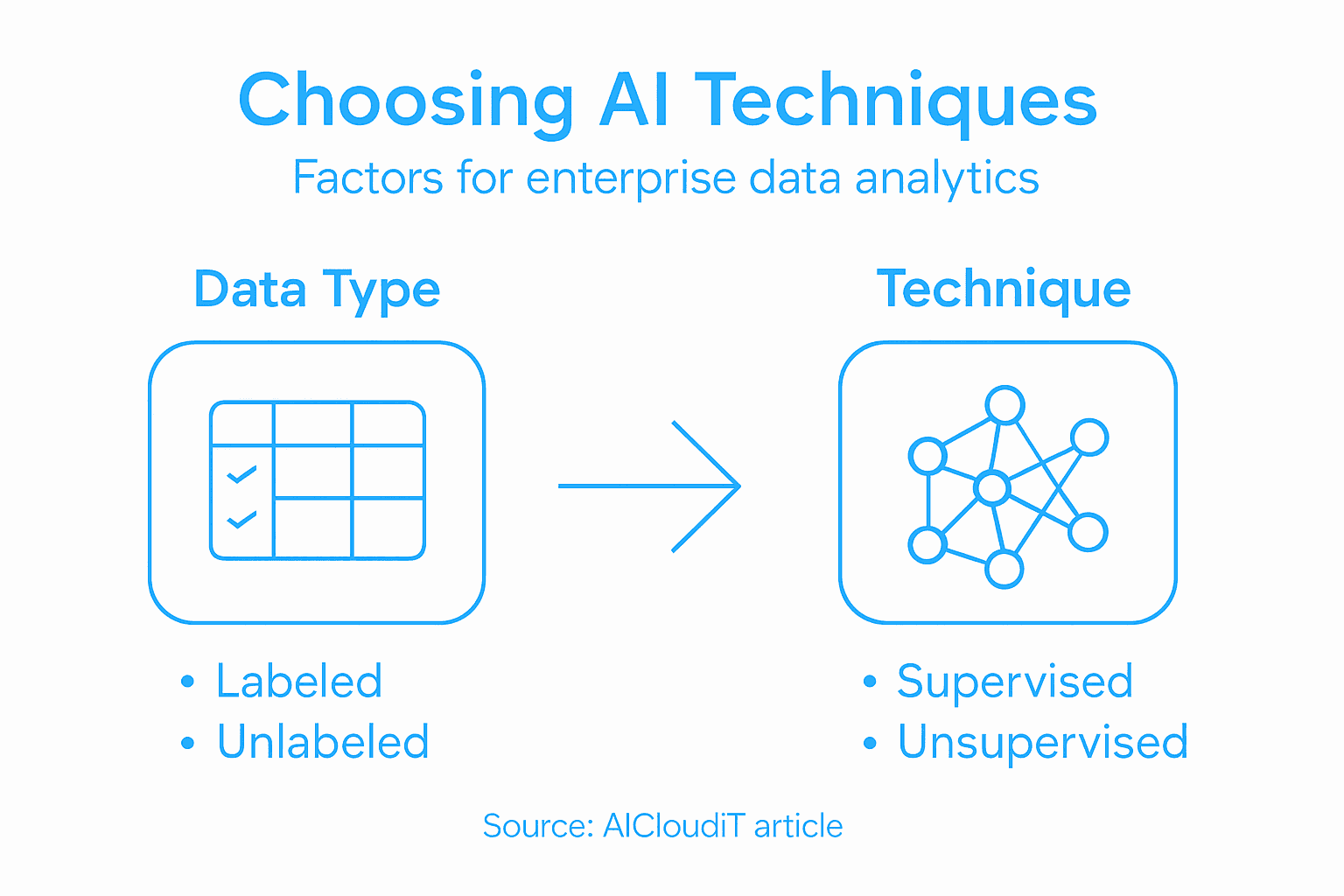
When evaluating AI tools for predictive analytics, verify they support the techniques your specific problem requires rather than forcing all problems into one framework.
Supervised learning works when you have labeled historical data and clear targets. Unsupervised learning explores unknown patterns. Reinforcement learning optimizes ongoing decisions.
Rare analytics problems use just one technique. Your production system might combine all three: unsupervised clustering to segment customers, supervised models to predict behavior within segments, and reinforcement learning to optimize actions based on results.
Here’s a comparison of major AI analytics techniques and their best-fit scenarios:
| Technique | Input Requirement | Primary Use Case | Typical Business Benefit |
|---|---|---|---|
| Supervised Learning | Labeled data needed | Outcome prediction | High accuracy in known scenarios |
| Unsupervised Learning | Unlabeled data | Pattern discovery | Finds hidden customer segments |
| Reinforcement Learning | Continuous feedback | Process optimization | Adapts strategies over time |
Pro tip: Start with supervised learning for new analytics projects since it delivers quick, measurable results—then layer in unsupervised methods to discover unexpected patterns your supervised models might have missed.
Key AI-Driven Applications for Data Analysts
AI transforms what data analysts can accomplish daily. Rather than spending hours on repetitive tasks, you now delegate preprocessing, pattern discovery, and insight generation to intelligent systems.
The most valuable AI applications solve real problems analysts face: time constraints, accuracy demands, and the need for actionable insights from massive datasets.
Automating Data Preprocessing
Data preprocessing consumes 60-80% of analyst time in traditional workflows. Cleaning messy data, handling missing values, and standardizing formats feels necessary but doesn’t generate insights.
AI automates this pain point completely. Machine learning models identify outliers, detect data quality issues, and suggest corrections without manual intervention.
Automation benefits include:
Reduces preprocessing time from days to hours
Catches data inconsistencies humans might miss
Standardizes handling across multiple datasets
Frees your time for analysis instead of data wrangling
Your team can now focus on asking better questions rather than preparing data to answer them.
Predictive Analytics at Scale
Predictive modeling traditionally required statistics expertise and significant setup time. AI tools democratize this capability, allowing any analyst to build accurate forecasts.
These systems automatically select optimal algorithms, tune parameters, and evaluate multiple approaches simultaneously. What took weeks now happens in minutes.
Common predictive applications include:
Customer churn forecasting
Sales pipeline predictions
Inventory demand estimation
Risk identification across portfolios
AI accelerates routine analytical tasks while enhancing accuracy, enabling data analysts to derive actionable insights from large datasets efficiently and supporting both seasoned professionals and novices.
Natural Language Processing for Insights
Natural language processing converts unstructured text into analyzable data. Customer feedback, support tickets, and social media comments now become quantifiable signals.
AI extracts sentiment, identifies themes, and ranks topics by frequency automatically. Your team gains insights from data previously considered too messy to analyze.
Applications span:
Customer sentiment tracking across channels
Competitive intelligence from news and reviews
Product feedback categorization
Voice-of-customer synthesis
Enhanced Data Visualization
AI recommends optimal visualization types based on your data and question. Instead of manually testing chart types, systems suggest approaches most likely to communicate patterns clearly.
Automated visualization accelerates communication. Stakeholders grasp insights faster when presented through appropriate visual formats rather than tables or standard charts.
Connecting AI to Your Workflow
When implementing AI tools for automating Python data analysis pipelines, prioritize solutions that integrate with your existing infrastructure rather than replacing it.
The goal isn’t replacing analysts—it’s amplifying them. AI handles routine work while you focus on strategy, interpretation, and decision support.
Pro tip: Start by automating your single most time-consuming task using AI, measure the time saved, then reinvest that efficiency into exploring deeper analytical questions your team previously lacked capacity to address.
Risks and Responsibilities in AI-Powered Analytics
AI analytics tools are powerful, but they bring real risks your organization must manage actively. Biased models, privacy breaches, and opaque decisions can damage reputation and violate regulations faster than you might expect.
Understanding these risks isn’t about paralyzing your analytics efforts—it’s about building safeguards that let you operate confidently.
The Data Privacy Challenge
Data privacy remains your most immediate risk. AI models trained on personal data can leak sensitive information through model behavior or inadvertent exposure during analysis.
Regulations like GDPR and CCPA impose severe penalties for mishandling customer data. Your team must know what data flows into models and where outputs go afterward.
Privacy safeguards include:
Encrypting data before AI processing
Anonymizing personal identifiers before model training
Limiting model access to only necessary data
Documenting data lineage from source to output
Your analytics infrastructure should treat privacy as mandatory, not optional.
Algorithmic Bias and Discrimination
Algorithmic bias emerges when training data reflects historical discrimination or underrepresents certain populations. Your model learns these patterns and amplifies them at scale.
A churn prediction model trained on biased historical data might systematically mispredict outcomes for minority customers. A hiring analytics system might perpetuate gender discrimination from past recruiting patterns.
Bias risks affect:
Customer segmentation accuracy across demographics
Prediction fairness for different population groups
Resource allocation decisions that inadvertently discriminate
Regulatory compliance in protected categories
Organizations must adopt risk management frameworks and ethical safeguards to responsibly deploy AI systems, with special attention to risks in contexts involving vulnerable populations.
The Transparency Problem
Model opacity creates accountability gaps. When your AI system makes decisions, can you explain why? If not, you can’t defend those decisions to regulators or affected stakeholders.
Some advanced models (deep neural networks) function as “black boxes”—excellent at predictions but terrible at explanation. Your team can’t articulate how inputs drive outputs.
Transparency requires:
Using explainable AI techniques when possible
Documenting model assumptions and limitations
Testing predictions for unexpected patterns
Maintaining human oversight of critical decisions
When ethical AI implementation demands transparency as a core principle, your organization builds trust with stakeholders and regulators alike.
Human Oversight Matters
AI doesn’t replace human judgment in analytics—it supplements it. Critical business decisions require human validation of AI recommendations, especially when decisions affect customers or employees.
Over-reliance on automated outputs creates dangerous blind spots. Your team must maintain skepticism, question surprising results, and verify assumptions underlying model predictions.
Building Your Risk Framework
Responsible AI analytics requires three components:
Assessment: Identify where bias, privacy, or transparency risks exist in your analytics
Mitigation: Implement controls addressing those specific risks
Monitoring: Continuously evaluate model behavior for drift or emerging issues
This isn’t a one-time audit—it’s ongoing management as your data and business evolve.
Pro tip: Before deploying any AI analytics model to production, conduct a risk assessment asking: “Who could this model harm? What data does it access? Can we explain its decisions?” If you can’t answer these clearly, the model isn’t ready.
Below is a summary of common AI risks in data analytics and how to address them:
| Risk Area | Potential Impact | Key Safeguard |
|---|---|---|
| Data Privacy | Regulatory fines, data leakage | Encryption, anonymization |
| Algorithmic Bias | Unfair outcomes, reputational harm | Diverse data, regular audits |
| Model Opacity | Lack of transparency, mistrust | Use explainable models, documentation |
| Over-reliance | Faulty decisions, loss of trust | Human oversight of AI outputs |
Comparing AI Analytics Alternatives and Common Pitfalls
No single AI analytics tool dominates every use case. Your team needs to evaluate alternatives based on your specific data challenges, budget constraints, and technical infrastructure.
Choosing poorly wastes time and money. Understanding common pitfalls prevents expensive mistakes before they happen.
Evaluating Your Options
When comparing AI analytics solutions, examine three dimensions: capabilities, cost, and integration.
Capabilities define what the tool actually does. Some excel at predictive modeling, others at natural language processing. Read beyond marketing claims and test the tool with your actual data.
Key capability questions:
Does it handle your data format and size?
Does it support the analytical techniques you need?
Can you integrate results into your existing workflows?
Does it provide explainability for model decisions?
Cost extends beyond software licensing. Factor in training time, implementation effort, and ongoing maintenance.
Cheap tools that require months of integration work become expensive quickly. Expensive tools that solve problems instantly provide genuine value. Avoid choosing based on price alone.
The Over-Reliance Pitfall
Over-reliance on AI outputs creates your biggest risk. Your team trusts the tool’s recommendations without validating assumptions or questioning surprising results.
This happens because AI tools feel authoritative. They present predictions with confidence, and teams default to acceptance rather than skepticism.
Common consequences include:
Acting on biased model outputs without detection
Missing data quality issues buried in predictions
Deploying models that work on test data but fail on new data
Losing organizational understanding of analytical processes
Common pitfalls include over-reliance on AI-generated content, data bias, computational costs, model overfitting, and the ethical challenges of deploying AI in sensitive contexts, requiring best practices for effective integration.
Data Quality and Bias Risks
Garbage in, garbage out applies to AI just as it does traditional analytics. Models trained on poor data make poor predictions—confidently.
Data bias emerges when training data underrepresents certain populations or reflects historical discrimination. Your model learns these biases and applies them consistently at scale.
Before selecting any tool, assess your data:
Check for missing values and their patterns
Verify representation across demographic groups
Test historical data for systematic biases
Document known data quality issues
Tools can’t fix bad data. You must fix data first, then select tools.
Integration Challenges
Many teams choose analytically superior tools that integrate poorly with existing infrastructure. These solutions end up siloed, creating duplicate work rather than streamlining it.
When comparing AI tools for your specific requirements, prioritize those that connect naturally to your data pipelines and reporting systems.
Integration questions:
Can it read from your data warehouse?
Does it output in formats your team uses?
Can it run on your infrastructure or cloud environment?
Does it support your preferred programming languages?
Making the Right Choice
The best tool solves your highest-priority problem while fitting your team’s technical capabilities. A sophisticated tool no one understands provides less value than a simple tool everyone can use effectively.
Start small. Pilot with a subset of your analytics challenge, measure results, then expand.
Pro tip: Before committing to any AI analytics platform, conduct a two-week proof-of-concept using your actual data to verify it solves your problem better than current methods—many impressive demos fail against real-world complexity.
Unlock the Full Potential of AI in Data Analytics Today
The article highlights the challenges your team faces when navigating AI in data analytics such as overcoming misconceptions about machine learning, managing data quality, and choosing the right AI techniques to gain actionable insights. You want to move beyond treating AI as a black box and instead harness its pattern recognition, predictive power, and automation capabilities effectively without falling into common pitfalls like over-reliance or biased outputs. Understanding these core concepts is key to achieving faster, smarter enterprise insights your organization can trust.
At AICloudIT we empower IT professionals and business leaders with the latest developments, tools, and strategies shaped specifically for transforming enterprise data analytics.
Frequently Asked Questions
What is the role of AI in data analytics?
AI in data analytics leverages machine learning, deep learning, and natural language processing to swiftly extract meaningful insights from large datasets, improving the efficiency and accuracy of analyses compared to traditional methods.
How does machine learning differ from artificial intelligence in analytics?
Machine learning is a subset of AI focused on identifying patterns and making predictions from data. In contrast, AI encompasses a broader range of technologies and problem-solving systems, including machine learning.
What are common misconceptions about AI in data analytics?
Common misconceptions include the belief that AI can function effectively without quality input data, that AI completely replaces human judgment, and that complex AI models always outperform simpler methods. Such misunderstandings can lead to unrealistic expectations and costly mistakes.
How can organizations ensure data quality when implementing AI in analytics?
Organizations can ensure data quality by assessing data for completeness and bias, and by addressing known issues prior to training AI models. Continuous monitoring and updates to data governance practices are also essential to maintain quality and reliability in AI outputs.
