
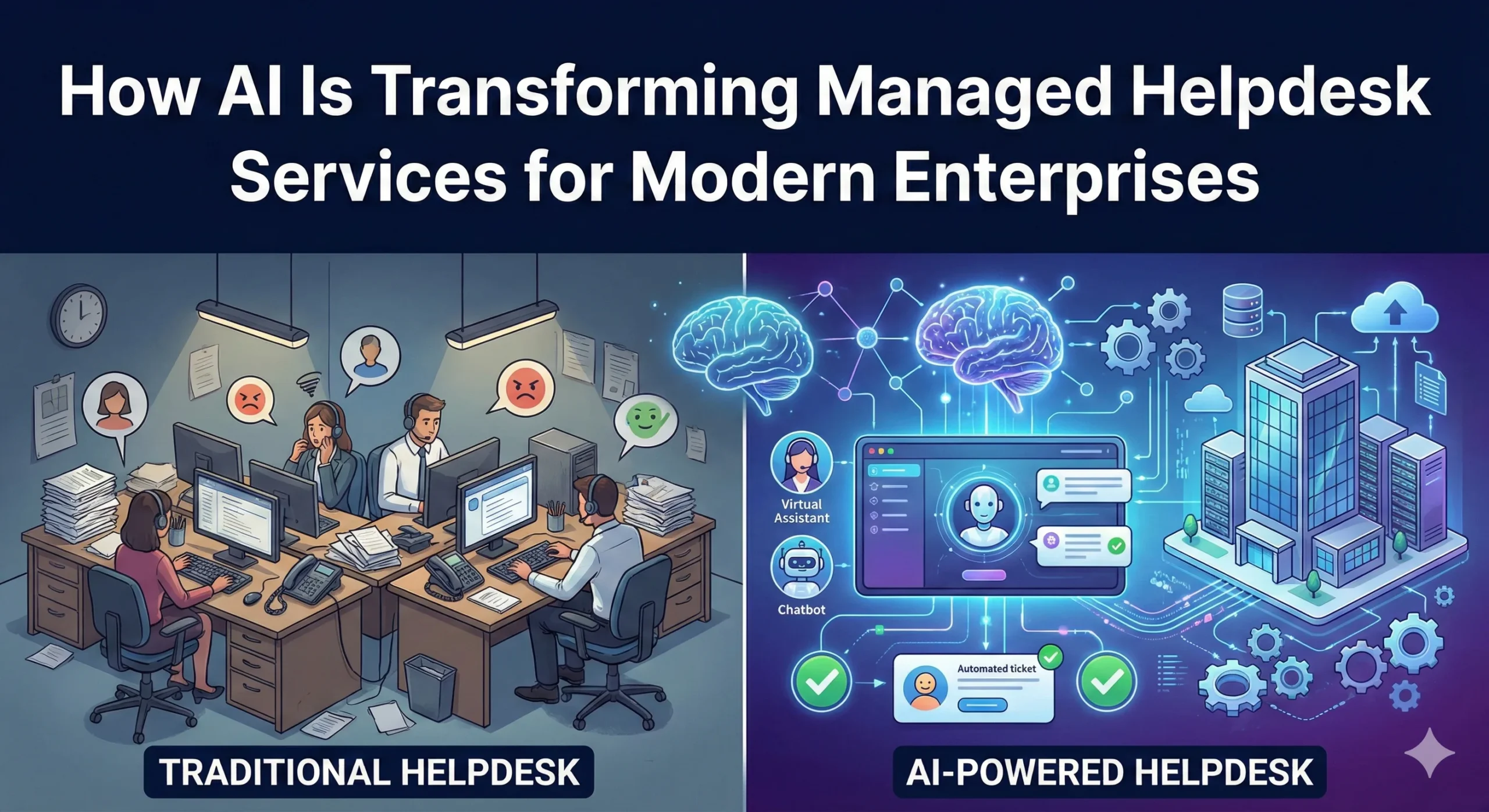
Helpdesk teams are dealing with more tickets than ever. Hybrid work, increasing SaaS sprawl, rising security incidents — the volume is climbing while expectations around resolution time go the other way. Users want issues fixed fast. IT teams are stretched.
AI is not a future scenario here. It is already running inside ticketing systems, handling Tier 1 requests, predicting failures, and reading user frustration before it turns into a complaint to someone’s manager. The shift from reactive managed helpdesk services to something genuinely proactive is underway. Here is what that looks like in practice.
Five Ways AI Is Reshaping Helpdesk Service Delivery
1. Intelligent Ticket Routing That Actually Works
Traditional routing is basically keyword matching. A ticket with “email” in it goes to the email queue. Someone on that queue is already handling 40 tickets. The new ticket sits.
AI routing reads the full context — what the user wrote, what similar issues looked like historically — and matches it to the right agent based on current workload, expertise, and past resolution rates. Studies put manual misrouting at 30-40%. Context-aware routing chips away at that number quickly.
2. Self-Service That Users Don’t Hate
The reason self-service portals fail is they are built around what IT thinks users will search for, not how users actually describe problems. AI changes that.
NLP-powered virtual agents understand conversational language, not just search terms. Automation workflows built on tools like Rewst or Power Automate handle Tier 1 requests end-to-end — password resets, VPN access, software provisioning — without a ticket being raised. The numbers back this up.
A Forrester study found that AI-powered digital agents and self-service portals increased ticket deflection by 35%and cut average handling time by 75%.
Agents stop babysitting routine requests and start handling work that actually needs them.
Do you know: What Is Claude Cowork? Features, Use Cases, and How to Use It?
3. Predictive Resolution Before Users Notice Problems
Reactive support has a fundamental flaw — by the time a ticket comes in, the damage is already done. AI flips that. It sits across system telemetry, log data, and ticket history around the clock, looking for signals that something is heading in the wrong direction.
Take an authentication service starting to slow down — the anomaly shows up in the data, gets matched against past incidents, and goes to remediation while most people are still logging in without a clue anything was off.
In environments running thousands of endpoints, that kind of early detection compounds fast:
- Incident volume drops because problems get resolved pre-emptively
- SLA breaches become rarer — fixes go in before the clock even starts
- Helpdesk teams stop running on adrenaline and start running on data
4. Automated Knowledge Base Updates
KB articles go stale fast. Software changes, processes change, someone writes one article and nobody updates it for two years. AI pulls from closed tickets to identify resolution patterns and flags gaps in existing documentation.
When agents resolve tickets the same way repeatedly and no article covers it, the system flags it. New content gets drafted. Outdated articles get flagged for review. Agents also get relevant historical resolutions surfaced in real time while working a case.
The result is a knowledge base that actually stays useful — not one that agents quietly stop trusting because half the articles are outdated.
5. Sentiment Detection and Smart Escalation
Most escalations happen too late. A user has emailed three times, the tone has shifted from polite to terse, and someone finally notices it’s been four days with no resolution.
AI reads tone across ticket threads and chat interactions, flagging frustration signals early. Not after the third email — after the first sign that something is off.
Sentiment-aware systems route flagged tickets to senior support proactively, not reactively. Enterprises using this approach report first-contact resolution rates climbing by around 35%, because the right people get involved before the situation gets worse.
Do you know: The Benefits of Using Software for Enterprise Faxing in the Modern Workplace
What Changes on the Ground for IT Teams and End Users?
The impact cuts both ways.
For IT teams: Repetitive Tier 1 volume drops. Agents stop spending half their day on password resets and basic access requests and start handling problems that actually need human input. Workloads distribute more evenly across the team. Agent burnout — a real problem in high-volume helpdesk environments — eases when the monotonous stuff gets automated. SLA tracking improves because the system is flagging at-risk tickets before breaches happen, not logging them after.
For end users: First response is faster. Routing is more accurate — problems don’t bounce between queues. Self-service actually works for the common stuff. And when a ticket does need a human, the sentiment detection means frustrated users get picked up earlier rather than sitting in a general queue until someone notices the tone.
What to Look for in AI-Enabled Managed Helpdesk Services?
Not every provider offering “AI-powered helpdesk services” has actually built something useful. Here are a few things you must check before signing anything:
- Does it integrate with your existing ticketing system? Integration matters not just for continuity but for maintaining operational visibility across the environment. Rip-and-replace projects add months of disruption and cost.
- What do the escalation protocols look like when AI cannot resolve something?
There should be a clean, fast path to a human agent — not a dead end that leaves the user waiting.
- How much visibility do you actually get into what the AI is doing?
Black-box automation is a risk in support environments. Explainability matters for auditing and for trusting the system.
Infrassist, for instance, runs helpdesk operations within existing MSP tool stacks — no platform replacement needed. Ticket handling, escalation paths, and knowledge management stay inside your environment, under your brand.
Also know: 3 Ways AI is Transforming the Future of Cloud Management
Automation for Scale, Humans for Impact
The point is not to automate everything. Handle the volume automatically, free up the humans for complexity. Organizations that get that balance right end up with faster resolution, lower operational costs, and support teams that are not constantly playing catch-up. That is what modern enterprise IT support looks like now.
