
Most American companies are discovering that automation is no longer just a buzzword—it is a major driver for real gains. Research shows that integrating generative AI can result in a productivity increase of up to 14 percent among employees, a figure too significant to ignore. With organizations under constant pressure to achieve more using fewer resources, the ability to streamline tasks and free up creative talent is rapidly changing what success looks like in the modern workplace.
Quick Summary
| Takeaway | Explanation |
| 1. Generative AI automates routine tasks | Businesses can shift human effort to strategic activities by automating repetitive tasks through AI implementation. |
| 2. AI enhances creativity and innovation | Using AI as a collaborative partner can help overcome creative blocks and inspire new ideas, augmenting human creativity. |
| 3. Hyper-personalization improves customer experiences | Generative AI allows real-time adaptation of content and recommendations, creating unique user experiences tailored to individual preferences. |
| 4. AI supports informed decision-making | Generative AI transforms raw data into actionable insights, enabling organizations to make faster and more accurate strategic decisions. |
| 5. Continuous learning through AI adapts skills | AI-driven platforms customize learning experiences, continuously refining and enhancing employee skills to meet evolving business needs. |
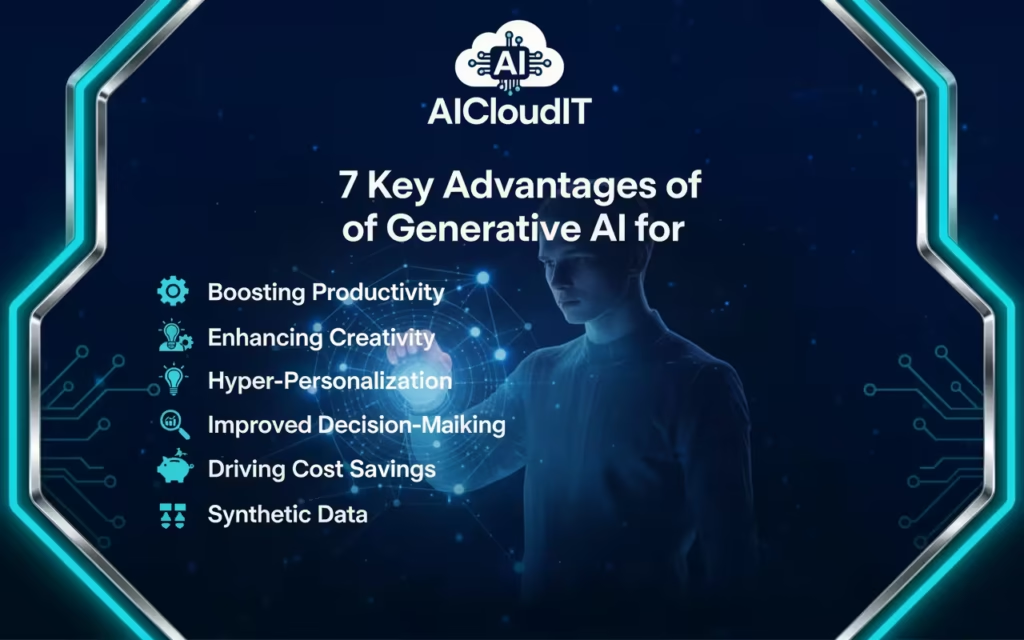
What are the 7 Key Advantages of Generative AI for Businesses and Tech Leaders?
1. Boosting Productivity Through Automation
Generative AI represents a groundbreaking tool for streamlining work processes and dramatically enhancing organizational productivity. By automating routine tasks and generating high quality outputs, businesses can redirect human talent toward more strategic initiatives.
Research demonstrates remarkable efficiency gains from AI automation. A study by Stanford Graduate School of Business revealed that customer service agents using a generative AI assistant increased their productivity by 14%, resolving more issues per hour while simultaneously improving customer satisfaction. Similarly, MIT research found that workers using ChatGPT decreased task completion time by 40% while improving output quality by 18%.
The power of generative AI automation extends across multiple business functions. In writing and content creation, AI can rapidly generate drafts, reducing initial composition time. For customer service, AI chatbots handle standard queries, freeing human agents to manage complex interactions. In data analysis, generative AI can quickly synthesize reports and extract actionable insights from large datasets.
Implementing generative AI automation requires strategic planning. Businesses should first identify repetitive tasks suitable for AI intervention, such as initial draft writing, preliminary research compilation, or standard customer communication. The goal is not to replace human workers but to augment their capabilities, allowing them to focus on creative problem solving and nuanced decision making.
Key Areas for Generative AI Automation Include:
Customer support ticket triage
Initial content drafting
Basic data analysis and reporting
Email and communication management
Preliminary research compilation
Scheduling and administrative tasks
Simple coding and script generation
Pro tip: Start small by automating one specific workflow and measuring productivity gains before expanding AI integration across your organization. Gradual, intentional implementation allows for smoother technological adaptation and helps teams build confidence in AI assisted processes.
Check the difference between Agentic AI vs Generative AI vs Traditional AI
2. Enhancing Creativity With AI Assistance
Generative AI represents a powerful tool for amplifying human creativity, transforming how professionals approach innovative problem solving and idea generation. Far from replacing human imagination, AI serves as a collaborative partner that can spark inspiration and help overcome creative blocks.
Research underscores the profound impact of AI on creative processes. A field experiment published in the Journal of Applied Psychology revealed that employees using large language model assistance demonstrated increased creativity, particularly among those who employed sophisticated metacognitive strategies. Similarly, MIT Sloan research indicated that generative AI significantly boosts employee creativity, especially for individuals who actively reflect on and adapt their technological interactions.
Key Ways AI Enhances Creative Processes:
Generating initial concept drafts
Providing diverse perspective suggestions
Breaking through mental barriers and conventional thinking
Offering rapid iterative feedback
Synthesizing complex information into novel ideas
AI creative assistance works by analyzing vast datasets and identifying unique connections that humans might overlook. For professionals in design, writing, marketing, and product development, this means access to an intelligent brainstorming partner capable of suggesting unexpected approaches and filling conceptual gaps.
Practical Implementation Strategies:
Start with specific, well defined creative challenges
Use AI as a collaborative tool, not a replacement for human insight
Experiment with multiple AI platforms to find the best fit
Maintain a critical and selective approach to AI generated suggestions
Pro tip: Develop a habit of critically examining AI suggestions, treating them as provocative starting points rather than finished solutions. Combine AI generated ideas with your unique expertise and contextual understanding to create truly innovative outcomes.
3. Enabling Hyper-Personalization at Scale
Generative AI transforms personalization from a static concept to a dynamic, intelligent process that adapts instantaneously to individual user preferences and behaviors. By leveraging advanced machine learning algorithms, businesses can create deeply tailored experiences that feel uniquely crafted for each customer.
Research from Georgia State University demonstrates that AI technologies enhance human labor by enabling personalized content creation and intelligent recommendation systems, ultimately driving increased productivity and firm value. This breakthrough allows organizations to move beyond traditional segmentation approaches toward truly individualized interactions.
Core Strategies for AI Driven Hyper Personalization:
Real time content adaptation
Dynamic user experience customization
Predictive preference modeling
Contextual recommendation generation
Individualized communication streams
Hyper personalization goes far beyond simple demographic targeting. Generative AI analyzes intricate user data patterns including browsing history, interaction preferences, temporal behaviors, and contextual signals to construct nuanced user profiles. This enables businesses to deliver experiences that feel almost telepathically attuned to individual needs.
Implementation Approaches:
Integrate machine learning models that continuously learn from user interactions
Develop flexible data infrastructure supporting real time personalization
Create feedback mechanisms for ongoing model refinement
Maintain transparent data usage policies
Prioritize user privacy and consent frameworks
Pro tip: Start small by implementing AI personalization in one specific customer touchpoint, such as email marketing or product recommendations, and progressively expand as you develop more sophisticated understanding of your AI systems capabilities.
Check for the: AI Tools for Automating Python Data Analysis Pipelines
4. Improving Decision-Making With Data-Driven Insights
Generative AI represents a transformative approach to organizational decision making, converting raw data into actionable intelligence with unprecedented speed and accuracy. By synthesizing complex information and identifying nuanced patterns, AI enables leaders to make more informed strategic choices.
Research from Georgia State University reveals that AI technologies augment human workers by providing intelligent recommendation systems, substantially improving decision making processes and overall productivity. This technological approach transcends traditional analytics by offering predictive and prescriptive insights that go beyond historical data interpretation.
Key Decision Making Capabilities of Generative AI:
Rapid pattern recognition
Predictive scenario modeling
Complex data synthesis
Risk assessment optimization
Real time strategic recommendations
Bias reduction in analytical processes
Comprehensive contextual understanding
Generative AI decision support works by analyzing massive datasets across multiple dimensions simultaneously. Unlike human analysts who might be limited by cognitive biases or processing constraints, AI can evaluate thousands of potential scenarios and extract nuanced insights in milliseconds.
Strategic Implementation Approaches:
Integrate AI analytics platforms with existing business intelligence systems
Develop clear protocols for AI generated recommendations
Train leadership on interpreting AI insights effectively
Establish robust validation mechanisms
Maintain human oversight in critical decision processes
Pro tip: Start implementing AI decision support in lower risk environments first, such as marketing strategy or inventory management, to build organizational comfort and understand the technology’s capabilities before expanding to more complex strategic domains.
5. Driving Cost Savings and Operational Efficiency
Generative AI emerges as a powerful catalyst for transforming organizational efficiency, enabling businesses to dramatically reduce operational costs while simultaneously enhancing productivity. By automating complex processes and providing intelligent workflow optimization, AI technologies create substantial economic value across multiple business domains.
Stanford Graduate School of Business research demonstrates that generative AI tools can lead to significant productivity gains, particularly among less experienced workers, resulting in meaningful cost savings and improved operational performance. The OECD further validates this perspective, highlighting how generative AI can automate tasks and enhance skills, driving substantial operational efficiency.
Primary Cost Saving Mechanisms:
Automated routine task processing
Reduced human labor requirements
Minimized error correction expenses
Accelerated workflow completion
Optimized resource allocation
Predictive maintenance strategies
Intelligent inventory management
Operational efficiency through generative AI transcends simple automation. These advanced systems analyze intricate workflow patterns, identifying bottlenecks and recommending precise optimization strategies that traditional management approaches might overlook.
Strategic Implementation Strategies:
Conduct comprehensive workflow audits
Identify repetitive and time consuming processes
Select targeted AI automation opportunities
Develop clear performance measurement metrics
Create robust change management protocols
Invest in employee AI literacy training
Maintain flexible technological integration approaches
Pro tip: Begin your AI efficiency transformation by selecting one specific, measurable operational process with clear performance indicators, allowing your organization to build confidence and demonstrate tangible value before broader implementation.
Do you know: Why Use Cloud AI
6. Creating Synthetic Data for Privacy-Safe Training
Synthetic data generation represents a groundbreaking approach to machine learning training that protects sensitive information while enabling robust model development. By creating artificially constructed datasets that mirror real world characteristics, generative AI provides organizations with powerful tools for innovation without compromising individual privacy.
Research from the Bank for International Settlements reveals that generative AI can generate synthetic data, enabling privacy safe training of models and enhancing productivity in coding tasks. The OECD further emphasizes that these synthetic datasets are valuable for training models while preserving privacy, thereby facilitating innovation and entrepreneurship.
Key Benefits of Synthetic Data Generation:
Protects individual personal information
Enables unrestricted model training
Reduces data acquisition costs
Mitigates legal and ethical compliance risks
Allows testing in simulated environments
Increases dataset diversity and representation
Accelerates machine learning development cycles
Synthetic data generation works by using advanced machine learning algorithms to create statistically accurate representations of real world data. These artificially constructed datasets maintain the core statistical properties and patterns of original information without revealing specific individual details.
Strategic Implementation Approaches:
Select robust generative AI platforms
Establish clear synthetic data generation protocols
Validate statistical similarity to original datasets
Implement comprehensive privacy validation checks
Train teams on synthetic data techniques
Monitor and adjust generation algorithms
Develop ethical usage guidelines
Pro tip: Begin synthetic data generation with low risk domains such as financial modeling or customer behavior analysis, using controlled environments to build organizational expertise and confidence in the technology.
Know more: What Is Agentic AI?
7. Supporting Continuous Learning and Innovation
Generative AI emerges as a transformative force for organizational learning, providing dynamic platforms that continuously adapt and evolve professional skills across multiple domains. This technology transcends traditional training models by creating personalized, intelligent learning experiences that grow alongside individual and organizational capabilities.
Research from Georgia State University highlights that generative AI acts as an engine for job growth and innovation, augmenting human workers and leading to increased productivity and firm value. The OECD further validates this perspective, demonstrating how generative AI supports continuous learning by automating tasks and enhancing skills.
Key Learning and Innovation Capabilities:
Adaptive skill development pathways
Personalized training content generation
Real time knowledge assessment
Intelligent skill gap identification
Contextual learning recommendation
Immersive simulation experiences
Continuous performance tracking
The power of generative AI in learning lies in its ability to create dynamic, responsive educational experiences. These systems analyze individual performance patterns, learning styles, and skill requirements to craft unique development strategies that evolve in real time.
Strategic Implementation Approaches:
Integrate AI powered learning management systems
Develop comprehensive skill mapping frameworks
Create personalized learning journey templates
Establish continuous feedback mechanisms
Train managers on AI learning technologies
Monitor and adjust learning algorithms
Promote a culture of technological adaptability
Pro tip: Begin your AI learning transformation by piloting the technology in one specific department, using detailed metrics to demonstrate value and build organizational confidence before broader implementation.
This table provides a comprehensive summary of the article’s insights into utilizing generative AI across various organizational functions to improve productivity, creativity, personalization, decision-making, operational efficiency, data privacy, and continuous learning.
| Area | Description | Benefits/Outcomes |
| Productivity Through Automation | Automates routine tasks, supports strategic initiatives. | Efficiency gains, enhanced focus on strategic tasks. |
| Enhancing Creativity | AI assists in creative processes by providing diverse suggestions and feedback. | Increased creativity and innovation. |
| Hyper-Personalization | Uses data to offer personalized experiences and recommendations. | Improved customer engagement and satisfaction. |
| Decision-Making | Converts data into actionable insights, aiding strategic choices. | Better informed decisions and bias reduction. |
| Operational Efficiency | Automates workflows, reducing costs and improving performance. | Cost savings and increased productivity. |
| Synthetic Data | Generates data for model training while preserving privacy. | Enables privacy-safe training and diverse dataset creation. |
| Continuous Learning | Provides adaptive learning experiences and skill development. | Supports continuous skill enhancement and innovation. |
Unlock the Full Potential of Generative AI for Your Business
Is your organization struggling to enhance productivity, drive innovation, or improve decision making with emerging technologies Generative AI offers solutions to automate routine tasks, boost creativity, enable hyper-personalization, and drive cost savings as highlighted in the article. Key challenges include effectively implementing AI automation and harnessing AI insights without losing human expertise or compromising privacy.
At AICloudIT we understand these challenges and provide the latest updates and insights on generative artificial intelligence alongside cloud computing trends and cybersecurity to empower tech leaders and businesses. Learn how to strategically adopt AI to transform workflows and innovate safely by exploring our expert resources at AICloudIT.
Frequently Asked Questions
What are the key advantages of using Generative AI for businesses?
Generative AI offers several key advantages, including enhanced productivity through automation, improved decision-making via data-driven insights, and the ability to personalize customer experiences. To maximize these benefits, identify specific workflows and operational tasks that could be automated within your organization.
How can Generative AI help with team productivity?
Generative AI can significantly boost team productivity by automating routine tasks, such as drafting documents or handling basic customer inquiries. Start by implementing AI for one specific workflow to measure productivity improvements, which can often be around 14% as shown in studies.
What practical steps should I take to implement Generative AI in my organization?
Begin by conducting a thorough audit of repetitive tasks across your organization, then select a few key areas for initial AI integration. Focus on creating a plan that includes training staff on AI tools and setting clear performance metrics to track improvements.
How does Generative AI support continuous learning and skill development?
Generative AI creates personalized training experiences that adapt to individual learning styles, making skill development more effective. To implement this, integrate AI-powered learning systems that assess and track employee performance in real time, allowing you to refine training content based on specific skill gaps.
Can Generative AI improve my customer service strategy?
Yes, Generative AI can enhance your customer service strategy by automating responses to standard inquiries and providing real-time support for agents. Invest in AI chatbots for initial query handling, which can free up your human agents to focus on more complex customer interactions, leading to higher satisfaction rates.
